At the upper end of the social spectrum of aristocratic organisations a number of interest groups of the richest aristocracy should be mentioned, in which the leadership was solely in the hands of rich grandseigneurs. Important organisations of this type included the Verein deutscher Standesherren (Association of German Mediatized Princes), the Reichsgrundbesitzerverband (National Landowner Association), the (Bavarian) Verein für den gebundenen Grundbesitz (Association for Entailed Land) and the local forest owners’ associations, which were united in the Reichsverband deutscher Waldbesitzerverbände (National Association of Forest Owners). These associations were particularly important due to the considerable wealth concentrated in the hands of a very thin aristocratic “upper class”, which was represented and defended here.
The German mediatized princes had their own organisation, which was founded in 1863. In 1903, there were 88 heads of the mediatized houses (55 princes and 33 counts), who had already organised themselves almost unanimously in the Association of German Mediatized Princes before the First World War. In the mid-1920s, the association had around 200 members, including 71 heads of families and around 123 agnates.
In 1921, the association’s statutes stated that its aim was to “revitalise and preserve the consciousness of the estates and safeguard the common ideals and interests of the mediatized houses on the basis of their historical past”. In addition to the heads of mediatized families, all agnates of full age could also become members as long as they fulfilled the conditions of the Goldenes Buch der deutschen Standesherren (Golden Book of German Mediatized Princes). This way, compared to the DAG statutes a “moderate” Aryan paragraph (in the form of a racially defined sixteen quarterings rule) was laid down in 1921, which was later apparently suspended and only re-enacted after 1933.
However, this is one of the few traces of an approach to the radicalisation tendencies among the petty nobility that can be found in the interest groups of the large landowning nobility. These organisations were characterised by a different approach.
Far more clearly than the Reichslandbund (National Rural League) and the locally organised Landbünde, the Großgrund und Waldbesitzervereine (Large Land Property and Forest Owners Associations), which behind the scenes organised and financed a considerable part of the agitation against the dissolution of the tied estate, remained dominated by the richest families of the old nobility. As these associations represented the rich, large landowning grand seigneurs – often from families of the high nobility – it is not surprising that the substantive work organised here concentrated almost entirely on the defence of property. In sharp contrast to the DAG, the focus of these associations was not on attacking the Republic, but on defending their own property rights. The tone of the debates held here was more defensive than aggressive. Efforts were concentrated on one issue in particular: the political and propagandistic defence against the dissolution of the Fideikommisse, which was decided by the Compulsory Dissolution Act at the end of 1920. Immediately after the end of the war, representatives of the high nobility from all parts of Germany agreed on the formation of effective committees in which various defence strategies were debated and coordinated well into the 1930s. Despite considerable regional differences, the importance of this legal form for the protection of noble estates throughout the Reich can hardly be overestimated. A few figures should suffice here to indicate the connection between this legal institution and the nobility: In the old Prussian provinces, the nobility owned around 2.5 million hectares with their Fideikommissen, which corresponded to over 7.3% of the total agricultural area. Among the 1,160 Prussian entailed estate owners in 1912, there were as many as 136 bourgeois landowners, who owned little more than 2% of the total entailed estate area and were no longer to be found among those with an area of more than 10,000 hectares. At the end of the war, 6.6% of the total agricultural area in Württemberg was under entailed ownership. 90.4% of this land belonged to aristocratic families, while only 0.33% of the tied land was in the hands of the bourgeoisie.
The attempts coordinated by the nobility to repeatedly delay the regulation of the 1920 dissolution ordinances in the legal committees and parliaments were not without success – in Prussia only about 50% of the tied land had become “free” by 1934.
The fact that later parts of the large landowning aristocracy also saw the Nazi agricultural policy as an opportunity – despite its völkisch-agrarian-socialist propaganda, which had been explicitly anti-aristocratic since Darre’s rise – can only be understood in view of the tough defensive battle that had been waged by the aristocratic-dominated landowners’ associations against the dissolution of the Fideikommisse since 1919. For a long time, the hope for a “Reichserbhofgesetz” (Hereditary Farm Law) modelled on aristocratic ideas, which would have created an acceptable replacement for the entail law for the landowning nobility, was an important bridge to National Socialism, the viability of which was even tested by wealthy Bavarian princes. The documented soundings of the NSDAP leadership appear to have been primarily an attempt to win over leading party functionaries in favour of accepting aristocratic property interests.
The surviving minutes and correspondence of the Standesherrenverein (Assoc. o. Mediatized Pr.), des Reichsgrundbesitzerverbandes (Reich Landowner Assoc.) and the various regional Fideikommiss, Wald- und Grundbesitzerverbände (Forest and Landowner Assoc.) speak the language of rational interest politics, which made use of institutional levers and could largely dispense with demagogic propaganda. Instead of highly ideological debates, the staffs of these associations organised legal opinions, handbook and encyclopaedia articles, episcopal reports on the question of ownership, expert opinions on land and income tax issues, memoranda against the Bund Deutscher Bodenreformer (League of Land Reformers), agronomic reports against social democratic experts and intervened in the economic and political debates on the benefits and efficiency of (tied) large-scale land ownership through renowned professors.
The organisational and financial capabilities of the associations were also used for tactical political goals, for example in the successful propaganda battle against the referendum on the expropriation of the princes initiated in 1926. With some success, the right-wing counter-propaganda endeavoured to portray the planned expropriation as Bolshevik-Godless “highway robbery”. Catholic nobles in particular had often turned to the clergy to have participation in the referendum declared a fall from grace in pastoral letters and sermons.
This work seems to have been carried out mainly outside the public sphere and forwarded in the form of petitions to state authorities or the liaison officers in the legal committees of parliaments. In contrast to the debates among the petty nobility, the factual, cool language of legal experts can be found throughout. The public relations work of these interest groups also packaged their messages not in theorems about the rights of the Nordic race, but in endless series of figures presented by Reich forestry councillors or retired ministerial directors with doctorates. To name two illustrative examples, the Reich Landowners’ Association reacted to the agricultural policy writings of Professor Friedrich Aereboe, who had gained some influence as an agricultural expert of the left-wing parties, by organising counter-reports, the authors of which were always required not to make their connections to the association public. In 1921, a motion by the DDP (Deutsche Demokratische Partei, German Democratic Party) parliamentary group in the Prussian state parliament with the aim of speeding up the dissolution of the Fideikommisse was opposed by the aristocratic representative of a landowners’ association, who was able to rely on the preliminary statistical work carried out in the association: There were 167 art collections, 154 libraries, 42 infant and cripple schools, 2 orphanages, 84 homes for the poor and elderly, 46 hospitals, 66 nurses’ stations, 8 department stores for employees and labourers and 79 foundations for churches and school purposes on just 500 of Prussia’s approximately 1,300 tied estates. “It would be interesting to find out,” it says in this report, “how many such […] institutions could be found on 500 estates that are not fideicommissarially bound. Presumably not a single one!” In January 1933, the Standesherrenverein financed a doctoral student who promised to promote the interests of the high nobility through “scientific” arguments in his dissertation on “the law of the high nobility”. In Württemberg, lords of the manor had commissioned an archivist with a doctorate to write historical-legal writings with titles such as “Dem Adel sein Recht” (“The nobility its right”) or “Recht vor Gewalt” (“Law before violence”), which warned against the “violent” dissolution of the entail commissions. In addition to the blatant “breach of the law”, the pamphlets spoke of the countless benefits of the entail commissions for the rural population and of their role as the material foundation of the Christian West, which the cultural and nefarious socialists were attacking through the dissolution of the entail commissions.
This form of professional and effective association work, financed by wealthy grand seigneurs, bears the hallmarks of sober, technocratic, expert debates in which aristocrats are advised by experts beyond ideological flights of fancy.
The content and tone of a conference of Prussian forest owners’ associations in Berlin in 1929, for which 18 aristocratic forest owners and 17 bourgeois lawyers and foresters had gathered to organise the defence against the planned dissolution of the Fideikommiß, are characteristic of this form of aristocratic association work. After the sober speeches of a retired bourgeois ministerial councillor and a state minister with a Ph. D. and a state forester with a doctorate, there was agreement on the uselessness of state policy and ideological arguments; the aim of the strategy agreed here was to “use” the Centre faction for their needs. In order to bring down the bill in the State Council and Parliament, the debate was to be conducted exclusively on the basis of “economic arguments”: “This has of course been prepared.”
Attempts to protect the large estates of wealthy aristocratic families from resettlement continued to be the main concern of these associations long after 1933 – in view of the fact that the Reich Hereditary Estates Act denied the possibility of keeping estates of over 125 hectares in one hand as “hereditary estates”, the lawyers of aristocratic and other large estates were still busy at the beginning of the Second World War devising legal constructions to circumvent the provisions of the hereditary estates legislation.
Regardless of the clear differences in methods and style, all these associations maintained personal and organisational links with the DAG as well as the parties and associations of the Right. To name just one example, the Standesherrenverein appointed one of the up-and-coming men of the radical right as a “special representative” as early as the spring of 1919 at the suggestion of its chairman, Prince zu Stolberg-Wernigerode, in the person of forestry councillor Georg Escherich. However, the radicalisation and aggressive agitation of such allies does not seem to have had any visible effect on the sober, unobtrusive work of the noble landowners’ associations. The aristocrat-dominated and financially very strong large landowners’ associations paid large sums of money to various “non-party” organisations, such as the Association for Tied Land Ownership in Bavaria to the Bavarian Homeland and Royal Association from 1926.
This observation could be interpreted in conspiracy theory as a division of labour within the nobility. However, to assume that the poor and the immensely rich nobility pursued the same goals using different methods based on a division of labour would overlook the enormous differences in lifeworld that existed between the clientele of the DAG and the members of the interest groups dominated by the nobility. The education, social position and, above all, the wealth of the grand seigneurs made it possible to assert their own interests in ways that were clearly superior to the DAG’s aggressive ethnic rampage in terms of political overview and, above all, effectiveness. The membership fee that had to be paid for the Standesherrenverein gives a rough idea of the pecuniary worlds that lay between an average DAG member and a Standesherr. At 1,500 marks, this exceeded the DAG annual fee by a factor of about 200. This ratio can also be seen in the case of lords of the manor who found themselves in financial difficulties and sought support from the association. In 1940, a noble countess did not ask for a sack of potatoes or a pair of shoes, but for the assumption of her son’s debts totalling 1,500 marks – a figure that was beyond the DAG budget.
The largely unshaken consolidation of wealth and tradition, which probably largely applied to the dominant nobles of the large landowners’ associations, seems to have facilitated the early distance from the Völkisch movement in particular, which actually had nothing to offer the richest segments of the nobility. Alfons Frhr. v. Redwitz, a member of the board of a Bavarian association, rejected the Völkisch programme after making contact in the summer of 1924, which he regarded as confused, anti-proprietor and “unpleasant” in terms of the monarchy issue.
Although the financial support of demagogic agitation – such as in the case of the Dolchstoß propaganda and the defensive battle against the expropriation of the princes – cannot be overlooked, the influence and impact of these associations clearly resulted from the factual work described above, which took place via personally established contacts beyond the tabloid press, flyers and peasant agitation. In contrast to the often socially ruined parts of the nobility in the DAG, the grand seigneurs active here were mostly still on the same social basis in their castles on which aristocratic rule had been organised for centuries. The levers of modern association policy were moved from this secure base. For southern Germany and Bavaria in particular, this type of organisation is illustrated by a prominent example. Among the most influential representatives of the Catholic nobility in Bavaria, one Franconian landowner should be emphasised, whose influence was primarily based on an accumulation of offices in newly founded interest groups, which was unusual even by grand seigneurial standards. Moritz Frhr. v. Franckenstein (1869-1931) had entered the Bavarian civil service after graduating from high school, studying and passing his law exams with honours. In 1908 he became a government councillor and in 1914 a member of the Chamber of Imperial Councillors. As a member of the Landtag and later the Reichstag, he was one of the influential opponents of Erzberger and the peace resolution on the right wing of the Centre Party. At the end of the war, the landowner became one of the leading founders of the BVP (Bayerische Volkspartei, Bavarian People’s Party). Together with Erwein Fürst v. d. Leyen, Franckenstein founded the Association for Tied Property, of which he became the first chairman; a key position to which his board positions in the Bavarian Forest Owners’ Association, the Reich Landowners’ Association, the Christian Farmers’ Association and the Bavarian State Chamber of Farmers were added. In addition to this accumulation of offices, which, alongside grandseigneurial representation of interests, testifies to the search for a policy of reconciliation between the nobility and the peasantry, Franckenstein was one of the spokesmen on the BVP’s Economic Advisory Council, an important hinge for the enforcement of aristocratic interests. This is in line with the bridge-building between aristocratic landowners and bourgeois heavy industrialists that he was instrumental in orchestrating: Franckenstein also played a leading role in the founding of the Gäa Circle. The prominent position of the Catholic monarchist was also represented in the Bavarian aristocratic organisations: The baron was second chairman of the Genossenschaft katholischer Edelleute (Cooperative of Catholic nobles) in Bayern and sat on the board of the Bavarian DAG-Department. However, his active work was clearly focussed on the agricultural interest groups, which operated with some success. The fact that, despite the law on the dissolution of entailed estates, it was still possible to settle an inheritance according to the old entailed estate regulations was thanks to von Franckenstein’s concerted association policy behind the scenes. At the time of his death following a car accident in 1931, the baron was the widely “recognised leader of the Bavarian nobility”.
It is true that Franckenstein had excellent contacts to the old and new right, which certainly extended beyond Bavaria. However, it is noticeable that the nobles who coordinated the work of the interest groups largely lacked nationalist symbolism and self-stylisation as “leaders”. Presumably, the need for such self-portrayals was low because the old patterns of aristocratic “lordship” could still be continued unbroken in these circles. The largely intact material basis of this “Herrentum” served the politically active grand seigneurs as a solid foundation on which the entire range of modern and efficient association politics could be played.
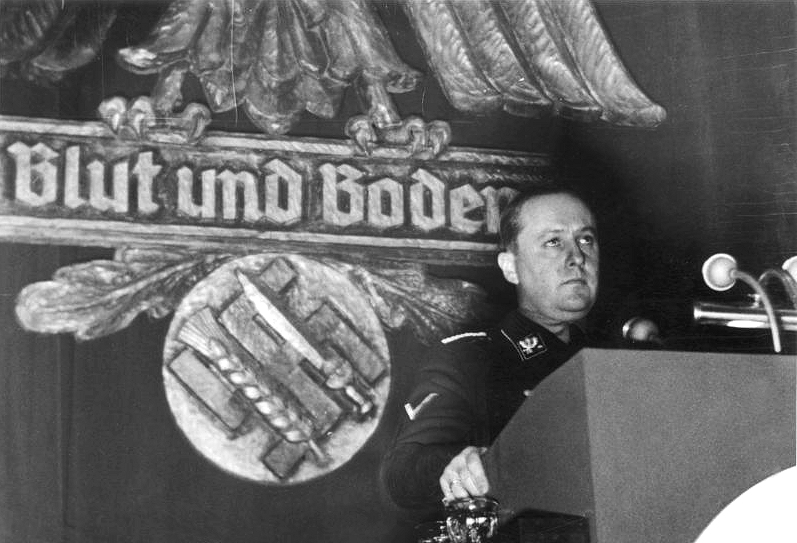
New nobility of blood and soil
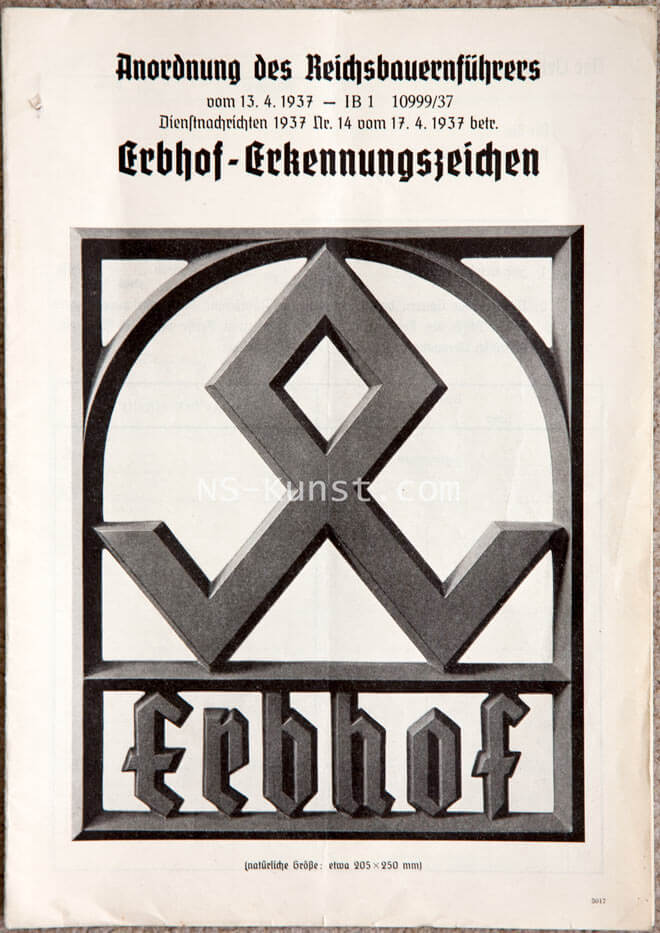
The maximum limit of 125 hectares stipulated in the Reich Hereditary Farms Act of October 1933, the ban on tying up forest estates and the requirement of independent farming were agrarian-“romantic” ideas and did not stand up to the requirements of total warfare. In his masterful vivisection of the Nazi state, Franz Neumann noted in 1942 about Darre’s ideal of medium-sized farms that “one could hardly expect National Socialism to sacrifice efficiency for anachronism. Only the ideology remains romantic and is thus, as usual, at odds with reality.” Meanwhile, the landowning aristocracy had also come to what they saw as a reassuring realisation by other means than Neumann in faraway New York. The minutes of a conversation that Alexander Prince of Dohna-Schlobitten had with Darre in the summer of 1938 give an impression of the all-clear that must have spread even among the aristocratic owners of the latifundia. The Prince had enquired with the Reichsbauernführer (Darre, Reich Peasant Leader) about the possibility of registering his large East Prussian estates as hereditary farms. Dohna sent the minutes of the conversation to the relevant authorities, somewhat prematurely: Darre had mentioned the exceptions and transitional solutions built into the Reich inheritance law, reserved the right to decide on individual applications himself and expressly stated that the Nazi state was interested in “binding the landholdings of long-established families of German or kindred blood of any size.” The application went even more smoothly for Josias Erbprinz zu Waldeck-Pyrmont, SS leader and party comrade since 1929, who rose to SS-Obergruppenführer in 1936 as a close friend of Himmler. The hereditary prince’s application to have his land holdings of over 5,000 hectares recognised as a hereditary farm was supported by the Kurhessian state farmer leader in 1938. In his report, the latter had emphasised the applicant’s extraordinary services to the “movement”, classified the prince as “capable and honourable” and pointed out that his ancestors had never increased their property through expropriation of peasants’ land. However, a certain concession was demanded of the prince: He was to cede a smaller part of his leased estates as a “land levy” for “resettlement”. After the SS general had agreed to this, his estates, which exceeded the legally stipulated maximum size of 125 hectares by a factor of forty and consisted mainly of forest land, were authorised as a hereditary farm in December 1938. The NSDAP members Otto Fürst v. Bismarck and Hermann Graf zu Dohna-Finckenstein had already succeeded in having their estates recognised as hereditary estates at the end of 1933. Bismarck, a grandson of the Reich Chancellor, had publicly announced that he would wear “the honourable name of farmer” with pride. If one compares these successes with the failure of the Catholic Prince Alois zu Löwenstein, it becomes clear how involvement in the “movement” and the Nazi state could be profitable for the landowning aristocracy in this respect too. The prince’s application to have his 7,000 hectare estate recognised as a hereditary farm was rejected in 1940 with reference to his strong “denominational ties”, his distance to “Germanness” and his lack of “farmer compatibility”. Although the estates were managed in an exemplary manner by knowledgeable stewards, this was only to safeguard the prince’s “befitting” lifestyle.