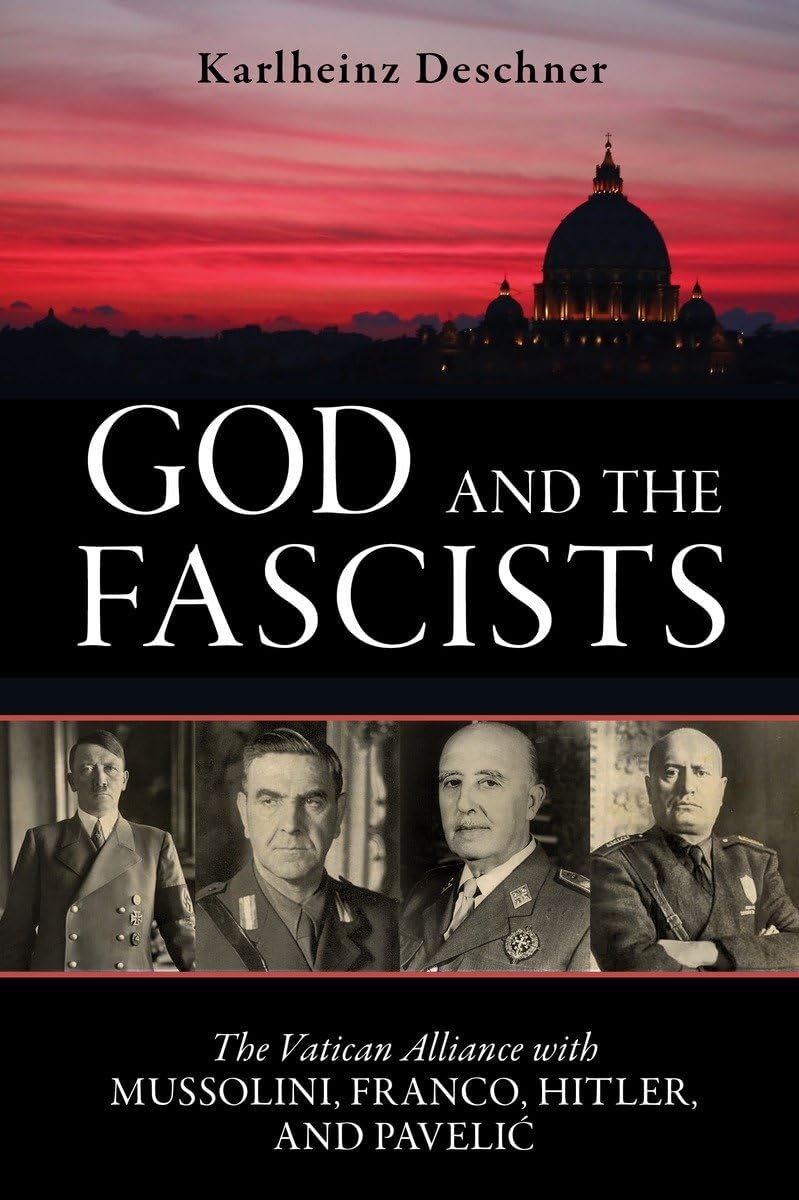
But slander from a church that not only persecuted and massacred millions in the Middle Ages but “repeatedly” and “most insistently” supported probably the greatest criminal of all time in the twentieth century; which in 1933 “would not withdraw the powers of the Church from him at any price,” but on the contrary, wanted to procure everyone for his “great development work,” which in 1935 “strictly [rejected] any action or position taken against the state by its members” and also promised “to support the ruler of the German Reich … with all means necessary” in 1936, which, one year before the war broke out, accompanied Hitler’s “work for the future with their highest blessings.” And, when the war started, the church ordered the Catholic soldiers “to do their duty out of obedience to the Führer and be prepared to sacrifice their entire person,” which followed his invasion of the Soviet Union in 1941 “with satisfaction” and affirmed: “We have repeatedly[!], and in the summer pastoral letter, called upon our believers to fulfill their duty with loyalty, to stand firm courageously, work in willingness to sacrifice and fight with all their might[!] in the service of our people in the most serious times of war,” only to condemn Hitler and the Nazis as soon as they collapsed. Well, I consider slander by a church like this an honor.
I give today’s politics a wide berth, it is still authoritarian paternalism and there is no real dialogue anyway. In a democracy, everyone would be a politician, but when people have no time day in, day out because they have to spend their lives doing repetitive work that they themselves have nothing to gain from, for people they don’t even know just to pay for the same concrete box and the same car time and time again, then they simply don’t have the time and energy to study current issues in depth themselves and form their own opinions and statements. In the absence of their own insights, all that remains is to adapt one of the prefabricated opinions, to choose between democrats or republicans. People are not being brought up to be emancipated at all. You could encourage participation in political debates every 2-3 weeks from an early age, actively involve them in politics and give them time off from work and commitments accordingly, so that politically educated people would be brought up. At the age of 6, children are put in a penitentiary where they are told to sit still and keep quiet, in school and education it is completely irrelevant what is correct, the only thing that matters is saying what they want to hear, it’s about obedience. You are taught that you can not, you are not taught that you can learn foreign languages with ease, but that it is tedious and difficult, that it requires expensive teachers and courses and, in short, that it is best to abandon the idea and go to work. Every child would love to study maths and build ingenious robots, vehicles or clever houses because it’s a pleasure if you are not de-graded, not penalized if you don’t perform “well enough”, but these are the really valuable things in life and are taken away from everyone from an early age. Want to develop your own vehicle or housing? No authorisation. Nobody voluntarily sells kebabs day in, day out in the street, people are broken as children and pressed into these moulds because this system needs cleaners and mechanics. Truth is these jobs are not actually mandatory for anybody to do all day, if people had to clean up their mess themselves instead of paying others to do it, then they would certainly make less mess and think about what’s actually worth it. Nobody would have to flip burgers at McDonalds all day if people could go there and do it themselves. We could also automate and abolish a lot of the jobs, Ford developed the conveyor belt and the automated factory and thus mass production, we wanted to develop these machines to do the work for us, but that benefit was never handed down to the people, instead the factory owner, the capitalist, the corporation keeps it to themselves, that’s their profit. Now that it is no longer really necessary for everyone to spend their lives working (and in fact never was), billions are literally burnt in pointless wars because the citizen has to work for the money that the national banks print. Likewise, nobody would use their free time to examine eczema every day or write expert opinions, be it doctor, lawyer or carpenter, everybody needs to buy almost everything because they themselves know almost nothing, they aren’t even a doctor, but only an ENT, especially of politics they have no clue, only real politicians can do this, they need to let others decide in their stead, they need to be governed. What that means is you haven’t even accomplished Marx’ idea yet and that’s while it’s 160 years old. Why doesn’t Marxism work? Because those who profit from the established system do not want the workers to rise up, free themselves from their chains and take their capital and their rights into their own hands. Paradise is possible, that’s where we come from, but then we forget all the negative things, the problems and difficulties of life and open the door to them, Marxism is not a miracle solution and therefore not a utopia.
When, in the course of the French Revolution, His Most Serene Highness the King of France Louis XVI was only a “citoyen Capet”, a citizen at the tribunal, this meant that even the highest nobility suddenly had to deal with civil rights and ideas. The aristocratic dynasties cant be squeezed into the petty-bourgeois idea of the nation state; they defined themselves through their widely ramified kinships at the international courts. What happened with the revolution dealt a blow to the aristocracy of the whole of Europe, it was clear that it would repeat itself in the Holy Roman Empire of German Nation and so it was pre-empted by making the nobody, the blank slate from Corsica emperor against all class differences and thus dissolving the HRE, he marched on Paris to fanfare and ended the revolution and waged wars across Europe to fight back the forthcoming changes.
[…] with the subjugation of the working class, accomplished in the days of February and March, 1848, the opponents of that class – the bourgeois republicans in France, and the bourgeois and peasant classes who were fighting feudal absolutism throughout the whole continent of Europe – were simultaneously conquered; that the victory of the “moderate republic” in France sounded at the same time the fall of the nations which had responded to the February revolution with heroic wars of independence; and finally that, by the victory over the revolutionary workingmen, Europe fell back into its old double slavery, into the English-Russian slavery. The June conflict in Paris, the fall of Vienna, the tragi-comedy in Berlin in November 1848, the desperate efforts of Poland, Italy, and Hungary, the starvation of Ireland into submission – these were the chief events in which the European class struggle between the bourgeoisie and the working class was summed up, and from which we proved that every revolutionary uprising, however remote from the class struggle its object might appear, must of necessity fail until the revolutionary working class shall have conquered; – that every social reform must remain a Utopia until the proletarian revolution and the feudalistic counter-revolution have been pitted against each other in a world-wide war. In our presentation, as in reality, Belgium and Switzerland were tragicomic caricaturish genre pictures in the great historic tableau; the one the model State of the bourgeois monarchy, the other the model State of the bourgeois republic; both of them, States that flatter themselves to be just as free from the class struggle as from the European revolution.
Frederick Engels
Wars are a much more suited to suppress and control one’s own population than foreign enemies, war is always the same class struggle and so it is clear that the last two major wars were about nothing else. Emperor Wilhelm wanted to end the November Revolution in 1918 by marching on Berlin like Napoleon did on Paris, but what stopped him was the extremely bloody deposition of the tsars by the Russian revolutionaries. The fact that he then retreated to his villa in Doorn was seen as desertion by the old nobility and never forgiven, they said he had better died heroically for the empire. The lower nobility were hit particularly hard after 1918, many now had to work as gas station attendants or secretaries or were even dependent on donations from the DAG and accordingly were angry about the defeat and especially the republic, they radicalized themselves towards the national right. Although the high nobility also had to accept losses, they continued to enjoy enormous wealth and possessions; of course, they hated the Republic no less, but they were able to fight the battle on a completely different level, they were able to bring committees of lawyers and doctors who were able to stop the dissolution of the Fideikommisse, for example, and were of course well represented in all important positions in the Republic and the Third roman-german Reich; Hindenburg’s family could certainly live carefree.
A few impressive passages from Stephan Malinowski’s dissertation/book from 2003 Vom König zum Führer:
According to the information passed on to the exiled emperor’s “house minister” by the Reich Defence Minister Werner v. Blomberg, who was present, Hitler had made vague but far-reaching promises: “As the conclusion of his work, [Hitler] sees the monarchy,” it said in the minutes of the meeting. However, only the Hohenzollern monarchy would come into question; a restoration of the thrones in the federal states was to be rejected. However, the time for restoration had not yet come and the monarchy was only conceivable as the result of a victorious war.
In October 1933, retired Lieutenant General August v. Cramon had written a memorandum to the Reich President proposing the reinstatement of Wilhelm II to his royal rights, as a kind of present for his 75th birthday in January 1934. Wisdom and dignity of age would now be added to the “hereditary wisdom of the lineage”. The “Führer concept” must inevitably end “in immortal leadership, the hereditary monarchy” and Hitler would help with this: “Adolf Hitler himself is, as far as is known, a monarchist.”
A grotesque variant of aristocratic attempts to direct the ubiquitous desire for leadership towards themselves is provided by a speech from 1930, in which Wilhelm II lamented the inflation of the leadership concept in Doorn:
To be a leader! Everyone wants that nowadays. Leaders present themselves everywhere. Many people pose as leaders […]. And yet the cry for leaders is omnipresent!
In a strange mixture of Christian and neo-right-wing motifs, Wilhelm II renewed his claim to leadership. The idea of leadership was first ‘revealed’ by God to the Sumerians. King Hammurabi was given the “leadership profession” by God 5,000 years ago, his own ancestors 500 years ago. “Only to these leaders is the leader Jesus Christ!” Spatially and mentally far removed from all political realities, the exiled emperor appointed Jesus as the otherworldly “leader” and himself as the earthly “leader”. The imperial leader referred to himself in the preceding passage from the Gospel of John, which had given the speech its title: “I am the vine; you are the branches. If a man remains in me and I in him, he will bear much fruit; apart from me you can do nothing.”
A “mobile” interface was created by the activities of Wilhelm II’s second wife, Princess Hermine v. Reuß, who socialised in the most important circles of the political right during her visits to Germany. She apparently made contact with the NSDAP leadership in 1929, on the fringes of the Nuremberg Party Congress. The date of her first meeting with Hitler is unclear, but a meeting with Hitler in the salon of Baroness Tiele-Winckler in November 1931 is well documented. In the presence of the “Empress”, Göring and the aristocratic chief advisors of Wilhelm II, Hitler held a monologue lasting several hours in which he explained his intention to have “all November criminals […] publicly strangled”. The lecture delighted the hostess and guests alike, and the Kaiser’s wife spoke favourably of the “likeable” Hitler, “also about his good and straight facial expression and his good eyes and their expression without falseness.” Pleased with the outcome of the meeting, Magnus v. Levetzow summarised his impressions of Hitler in a letter to Prince v. Donnersmarck: “He was good on the plate, by golly.”
etc, the book contains a wealth of intriguing source material. See Books
The Republic was thus hated and so once again a nobody, a blank slate, was brought in to eliminate it. It had to be a nobody who had no connections to existing powerful structures, otherwise old alliances and rivalries would make effective action impossible. The Republic as an enemy may have been a common front of the high nobility, but old ties and rivalries were far from forgotten:
In agreement with his Westphalian peers, Abbot Augustinus von Galen, a brother of the later famous bishop, described the monarchy problem in 1926 as a cura posterior and considered the claims of the House of Habsburg to be justified in contrast to those of the Hohenzollerns: ,,As far as the Hohenzollerns were concerned, their emperorship had not the slightest thing to do with that of the old empire […]. The Hohenzollerns were therefore in no way the legal successors of the old emperors and from this point of view, they could therefore absolutely not be considered as favoured candidates for the future crown.”
For the south-west German nobility association, which maintained friendly relations with the Bavarian associations, Attila Graf v. Neipperg explained to a fellow Bavarian that the nobility in the south-west was also monarchist, but unlike in Bavaria, which was loyal to Wittelsbach, their loyalty only partly belonged to the houses of Württemberg and Zähringen, while many West German nobles had not forgotten the “sins” of the princes from the Napoleonic era. The monarchism that Count Neipperg outlined here also resembled a vague basic attitude rather than a practicable programme: “These people are fully Holy Roman Empire of the German Nation. And to a certain extent, cum grano salis, I am also with this side. Our stance is that we want to show and prove that the nobility is necessary in the republic, even more necessary than in the monarchy, where everything went its more or less regular course. But officially we are not monarchists.”
As late as the 1930s, Churchill said that the Russians were the greatest threat to Europe, so it may have been unthinkable before the war for the Allies and Russians to forge an alliance. When they faced each other after the war without a common enemy, the old antipathy broke out again, but the peace treaties that had now been signed made further warfare impossible and so it smouldered instead as a Cold War, which was fought preferentially on the loser country, Germany (and other puppets): it was torn apart into the Allied West and the Russian East. How the story ended is now well known: today everything in Germany is English-American, American banks and corporations as far as the eye can see. The first changes after the war included things like removing the Brothers Grimm from the classroom as “too German” (“anti-Semitic”, throughout all editions of Grimms Fairy Tales three of 200 tales contain Jews, the Christian is not shelt at all, on the contrary) and that newspapers and press agencies had to request their concessions from the occupying forces. In this way, education and news were made allied and, accordingly, historiography and politics today are allied, in which the German is the absolute enemy, the Nazi, about whom there can be nothing good. Yet the political constellation of a nationalist, socialist German workers’ party (NSDAP) in and of itself has nothing to do with anti-Semitism or dictatorship. In fact, the system of nation states is nationalism, that is the New World Order that has also created new elites. Under international pressure and competition, nationalism shows its problematic facets, such as a tendency towards xenophobia, because the state puts its own citizens before all foreigners. The state is a covenant of people that excludes others, strangers; the highest covenant today is the covenant with oneself, so freedom for individuality tends towards egoism that puts oneself before all others. In the past, the covenant with God was the highest, the Lord is more important than one’s own life, Christians are martyrs, servants of their masters, that is why religions have been spread so readily, Islam literally means submission, submitting to Allah the Lord. The “immortal leadership” mentioned in the quote earlier indicates an important facet of the nobles’ self-image: they are “immortal” through their bloodline as long as it continues to exist, “the king is dead, long live the king”, while the testament of the common people is that their lives and their achievements are inherited by the Lord and not by themselves.
The world of the stories of Holy Scripture is not content with the claim to be a historically true reality – it claims to be the only true world, the world destined for sole dominion. … The stories of Scripture do not court our favor, as Homer’s do, they do not flatter us in order to please and charm us – they want to subjugate us, and if we refuse, we are rebels”. The belief in the one God who reveals himself to the world in Israel’s fate is imperious and exclusive.
Otto Kaiser – Zwischen Athen und Jerusalem
The people of the Christian state is only a non-people, which no longer has a will of its own, but possesses its true existence in the head to which it is subject, which, however, is originally and by its nature alien to it, i.e. given to it by God and has come to it without its own intervention.
Bruno Bauer, On The Jewish Question, 1843
The only man who counts, the king, is a being specifically different from other men, and is, moreover, a religious being, directly linked with heaven, with God.
Karl Marx, On The Jewish Question, 1844
By its very nature, the Christian state is incapable of emancipating the Jew; but, adds Bauer, by his very nature the Jew cannot be emancipated. So long as the state is Christian and the Jew is Jewish, the one is as incapable of granting emancipation as the other is of receiving it.
Karl Marx, On The Jewish Question, 1844
To have a thought about how it all began, another book: This is an international lecture series at the University of Heidelberg
I (am) Darius the great king, king of kings, king of Persia, king of the countries, the son of Hystaspes, the grandson of Arsames, an Achaemenid. Proclaims Darius, the king: my father (is) Hystaspes; the father of Hystaspes (is) Arsames; the father of Arsames (was) Ariaramnes; The father of Ariaramnes (was) Teispes; the father of Teispes (was) Achaemenes. Proclaims Darius, the king: For this reason we are called Achaemenids; from ancient times we are noblemen; from ancient times our family has been kings. Proclaims Darius, the king: (There are) eight in my family who formerly have been kings; I (am) the ninth; (thus altogether) nine, now as ever, are we kings.
(Schmitt 1991: 49 lines 1–11)
This genealogy is particularly significant because Darius, like Cyrus, claims that his right to the throne is based on his family line. Also, like Cyrus, he claims that his family had been kings for a long period of time, in succession. What can one make of these statements? There are conspicuous absences in this genealogy, including Cyrus and Cambyses. Herodotus comments in a story concerning Cambyses in Egypt that Darius was a member of Cambyses’ guard and a “man of no great importance” (III.139–40). Thus, according to Herodotus, Darius was not in line for the throne, although he was of noble birth. Yet David Stronach argues that Darius’s ancestors may have had control of certain areas of Fars, and thus he was from a family of monarchs (2003: 256). Hence, his claim is not necessarily a lie. What then is Darius attempting to do in his genealogy? There are clear examples of usurpers who did not attempt to create a genealogy in order to justify their right to the throne. The classic case is the Neo-Assyrian ruler, Sargon II, who never provides a genealogy to support his right to the throne. Yet Darius did not claim that he had no royal pedigree but, rather, justifies his right to the throne through his family. Still, he provides no specifics except for family names. Unlike Cyrus, he gives no geographical location for his ancestors’ supposed kingdom. Hence, Darius attempted to redefine what it meant to be the rightful monarch through the use of his genealogy. Briant observes, “It was not because he was Achaemenid (in the clan sense) that Darius achieved power; it was his accession to royalty that allowed him to redefine the reality of what it meant to be ‘Achaemenid’” (2002: 111).
Judah and the Judeans in the Achemenid Period – Negotiating Identity in an International Context
It was also Darius and Darius II who called themselves Aryan and their homeland the land of the Aryans (Iran). It is early human history and Wilhelm was probably not far from the truth with his chronological and geographical classification of the origins of kingship. Genesis mentions Nimrod as the first to become mighty, the first of all Kings (in the Hebrew perception), he can’t be clearly identified but was probably either a King of Babylon or Assyria. These ancient actors had a decisive influence on the further course of history and shaped the concepts and structures that prevailed for a long time, the later nobility may have made up something about the “Aryan” origin of their ruling caste and, as a reaction to the new sciences such as the biological-zoological theory of heredity, postulated a racial one that was supposed to confirm the superiority of their own descent. If they were actually convinced of this is another question, as mentioned in the quote above, it was also about “proving that the nobility is necessary in the republic”, so they were aware of the changing times and wanted to preserve their own position as an elite by redefining themselves as leaders, with programs such as “New nobility of blood and soil” and “The nobility its right”.
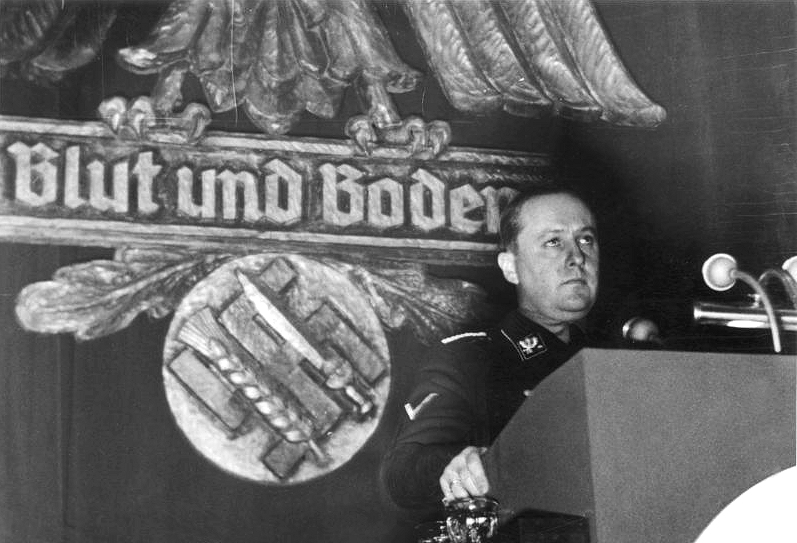
Upon blood and soil the Führer is building his Reich. We have understood blood selection for seven centuries and have wisely chosen to build and continue our bloodstream on the basis of age-old race and culture. […] All the great ideals that the Führer has set for the German people stem from ancient Germanic heritage and not least from the deepest treasuries of the German nobility. Thus the German aristocracy is fundamentally akin to National Socialism in nature and origin. At the time of the red governments, the motto was: down with the aristocracy, we all want to be proletarians. Now it is the other way: the common man from the people should rise up, and we all want to meet again on the level of a true aristocracy. […] What the future will bring us, we leave in the hands of God and the enlightenment of the leader. But we know one thing. Our old lineage is not a foreign body in the Third Reich, rotting and decaying, it is a load-bearing block in the building, hardened over centuries. […] Sieg Heil! Sieg Heil! Sieg Heil!
Friedrich v. Bulöw, 1935
In 1921, an Pan-German (Alldeutsch) baron saw the EDDA project as the deliberate continuation of the […] selective breeding […] that has always been practised by the nobility through the cultivation of pedigree and genealogy […]. The aristocracy’s attitude towards the idea of selection and race breeding is therefore not a new goal for the nobility, but actually a self-evident one.
Stephan Malinowski
I can breed pugs, and I can breed dachshunds, but if the malör (sic) happens to me and I get a basket full of young dachshund pugs, they will be drowned with good reason. This is neither anti-pug nor anti-dachshund, but a realization of the centuries-old experience that all bastards are inferior.
Börries Frhr. v. Münchhausen
There are other interesting paradigm shifts in the course of the modern era. You can only call someone wealthy compared to someone who has less, there can only be rich if there are poor, they have too much that is lacking elsewhere. The powerful were only powerful when they were above others, for the mighty require the oppressed, the formulation that their power comes from the people is the very idea of republic and democracy. It can be seen that it is merely a paradigm shift, that what changes is merely people’s attitude towards the subject matter, that politics is merely a set of instruments that can vary. In reality, every one *is* a politician and influences the course of society with his decisions every day, whether this is recognized and promoted in the political apparatus or not. In the same way, socialism and communism are much more a quantity than a decision, no one can live their life alone, everyone draws from society and what they do with their life is what they give back, whether this can be quantified depends on the value system used.
So to jump from the ancient era in which claims to rulership by descent were established to the time of ancient Judaism discussed in the article, I quote the book again:
Von Rad suggested a three-part structure for the Priestly Document. He differentiated between “three big concentric circles . . . which move from the outside inwards towards the salvific mystery of God—the circle of the world, the circle of Noah, and the Abrahamic circle” (“drei mächtige konzentrische Kreise . . . die von außen nach innen fortschreitend in das Heilsgeheimnis Gottes einführen: der Weltkreis, der Noahkreis und der abrahamitische Kreis”).
[…]
The circle of Abraham includes “the Abrahamic household,” consisting of the Arabs (“Ishmael”), Israel (that is, “Samaria”) and Judah (“Jacob”), and Edom (“Esau”).
[…]
This Abrahamic circle is defined by the Abrahamic covenant of Genesis 17, which promises the participating covenant partners fruitfulness, land inheritance (which seems to imply a right to use rather than to possess), and proximity to God. The circle of Israel narrows the focus down to the nation of God alone. It is generally concerned with the establishment of the sanctuary, which enables the sacrificial cult of Israel. This sacrificial cult alone is what allows Israel to achieve atonement. The sanctuary and the implementation of the cult seem to function as the partial restoration of the initial creation, in the sense of a second “creation within creation.” The circle of Israel is not established by its own covenant because the foundational promise of the presence of God (“I will be your God”) was already given in Gen 17:7 (cf. Exod 6:7, 29:45–46).
[…]
Whether the Priestly writer’s Abraham is aware of it or not, what he asks is that Ishmael become Yhwh’s priest; and it is that request that is denied to Ishmael and offered instead to the yet to be born Isaac. In this whole exchange (vv. 18–21), the question therefore is not whether Ishmael will be allowed to live in the land of Canaan—the right of Ishmael to live in Canaan has been settled once and for all in v. 8—but the question is only whether there is a need for a further son, i.e. for a further category among Abraham’s multi-nation descendants. And the answer to that question is yes. Sarah’s son Isaac will beget those descendants of Abraham who are destined to become Yhwh’s priestly nation.
Judean Identity abd Eucumenicity, Konrad Schmid
A further striking feature of the book of Esther is the virtual absence of God in the book. This has, of course, given rise to manifold speculation about hidden references, double entendres, and so on. On the other hand, it is incorrect to view the apparent “secular” nature of the book as an indication of the book’s being of lesser quality. I think, if we approach the Esther story with the remarks about God in mind that were made above when dealing with Genesis 20, some light will be shed on the issue. The personal God of the patriarchs was changed in Genesis 20 into a universal divine being to whom Israelites and pagans can speak and to whose universal laws even apparently foreign kings can adhere. This change from a personal to a universal God is taken a step further in Esther. Because none of the actions that lead to an endangerment of the Jews in Persia are explicitly linked to the religious factor, the absence of any direct divine intervention might be understandable. Only in passing can we mention that the apparent noninvolvement of Persia in the religious affairs of its subject people makes Persia an ideal setting for the legitimation of a new festival, which seems to defy the common notions of biblical festivals. For any issues of religion, the conflict between Mordecai and Haman reported in Esth 3:1–15 is often interpreted by drawing attention to Exod 20:1–5. True, חוה is used in the stipulation of Exod 20:5, but nothing in the text of Esther suggests that Haman had any divine quality, and only the Targum adds this aspect by stating that Haman wore a portrait of an idol on his clothes. [The motif of Haman’s divinity only occurs in Judg 3:8, where Nebuchadnezzar claims divine honors: “And he destroyed all of their sanctuaries and ravished their cultic groves. He was given the order to extinguish all the gods of the earth so that all people of the earth serve Nebuchadnezzar alone and all tongues and tribes should worship him alone as god”] Despite Mordecai’s statement that he is a Jew (Esth 4:4bβ), we have instances in the Hebrew Bible in which it is perfectly acceptable to bow down before another man (see Gen 23:7, 27:29; 1 Kgs 1:31). The combination of the Hebrew verbs חוה and כרע is normally reserved for God (Ps 22:30, 95:6; 2 Chr 7:3), “but if idolatry is the cause of Mordecai’s noncompliance, the text is strangely silent about this. In addition it is difficult to see why the king commands that an underling be treated as god when he himself is not.” Esth 3:4bβ (כי הגיד להם אשר הוא יהודי ) seems to look forward to Esth 3:8–15 rather than serving as an adequate reason why Mordecai refuses to bow down.
The Absent Presence, Anselm C. Hagedorn
To judge a story’s historicity by its degree of realism is to mistake veri-similitude for historicity.
Adele Berlin
What are fairy tales and myths to us today were the only real reality for our ancestors. There is no doubt that the light bulb, medicine, hygiene and education defeated the devil, and yet even if you think he is a figment of the imagination (the beast and the animal in man are hardly a figment of the imagination) he had an enormous influence on human history. The world we see through our eyes is an image in our head, we experience our own senses, our own perception, not an external world “in itself” (Kant). Nature, the animal and plant world cannot adhere to the borders that we print on a map because they do not exist, in the world there are neither speed vectors nor meters or minutes. They are concepts of the human mind. Logic is a discipline of philosophy, mathematics is a discipline of logic, this is the Greek school and the origin and fundament of ours, therefore it is clear and easy for us to understand when the ancient Greeks speak of cosmos and chaos, order and disorder, but when the Jewish Kabbalah speaks of the Sephiroth or the Vedantas speak of Brahman, this is not logical and therefore not correct, because right or wrong is a very specific logical operation. So in order to understand foreign and ancient cultures, you have to be able to detach yourself from your own world view. We always like to assume that we are superior to all past people, after all we have all their experiences behind us, in reality this is a fallacy, nobody has had all the experiences, we rely on the statements of others in almost everything. Progress is preached today as a mantra, forgetting that too rapid growth cannot be sustained or that something is lost at the other end, so a lot of things have fallen by the wayside in the course of history, such as closeness to nature. “It’s not weapons that kill people, it’s people who kill people”, technology is only superficial, much more causal and therefore more important are the more fundamental, simpler things and so the earliest questions of mankind are also the longest lasting and our “superiority” over our ancestors is also just one that we would like to confirm to ourselves.
At the upper end of the social spectrum of aristocratic organisations a number of interest groups of the richest aristocracy should be mentioned, in which the leadership was solely in the hands of rich grandseigneurs. Important organisations of this type included the Verein deutscher Standesherren (Association of German Mediatized Princes), the Reichsgrundbesitzerverband (National Landowner Association), the (Bavarian) Verein für den gebundenen Grundbesitz (Association for Entailed Land) and the local forest owners’ associations, which were united in the Reichsverband deutscher Waldbesitzerverbände (National Association of Forest Owners). These associations were particularly important due to the considerable wealth concentrated in the hands of a very thin aristocratic “upper class”, which was represented and defended here.
The German mediatized princes had their own organisation, which was founded in 1863. In 1903, there were 88 heads of the mediatized houses (55 princes and 33 counts), who had already organised themselves almost unanimously in the Association of German Mediatized Princes before the First World War. In the mid-1920s, the association had around 200 members, including 71 heads of families and around 123 agnates.
In 1921, the association’s statutes stated that its aim was to “revitalise and preserve the consciousness of the estates and safeguard the common ideals and interests of the mediatized houses on the basis of their historical past”. In addition to the heads of mediatized families, all agnates of full age could also become members as long as they fulfilled the conditions of the Goldenes Buch der deutschen Standesherren (Golden Book of German Mediatized Princes). This way, compared to the DAG statutes a “moderate” Aryan paragraph (in the form of a racially defined sixteen quarterings rule) was laid down in 1921, which was later apparently suspended and only re-enacted after 1933.
However, this is one of the few traces of an approach to the radicalisation tendencies among the petty nobility that can be found in the interest groups of the large landowning nobility. These organisations were characterised by a different approach.
Far more clearly than the Reichslandbund (National Rural League) and the locally organised Landbünde, the Großgrund und Waldbesitzervereine (Large Land Property and Forest Owners Associations), which behind the scenes organised and financed a considerable part of the agitation against the dissolution of the tied estate, remained dominated by the richest families of the old nobility. As these associations represented the rich, large landowning grand seigneurs – often from families of the high nobility – it is not surprising that the substantive work organised here concentrated almost entirely on the defence of property. In sharp contrast to the DAG, the focus of these associations was not on attacking the Republic, but on defending their own property rights. The tone of the debates held here was more defensive than aggressive. Efforts were concentrated on one issue in particular: the political and propagandistic defence against the dissolution of the Fideikommisse, which was decided by the Compulsory Dissolution Act at the end of 1920. Immediately after the end of the war, representatives of the high nobility from all parts of Germany agreed on the formation of effective committees in which various defence strategies were debated and coordinated well into the 1930s. Despite considerable regional differences, the importance of this legal form for the protection of noble estates throughout the Reich can hardly be overestimated. A few figures should suffice here to indicate the connection between this legal institution and the nobility: In the old Prussian provinces, the nobility owned around 2.5 million hectares with their Fideikommissen, which corresponded to over 7.3% of the total agricultural area. Among the 1,160 Prussian entailed estate owners in 1912, there were as many as 136 bourgeois landowners, who owned little more than 2% of the total entailed estate area and were no longer to be found among those with an area of more than 10,000 hectares. At the end of the war, 6.6% of the total agricultural area in Württemberg was under entailed ownership. 90.4% of this land belonged to aristocratic families, while only 0.33% of the tied land was in the hands of the bourgeoisie.
The attempts coordinated by the nobility to repeatedly delay the regulation of the 1920 dissolution ordinances in the legal committees and parliaments were not without success – in Prussia only about 50% of the tied land had become “free” by 1934.
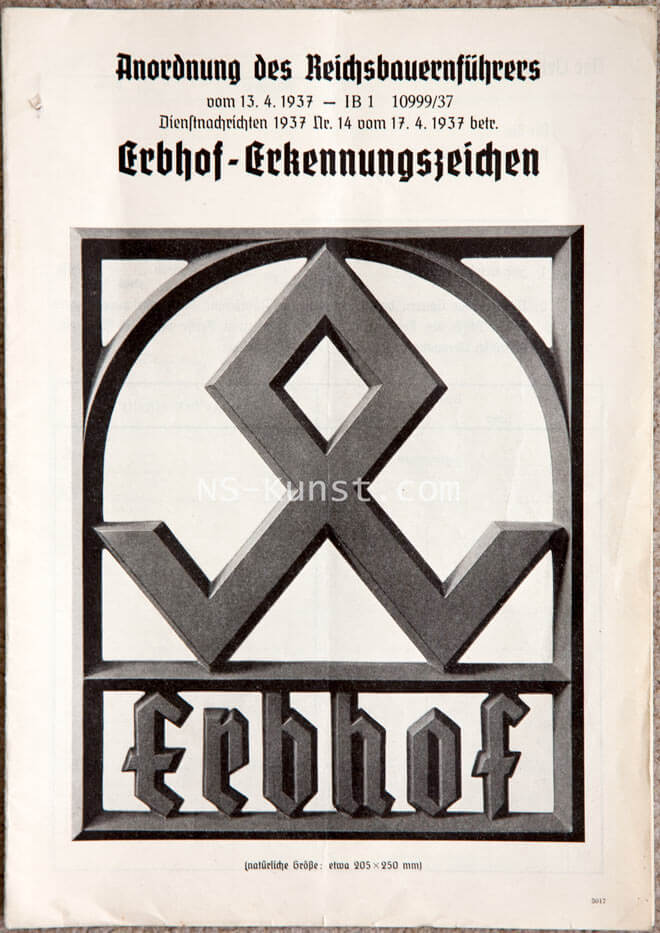
The fact that later parts of the large landowning aristocracy also saw the Nazi agricultural policy as an opportunity – despite its völkisch-agrarian-socialist propaganda, which had been explicitly anti-aristocratic since Darre’s rise – can only be understood in view of the tough defensive battle that had been waged by the aristocratic-dominated landowners’ associations against the dissolution of the Fideikommisse since 1919. For a long time, the hope for a “Reichserbhofgesetz” (Hereditary Farm Law) modelled on aristocratic ideas, which would have created an acceptable replacement for the entail law for the landowning nobility, was an important bridge to National Socialism, the viability of which was even tested by wealthy Bavarian princes. The documented soundings of the NSDAP leadership appear to have been primarily an attempt to win over leading party functionaries in favour of accepting aristocratic property interests.
The surviving minutes and correspondence of the Standesherrenverein (Assoc. o. Mediatized Pr.), des Reichsgrundbesitzerverbandes (Reich Landowner Assoc.) and the various regional Fideikommiss, Wald- und Grundbesitzerverbände (Forest and Landowner Assoc.) speak the language of rational interest politics, which made use of institutional levers and could largely dispense with demagogic propaganda. Instead of highly ideological debates, the staffs of these associations organised legal opinions, handbook and encyclopaedia articles, episcopal reports on the question of ownership, expert opinions on land and income tax issues, memoranda against the Bund Deutscher Bodenreformer (League of Land Reformers), agronomic reports against social democratic experts and intervened in the economic and political debates on the benefits and efficiency of (tied) large-scale land ownership through renowned professors.
The organisational and financial capabilities of the associations were also used for tactical political goals, for example in the successful propaganda battle against the referendum on the expropriation of the princes initiated in 1926. With some success, the right-wing counter-propaganda endeavoured to portray the planned expropriation as Bolshevik-Godless “highway robbery”. Catholic nobles in particular had often turned to the clergy to have participation in the referendum declared a fall from grace in pastoral letters and sermons.
This work seems to have been carried out mainly outside the public sphere and forwarded in the form of petitions to state authorities or the liaison officers in the legal committees of parliaments. In contrast to the debates among the petty nobility, the factual, cool language of legal experts can be found throughout. The public relations work of these interest groups also packaged their messages not in theorems about the rights of the Nordic race, but in endless series of figures presented by Reich forestry councillors or retired ministerial directors with doctorates. To name two illustrative examples, the Reich Landowners’ Association reacted to the agricultural policy writings of Professor Friedrich Aereboe, who had gained some influence as an agricultural expert of the left-wing parties, by organising counter-reports, the authors of which were always required not to make their connections to the association public. In 1921, a motion by the DDP (Deutsche Demokratische Partei, German Democratic Party) parliamentary group in the Prussian state parliament with the aim of speeding up the dissolution of the Fideikommisse was opposed by the aristocratic representative of a landowners’ association, who was able to rely on the preliminary statistical work carried out in the association: There were 167 art collections, 154 libraries, 42 infant and cripple schools, 2 orphanages, 84 homes for the poor and elderly, 46 hospitals, 66 nurses’ stations, 8 department stores for employees and labourers and 79 foundations for churches and school purposes on just 500 of Prussia’s approximately 1,300 tied estates. “It would be interesting to find out,” it says in this report, “how many such […] institutions could be found on 500 estates that are not fideicommissarially bound. Presumably not a single one!” In January 1933, the Standesherrenverein financed a doctoral student who promised to promote the interests of the high nobility through “scientific” arguments in his dissertation on “the law of the high nobility”. In Württemberg, lords of the manor had commissioned an archivist with a doctorate to write historical-legal writings with titles such as “Dem Adel sein Recht” (“The nobility its right”) or “Recht vor Gewalt” (“Law before violence”), which warned against the “violent” dissolution of the entail commissions. In addition to the blatant “breach of the law”, the pamphlets spoke of the countless benefits of the entail commissions for the rural population and of their role as the material foundation of the Christian West, which the cultural and nefarious socialists were attacking through the dissolution of the entail commissions.
This form of professional and effective association work, financed by wealthy grand seigneurs, bears the hallmarks of sober, technocratic, expert debates in which aristocrats are advised by experts beyond ideological flights of fancy.
The content and tone of a conference of Prussian forest owners’ associations in Berlin in 1929, for which 18 aristocratic forest owners and 17 bourgeois lawyers and foresters had gathered to organise the defence against the planned dissolution of the Fideikommiß, are characteristic of this form of aristocratic association work. After the sober speeches of a retired bourgeois ministerial councillor and a state minister with a Ph. D. and a state forester with a doctorate, there was agreement on the uselessness of state policy and ideological arguments; the aim of the strategy agreed here was to “use” the Centre faction for their needs. In order to bring down the bill in the State Council and Parliament, the debate was to be conducted exclusively on the basis of “economic arguments”: “This has of course been prepared.”
Attempts to protect the large estates of wealthy aristocratic families from resettlement continued to be the main concern of these associations long after 1933 – in view of the fact that the Reich Hereditary Estates Act denied the possibility of keeping estates of over 125 hectares in one hand as “hereditary estates”, the lawyers of aristocratic and other large estates were still busy at the beginning of the Second World War devising legal constructions to circumvent the provisions of the hereditary estates legislation.
Regardless of the clear differences in methods and style, all these associations maintained personal and organisational links with the DAG as well as the parties and associations of the Right. To name just one example, the Standesherrenverein appointed one of the up-and-coming men of the radical right as a “special representative” as early as the spring of 1919 at the suggestion of its chairman, Prince zu Stolberg-Wernigerode, in the person of forestry councillor Georg Escherich. However, the radicalisation and aggressive agitation of such allies does not seem to have had any visible effect on the sober, unobtrusive work of the noble landowners’ associations. The aristocrat-dominated and financially very strong large landowners’ associations paid large sums of money to various “non-party” organisations, such as the Association for Tied Land Ownership in Bavaria to the Bavarian Homeland and Royal Association from 1926.
This observation could be interpreted in conspiracy theory as a division of labour within the nobility. However, to assume that the poor and the immensely rich nobility pursued the same goals using different methods based on a division of labour would overlook the enormous differences in lifeworld that existed between the clientele of the DAG and the members of the interest groups dominated by the nobility. The education, social position and, above all, the wealth of the grand seigneurs made it possible to assert their own interests in ways that were clearly superior to the DAG’s aggressive ethnic rampage in terms of political overview and, above all, effectiveness. The membership fee that had to be paid for the Standesherrenverein gives a rough idea of the pecuniary worlds that lay between an average DAG member and a Standesherr. At 1,500 marks, this exceeded the DAG annual fee by a factor of about 200. This ratio can also be seen in the case of lords of the manor who found themselves in financial difficulties and sought support from the association. In 1940, a noble countess did not ask for a sack of potatoes or a pair of shoes, but for the assumption of her son’s debts totalling 1,500 marks – a figure that was beyond the DAG budget.
The largely unshaken consolidation of wealth and tradition, which probably largely applied to the dominant nobles of the large landowners’ associations, seems to have facilitated the early distance from the Völkisch movement in particular, which actually had nothing to offer the richest segments of the nobility. Alfons Frhr. v. Redwitz, a member of the board of a Bavarian association, rejected the Völkisch programme after making contact in the summer of 1924, which he regarded as confused, anti-proprietor and “unpleasant” in terms of the monarchy issue.
Although the financial support of demagogic agitation – such as in the case of the Dolchstoß propaganda and the defensive battle against the expropriation of the princes – cannot be overlooked, the influence and impact of these associations clearly resulted from the factual work described above, which took place via personally established contacts beyond the tabloid press, flyers and peasant agitation. In contrast to the often socially ruined parts of the nobility in the DAG, the grand seigneurs active here were mostly still on the same social basis in their castles on which aristocratic rule had been organised for centuries. The levers of modern association policy were moved from this secure base. For southern Germany and Bavaria in particular, this type of organisation is illustrated by a prominent example. Among the most influential representatives of the Catholic nobility in Bavaria, one Franconian landowner should be emphasised, whose influence was primarily based on an accumulation of offices in newly founded interest groups, which was unusual even by grand seigneurial standards. Moritz Frhr. v. Franckenstein (1869-1931) had entered the Bavarian civil service after graduating from high school, studying and passing his law exams with honours. In 1908 he became a government councillor and in 1914 a member of the Chamber of Imperial Councillors. As a member of the Landtag and later the Reichstag, he was one of the influential opponents of Erzberger and the peace resolution on the right wing of the Centre Party. At the end of the war, the landowner became one of the leading founders of the BVP (Bayerische Volkspartei, Bavarian People’s Party). Together with Erwein Fürst v. d. Leyen, Franckenstein founded the Association for Tied Property, of which he became the first chairman; a key position to which his board positions in the Bavarian Forest Owners’ Association, the Reich Landowners’ Association, the Christian Farmers’ Association and the Bavarian State Chamber of Farmers were added. In addition to this accumulation of offices, which, alongside grandseigneurial representation of interests, testifies to the search for a policy of reconciliation between the nobility and the peasantry, Franckenstein was one of the spokesmen on the BVP’s Economic Advisory Council, an important hinge for the enforcement of aristocratic interests. This is in line with the bridge-building between aristocratic landowners and bourgeois heavy industrialists that he was instrumental in orchestrating: Franckenstein also played a leading role in the founding of the Gäa Circle. The prominent position of the Catholic monarchist was also represented in the Bavarian aristocratic organisations: The baron was second chairman of the Genossenschaft katholischer Edelleute (Cooperative of Catholic nobles) in Bayern and sat on the board of the Bavarian DAG-Department. However, his active work was clearly focussed on the agricultural interest groups, which operated with some success. The fact that, despite the law on the dissolution of entailed estates, it was still possible to settle an inheritance according to the old entailed estate regulations was thanks to von Franckenstein’s concerted association policy behind the scenes. At the time of his death following a car accident in 1931, the baron was the widely “recognised leader of the Bavarian nobility”.
It is true that Franckenstein had excellent contacts to the old and new right, which certainly extended beyond Bavaria. However, it is noticeable that the nobles who coordinated the work of the interest groups largely lacked nationalist symbolism and self-stylisation as “leaders”. Presumably, the need for such self-portrayals was low because the old patterns of aristocratic “lordship” could still be continued unbroken in these circles. The largely intact material basis of this “Herrentum” served the politically active grand seigneurs as a solid foundation on which the entire range of modern and efficient association politics could be played.
New nobility of blood and soil
The maximum limit of 125 hectares stipulated in the Reich Hereditary Farms Act of October 1933, the ban on tying up forest estates and the requirement of independent farming were agrarian-“romantic” ideas and did not stand up to the requirements of total warfare. In his masterful vivisection of the Nazi state, Franz Neumann noted in 1942 about Darre’s ideal of medium-sized farms that “one could hardly expect National Socialism to sacrifice efficiency for anachronism. Only the ideology remains romantic and is thus, as usual, at odds with reality.” Meanwhile, the landowning aristocracy had also come to what they saw as a reassuring realisation by other means than Neumann in faraway New York. The minutes of a conversation that Alexander Prince of Dohna-Schlobitten had with Darre in the summer of 1938 give an impression of the all-clear that must have spread even among the aristocratic owners of the latifundia. The Prince had enquired with the Reichsbauernführer (Darre, Reich Peasant Leader) about the possibility of registering his large East Prussian estates as hereditary farms. Dohna sent the minutes of the conversation to the relevant authorities, somewhat prematurely: Darre had mentioned the exceptions and transitional solutions built into the Reich inheritance law, reserved the right to decide on individual applications himself and expressly stated that the Nazi state was interested in “binding the landholdings of long-established families of German or kindred blood of any size.” The application went even more smoothly for Josias Erbprinz zu Waldeck-Pyrmont, SS leader and party comrade since 1929, who rose to SS-Obergruppenführer in 1936 as a close friend of Himmler. The hereditary prince’s application to have his land holdings of over 5,000 hectares recognised as a hereditary farm was supported by the Kurhessian state farmer leader in 1938. In his report, the latter had emphasised the applicant’s extraordinary services to the “movement”, classified the prince as “capable and honourable” and pointed out that his ancestors had never increased their property through expropriation of peasants’ land. However, a certain concession was demanded of the prince: He was to cede a smaller part of his leased estates as a “land levy” for “resettlement”. After the SS general had agreed to this, his estates, which exceeded the legally stipulated maximum size of 125 hectares by a factor of forty and consisted mainly of forest land, were authorised as a hereditary farm in December 1938. The NSDAP members Otto Fürst v. Bismarck and Hermann Graf zu Dohna-Finckenstein had already succeeded in having their estates recognised as hereditary estates at the end of 1933. Bismarck, a grandson of the Reich Chancellor, had publicly announced that he would wear “the honourable name of farmer” with pride. If one compares these successes with the failure of the Catholic Prince Alois zu Löwenstein, it becomes clear how involvement in the “movement” and the Nazi state could be profitable for the landowning aristocracy in this respect too. The prince’s application to have his 7,000 hectare estate recognised as a hereditary farm was rejected in 1940 with reference to his strong “denominational ties”, his distance to “Germanness” and his lack of “farmer compatibility”. Although the estates were managed in an exemplary manner by knowledgeable stewards, this was only to safeguard the prince’s “befitting” lifestyle.
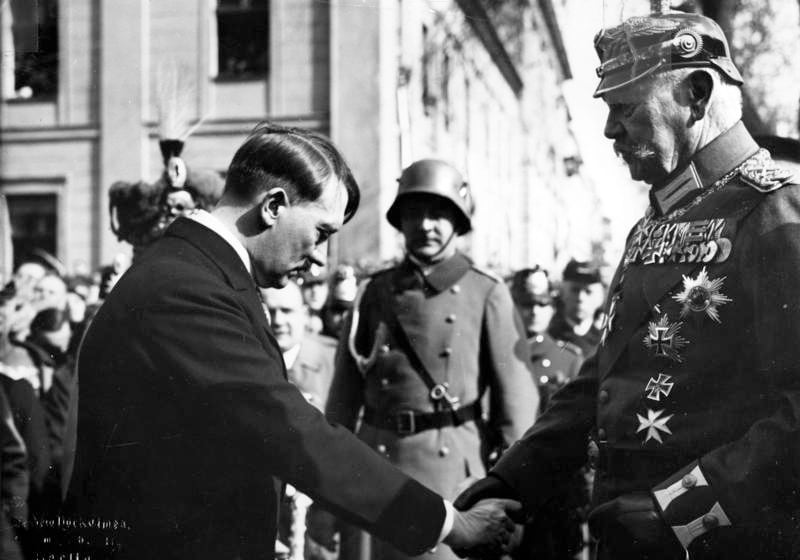
The failed mesalliance between the Hohenzollern dynasty and the Nazi movement before the seizure of power had an aftermath lasting several months, during which the imperial loyalists tried one last time to articulate their restoration plans. After the pseudo-monarchist mummery staged by the Nazi leadership on the Day of Potsdam, the “royal question” was raised with Hitler several times between May 1933 and April 1934 by the official representatives of Wilhelm II. Leading monarchists appeared four times during this period as petitioners to explore the possibilities of a restoration, and once the DAG chairman Prince Bentheim also touched on the monarchical question in a personal conversation with Hitler. Unlike Prince Bentheim, whose anticipatory obedience was able to immunise the DAG against the ban on monarchist associations in February 1934 and obtain a Reich law against the misuse of aristocratic names, Hitler allowed the messengers of monarchism to bite the dust. According to the information passed on to the exiled emperor’s “house minister” by the Reich Defence Minister Werner v. Blomberg, who was present, Hitler had made vague but far-reaching promises: “As the conclusion of his work, [Hitler] sees the monarchy,” it said in the minutes of the meeting. However, only the Hohenzollern monarchy would come into question; a restoration of the thrones in the federal states was to be rejected. However, the time for restoration had not yet come and the monarchy was only conceivable as the result of a victorious war. At a second meeting with Hitler in October 1933, held by the general plenipotentiary of the exiled emperor, retired General Wilhelm v. Dommes, the tone was already much more aggressive. Hitler “passionately” rejected the monarchist insistence of his interlocutor: the task was to defeat communism and Judaism. The Crown Prince as a person and the monarchy as an institution were not “tough enough” for this task. In February 1934, Hitler finally rejected the emissaries in extremely harsh terms. The climate for the talks had become charged in the run-up to the meeting with harsh anti-monarchist speeches in which Baldur v. Schirach and Richard Walther Darre, among others, had derided Wilhelm II as a coward. Dommes’ plan to “stand up in arms” for the honour of his “attacked master” failed, as did his attempt to get through to Hitler with his complaints. In a lofty tone, Hitler now forbade himself to be continually disturbed in his “reconstruction work” by the German princes. To achieve these goals – “eradicating the criminals of the November Revolution” and building up the Reichswehr – he would need 12-15 years.
While Berg’s and Dommes’ enquiries already revealed an astonishing degree of political naivety, this was far surpassed by prominent colleagues. The complete misjudgement of the political situation by aristocratic monarchists from the former inner circle around the Kaiser is illustrated by a petition to Hindenburg written in the autumn of 1933 – even if this form of obviously age-related blindness to reality cannot be applied to an entire generation.
In October 1933, retired Lieutenant General August v. Cramon had written a memorandum to the Reich President proposing the reinstatement of Wilhelm II to his royal rights, as a kind of present for his 75th birthday in January 1934. Wisdom and dignity of age would now be added to the “hereditary wisdom of the lineage”. The “Führer concept” must inevitably end “in immortal leadership, the hereditary monarchy” and Hitler would help with this: “Adolf Hitler himself is, as far as is known, a monarchist.”
Surrounded by advisors who had a better understanding of the new era, Hindenburg had replied that the moment for the return of the Kaiser had not yet arrived. Apart from the absurd petitions of military-monarchist fossils, the slogan “wait and see” was issued within the aristocratic associations and in private correspondence wherever restoration was still being discussed at all. For the DAG leadership, Prince Bentheim rejected the “unrealisable demands” on the “monarchical question” and the “church question” in 1937: the monarchical question, said the Prince, “is not up for debate for the DAG as such, regardless of the personal attitude of the individual.”
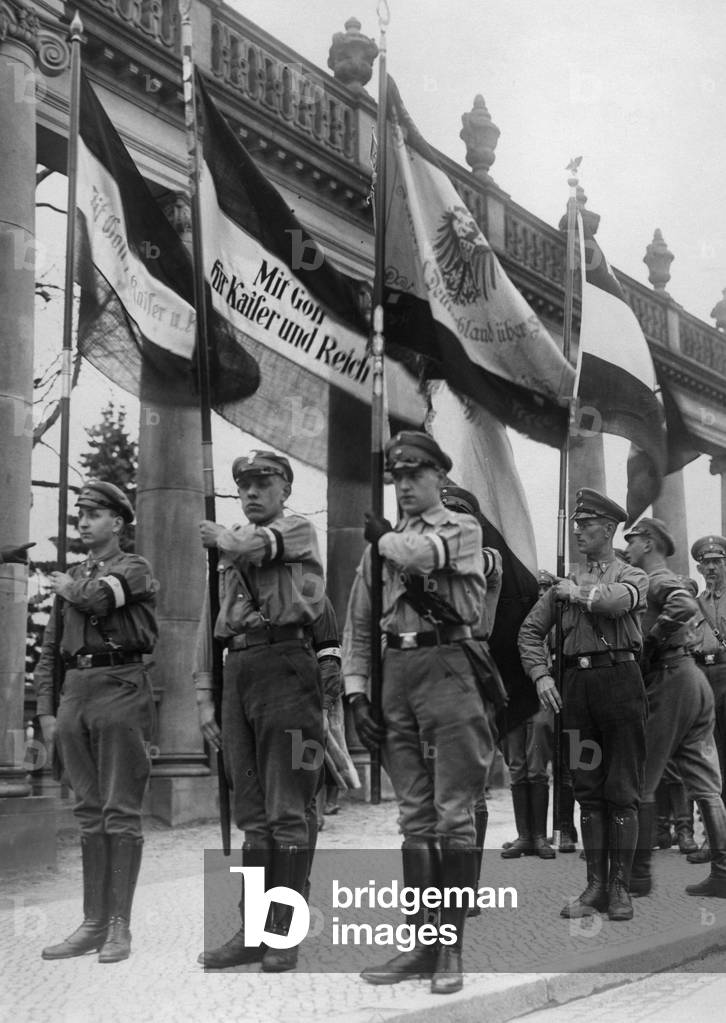
A few months after Cramon’s memorandum, the old and new Right clashed sharply in Berlin on the occasion of the monarchist celebrations to mark the 75th birthday of Wilhelm II on 27 January 1934. While the assembled “royalty in their old, colourful uniforms and the fabulous jewellery of the ladies” could once again be admired in faraway Doorn, the central festive event at Berlin Zoo was stormed by marauding SA thugs. Hitler took the public demonstrations of monarchist “selfishness” as an opportunity to have the monarchist organisations banned. The report that Rüdiger Graf v. d. Goltz, chairman of the Reich Association of German Officers and a party member since May 1933, wrote about the events bears witness to the shock of the older generation. Outraged, the 70-year-old retired Major General described the events after his birthday speech to “our former Supreme Warlord”: “Two hours after the speech, a horde broke in, partly in civilian clothes, partly abusing the brown shirt, and took up residence like Bolsheviks, maltreating officers and their wives, destroying furniture and firing mock pistols and fireworks with loud bangs that ruined the ladies’ clothes. […] I then said to those assembled: Adolf Hitler will never approve of what you have just done. Don’t let your loyalty to him be misled.” The displayed outrage of the present nobles is less evidence of political differences than of the drastic misjudgement of the aged monarchists, who had misjudged not only the National Socialist goals but also the brutality of the associated methods.
Most notably, with Magnus v. Levetzow the storming of the Kaiser’s birthday celebrations took place under an aristocratic police chief who had been the chief political coordinator of the exiled Kaiser for four years and who in National Socialism had seen the vehicle with which Wilhelm II would one day roll back to the throne. Also noteable, Levetzow was replaced as early as 1935 by the SA and SS leader Wolf Heinrich Graf v. Helldorf, a fellow member who had been “part of the movement” for some time.
According to a report by columnist Bella Fromm, a brown-uniformed “horde” invaded a Berlin ball organised by the aristocratic society in January 1934, bringing down several of the older gentlemen, playing football with the helmets of the aristocratic officers and threatening the ladies present with revolvers. The party badge, which many of the aristocratic ball guests now wore openly and no longer “bashfully under their skirts”, as Fromm noted cynically, proved to be insufficient insurance against the unleashed petty-bourgeois proletarian resentment. The retired lieutenant general August v. Cramon, president of the Guards Cavalry Club quoted above, now turned to the crown prince for help and protested to an NSDAP party office: “Unfortunately, I must confess to you that the indignation about these events in our and not the worst circles, which are absolute supporters of Chancellor Hitler, is very great […]”. The reply Cramon received from an aristocratic party member shows how little the old guard of monarchists loyal to the emperor had understood of the “fascist style” (Mohler). In an emphatically disrespectful tone, Cramon was informed that “the majority of us […] are not at all monarchically minded, but are committed to Hitler and the National Socialist programme. Moreover, I am not betraying a secret to Your Excellency when I state the fact that the National Socialist movement’s direction of struggle was and is always directed against Marxism and reaction. […] It is with bitter pain that our comrades can today already see that opponents from the bourgeois-nationalist camp are managing to push themselves forward with great skill in every corner. But it was not them who we have gone into the streets fighting for, have been wounded for, have been arrested for. We have the right to assert the right of revolution too, which is a National Socialist revolution. We owe this to our conscience, especially to the many thousands of comrades from the young labour force who stood beside us when we were still indiscussable hooligans and swastika bandits for the good society.”
Cleanup Squad of the SA
An explanation for the sharpness of the attacks used can be found less in political than in socio-cultural differences. It is important to contemplate the enormous social and cultural distance that lay between the castle, manor house and casino on the one hand and the SA home and “Sturmlokal” on the other. As was to be expected, the Bavarian aristocracy found it particularly difficult to cope with the mimicry required after 1933. Here is another meaningful example: in 1936, the announcement by the newspaper Angriff that it intended to publish a series of articles entitled “Menschen, die in Schlössern wohnen” (People who live in castles) caused nervous unrest among the Bavarian aristocracy. The paper had announced that it was sending a “flying editorial team” to visit an old aristocratic family who had “owned castles for generations”. In a circular letter, the DAG’s chief executive v. Bogen had warned with concern that the editorial team would “probably not fail to mention any actual grievances.” The Bavarian DAG management quickly agreed not to put “the snobby Fugger […] in the foreground”. The search for a cousin loyal to the Nazis who was prepared to have his castle and his loyalty to the Nazis inspected took some time: “So let your trusted eyes glide over the men and make your choice wisely and carefully. In any case, it might be advisable to gather the ‘chosen ones’ in one place beforehand for precise instructions […].” Prince Öttingen asked the Berlin DAG leadership for more time to find “palace owners who seemed particularly suitable”, rejected the date requested by Berlin and suggested “first sending the ‘flying editors’ on trips to other, especially northern German [regions], so that we in Bavaria can prepare the matter particularly carefully in the meantime”. Having been informed that the “Angriff” was “not exactly a sentimental publication”, they looked for comrades whose behaviour would stand up to the stern gaze of old fighters. With a mocking undertone, it was planned to send the NS editors “to Pöttmes, Thüngen or Aystetten”, three estates whose owners were relatively rare party members among the Bavarian nobility. In fact, a visit to the castle of the Franconian Baron Aufseß seems to have been suggested to the “flying editors” in the end.
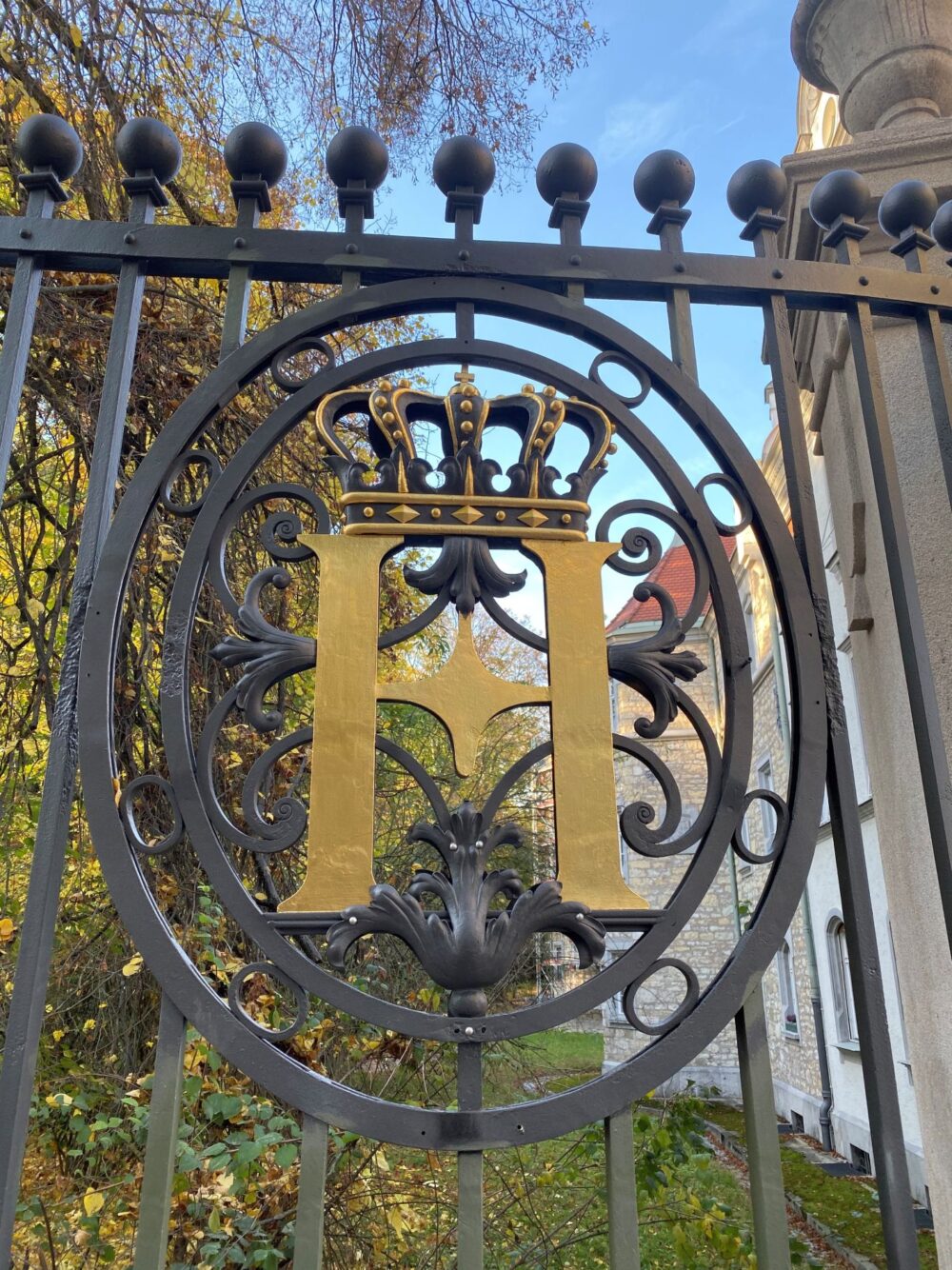
The barriers between the Catholic grand seigneurs and the majority of party members remained as high as ever after 1933. A bizarre example of the preservation of such barriers was provided in autumn 1938 in an attempt by the Regensburg NSDAP to seize the steel fences around the impressive palace grounds of the Princes of Thurn und Taxis. In a letter to the princely court marshal’s office, the “scrap metal task force” of the local NSDAP district leadership decided to suggest to the prince that the fences be completely demolished: “The fences and bars […] are often completely superfluous, unsightly remnants of a bygone era and taste and should disappear if possible.” In fact, the “clearing out” propagated here was part of a programme to supply steel to the German arms industry. Symbolically, however, the initiative can also be read as a call for the demolition of aristocratic distinctions: The “scrap metal task force” is rattling the castle fence of one of Germany’s richest princes. The planned “clearing out” of the iron differences was a reminder to the princely family to finally become part of the national community. The reference, formulated as an offer rather than a threat, to “a cleanup squad from the SA”, which would “demolish the front garden fence free of charge”, embarrassed the princely administration. After some debate about the appropriate wording, the court marshal’s office informed the “scrap metal task force” “that for aesthetic reasons, as well as for security reasons, it does not seem possible for us to remove the iron fences around our estates […].” The SA commando stayed away from the castle and its owner from the Nazi movement. The prince’s efforts to adapt do not appear to have gone beyond the appearance of the prince at local “solstice celebrations”, which the district leadership had urged, and an arrangement with the local SS cavalry, which was allowed to use the riding arena in the castle free of charge. Other than five members of the Princely family who joined the party in 1938, neither the Prince nor the Hereditary Prince came close to the party. “I never joined the party because, as a devout Catholic, I didn’t want to compromise myself”. The Hereditary Prince’s explanation in the context of his denazification proceedings is entirely plausible when supplemented by the distance from his position as a high aristocratic multimillionaire.
…but officially we are not monarchists
As in Bavarian monarchism, nobles also played a decisive role in Guelph (Welf) particularist monarchism. Both currents contained an anti-Borussian element, for the symbolic accentuation of which Guelph-orientated aristocratic families sent their sons in leather trousers and noble white embroidered trouser braces to run the gauntlet among their Lower Saxon classmates. In addition to the most influential monarchist currents in Bavaria, Prussia, Saxony and Hanover, there was another influential line in the Catholic nobility of south-west and west Germany, which was orientated towards the old imperial idea. In agreement with his Westphalian peers, Abbot Augustinus von Galen, a brother of the later famous bishop, described the monarchy problem in 1926 as a cura posterior and considered the claims of the House of Habsburg to be justified in contrast to those of the Hohenzollerns: ,,As far as the Hohenzollerns were concerned, their emperorship had not the slightest thing to do with that of the old empire […]. The Hohenzollerns were therefore in no way the legal successors of the old emperors and from this point of view, they could therefore absolutely not be considered as favoured candidates for the future crown.” The orientation towards the idea of empire, combined with good relations with the high clergy and an attitude critical of the Hohenzollern and in favour of the Habsburgs, which the Westphalian count represented here, was characteristic of influential members of the south-west German nobility, especially the local mediatized princes. The supporters of the unrealistic idea of empire in particular were often characterised by a relaxed attitude towards the republic. For the south-west German nobility association, which maintained friendly relations with the Bavarian associations, Attila Graf v. Neipperg explained to a fellow Bavarian that the nobility in the south-west was also monarchist, but unlike in Bavaria, which was loyal to Wittelsbach, their loyalty only partly belonged to the houses of Württemberg and Zähringen, while many West German nobles had not forgotten the “sins” of the princes from the Napoleonic era. The monarchism that Count Neipperg outlined here also resembled a vague basic attitude rather than a practicable programme: “These people are fully Holy Roman Empire of the German Nation. And to a certain extent, cum grano salis, I am also with this side. Our stance is that we want to show and prove that the nobility is necessary in the republic, even more necessary than in the monarchy, where everything went its more or less regular course. But officially we are not monarchists.”
The intertwining of the aristocracy and the Nazi movement in the countryside had an important counterpart in the big cities in the form of a number of salons. The “colourful mixture of cuts and SS uniforms” and the scenes known from mocking descriptions, in which Hitler awkwardly kisses hands and excitedly chops at members of the German aristocracy close to the Nazis, had been rehearsed in these places long before 1933.
Hitler’s own contacts with aristocratic and upper-class members of the bourgeoisie had already been established in the homes of individual patrons at the beginning of his political career. In addition to the family of the piano manufacturer Bechstein, Hitler made such connections, including the momentous meeting with Emil Kirdorf, in the parlour of Elsa Bruckmann. The wife of Munich publisher Hugo Bruckmann was Princess Cantacuzène by birth and came from a family of Romanian high nobility. When the Bruckmanns’ parlour became “worried about the psychological impact of the success on Hitler”, he had long since withdrawn from the control that they had wished for. Karl Prinz zu Löwenstein, the chairman of the radical right-wing National Club, had played a role as an intermediary for the contact between Hitler and Kirdorf. The Bechsteins’ Berlin house remained important until the transfer of power – Helene Bechstein, who had also supported Hitler financially during his years as a “drummer boy”, hosted the aforementioned meeting in January 1931, at which Hitler met a circle of fifteen people with large landowners from renowned Prussian families.
Prominent National Socialists created further connections to the nobility, including Hermann Göring, who as the former commander of the famous Richthofen fighter squadron had contacts to the aristocracy up to the Prussian crown prince, which were considerably increased by his first wife. In August 1931, a two-hour lecture by Hitler at Göring’s home fascinated the audience of Rüdiger Graf v. d. Goltz, Leopold v. Kleist, Hjalmar Schacht and Magnus v. Levetzow to such an extent that “the circle remained in silence for a while, moved and impressed. Göring and the Strasser brothers again socialised in the salon that Oskar v. Amim-Burow ran with his bourgeois wife from a wealthy Frankfurt family in Berlin’s Dahlmannstrasse.
By 1930 at the latest, the salon of a new aristocrat became the perhaps most important “social” interface between the old aristocracy and National Socialism: the v. Dirksen house in Berlin-Tiergarten. Viktoria Auguste v. Dirksen, daughter of a noble Danzig family, was the second wife of the envoy Willibald v. Dirksen, who died in 1928, and mother-in-law of the antisemite diplomat Herbert v. Dirksen, who held ambassadorial posts in Moscow, Tokyo and London between 1928 and 1939. The salon in the pompous palace that the family owned in Berlin’s Margaretenstrasse was a meeting place for Potsdam and Berlin court society even before 1918. After the war, a significant proportion of the “old society” gathered in this salon, which always retained a political, fiercely anti-republican orientation. In the late 1920s, the widow, who had already supported Hitler in 1923, opened her house to the leaders of the NSDAP, who successfully wooed prominent representatives from the lower and higher nobility there. “The old lady has taken a special fancy in me and wants me to convert the whole world,” noted Joseph Goebbels in February 1930. These endeavours were not without success. The minutes of a meeting held in November 1931 give an impression of the unification achieved here.
Among those present were Hermann Göring, Joseph Goebbels, Marie Adelheid Princess zur Lippe (NSDAP member since 1 May 1930), Viktor Prinz zu Wied and his wife (party members since 1 January 1932), the DAB leader Walther Eberhard Frhr. v. Medem, the party comrades August Wilhelm Prinz v. Preußen, the banker August Frhr. v. d. Heydt and retired Colonel Leopold v. Kleist as representatives of Wilhelm II. Members of the old aristocracy met with the most prominent Nazi leaders in this salon, which insiders in Berlin society regarded as the “social centre of the National Socialist movement”. Hitler, Göring and Goebbels spoke here with the Berlin SA chief Wolf Heinrich Graf v. Helldorf and members of the Hohenzollern dynasty. Prince “Auwi” presented himself at the Dirksen house in his brown uniform; where he and his son Alexander – also a party comrade – were “introduced to Hitler’s teachings”.
For years, the widow, whose brother Karl August v. Laffert was a member of the SS, mediated “between the National Socialists and the old court party”. By the end of 1933, the salon of the “old witch”, as she was now called, had evidently lost its former significance, which had grown again in the crucial months of the transfer of power between August 1932 and January 1933. Salons of this kind provided a suitable forum for the chess moves of individuals in the proverbial “camarilla” around Hindenburg. The Dirksens’ house still played a role in linking individuals, for example in the arrangement of the momentous meeting between Hitler and the “son of the Reichspresident not provided for in the constitution” on 22 January 1933.
In addition to their function of connecting two socially largely separate worlds, the Nazi salons also fulfilled another function. Bella Fromm describes the attempt to sound out and pass on the moods and knowledge of the ruling elite via mostly female Nazi supporters in the salon discussions as “salon espionage”. It is quite obvious that aristocratic confidants were often chosen for this task.
A “mobile” interface was created by the activities of Wilhelm II’s second wife, Princess Hermine v. Reuß, who socialised in the most important circles of the political right during her visits to Germany. She apparently made contact with the NSDAP leadership in 1929, on the fringes of the Nuremberg Party Congress. The date of her first meeting with Hitler is unclear, but a meeting with Hitler in the salon of Baroness Tiele-Winckler in November 1931 is well documented. In the presence of the “Empress”, Göring and the aristocratic chief advisors of Wilhelm II, Hitler held a monologue lasting several hours in which he explained his intention to have “all November criminals […] publicly strangled”. The lecture delighted the hostess and guests alike, and the Kaiser’s wife spoke favourably of the “likeable” Hitler, “also about his good and straight facial expression and his good eyes and their expression without falseness.” Pleased with the outcome of the meeting, Magnus v. Levetzow summarised his impressions of Hitler in a letter to Prince v. Donnersmarck: “He was good on the plate, by golly.”
The places where the entre-nous milieu of society opened up politically and stylistically to the far right became more numerous and larger. In December 1932, Bella Fromm described a “more colourful than distinguished society” that came together at the “Cecilenwerk” charity ball and brought together the aristocracy with Magdalena Goebbels. Fromm, who as a society columnist with an upper-class background knew her way around Berlin society very well, had personal contacts on the right as far as Schleicher and Papen and, as a Jew, observed the changes in the social fluid with particular acuity, captured the major upheavals in her diary in the form of vivid miniatures and snapshots. Alongside Count Helldorf and Prince “Auwi” in SA uniforms, members of the old aristocracy walked through the discussion groups of foreign diplomats and the old Potsdam society in an increasingly offensive display of their National Socialist sympathies. In her sketch of a collection of “small repulsions”, Fromm recorded in December 1932: “It was disheartening to see how many new friends National Socialism had made from the ranks of the old aristocracy.” Fromm’s descriptions are reminiscent of Hannah Arendt’s account of the receptions in the Paris salons at the time of the Dreyfus Affair. For the French capital of the fin-de-siecle, Arendt describes a pattern that “became the rule after the world war: The hero worship of gangsters on the part of the elite, the admiration of all cruelty, the alliance finally of all the declassed on the basis of resentment or despair” The external characteristics of this alliance included kowtowing, which was still being carried out in all aristocratic associations in 1933.
Parallel to the wave of people joining the NSDAP, which will be discussed in more detail later, a flood of aristocratic appeals to the new rulers swept across the country in 1933. Here too, the DAG provided the symbolic pinnacle of aristocratic ingratiation. The kowtowing that Prince Bentheim staged in the name of the DAG leadership was early and unconditional. The DAG leadership’s hope of being able to integrate the DAG as a state-recognised ‘elite’ formation into the leading bodies of the new state was presented to Hitler personally by Prince Bentheim in June 1933. Bentheim wanted the DAG to be recognised as a public corporation. State bodies were to exert pressure on non-members of the nobility and DAG membership was to be legally established as an indispensable prerequisite for membership of the nobility. Hitler had raised Bentheim’s hopes by making extremely vague promises, which Bentheim later presented to the “state leaders” and Prince Löwenstein in an embellished form, and which were later repeated by his state secretaries.
Bentheim believed that “[the great] goal that has been lost to us for a hundred years” was within reach: “that the nobility would once again become a political status.” Bentheim solemnly promised Hitler that after a major “cleansing operation” he would make the “purified German nobility” “available to the Nazi state without restriction”
The tightening of the Aryan paragraph described above came into force on 12 September 1933 with an amendment to the statutes and led to the “expulsion” of well over 100 members from the ranks of the DAG. At the same time, five prominent National Socialists who held high and top SA ranks were added to the DAG main board. The DAG thus formed the symbolic tip of a broad movement among the nobility, which in turn became part of the attempt to “work towards the Führer”, which was now gaining momentum everywhere. For the DAG leadership, the speed and radicalism of this self-alignment was no more surprising than the sycophantic notes that Bentheim sent to Hitler after the Röhm murders and the assassination attempt of 20 July 1944. The naivety with which the men of the DAG leadership “licked Hitler’s boots”, as Erwein Frhr. v. Aretin put it, was the consistent continuation of the course that had been steered for years – the only astonishing thing here is that this attitude did not undergo any recognisable correction until 1945.
The dizzying sums that Christian Ernst Prince zu Stolberg-Wernigerode distributed for charitable purposes in 1921, compared to the budgets of the DAG regional departments, give an idea of the immense social distance that existed between the richest and poorest groups of the nobility. A glance at the internal accounts of the Princes of Thurn und Taxis illustrates the width of the gap between the ruined lesser nobility, who needed support by the aristocratic organisations with donations of linen, and the pinnacles of aristocratic wealth.
Before the First World War, the hereditary prince of the Princely House received an annual allowance of around 42,000 marks, which was increased to 60,000 marks in 1916. Together with other allowances, including for cars, riding horses, valets and bodyguards, the Hereditary Prince had a sum of around 136,000 marks “at his free disposal” for the year 1930. Shortly before the start of the Second World War, Prince Albert was once again able to increase his eldest son’s allowance. In 1939, “His Most Serene Highness, on the occasion of His Most Serene Birthday, had decided” to increase the annual payment to 84,000 marks per year.
In most of the grand seigneurs’ families, it was still possible to pay them bonuses, which also made the sons and daughters born after them wealthy aristocrats who were unimaginably rich in comparison to the DAG standards described above. According to bourgeois understanding, it was the respective heads of aristocratic and noble houses who benefited from the continued existence of the considerable, often enormous fortunes within the high nobility. Representation, splendour and the preservation of the economic and symbolic capital of an aristocratic house were primarily guaranteed by the respective head. The idea of luxurious lifestyles in spacious castles with free disposal of enormous assets is therefore initially appropriate for the heads of the family even for the period after 1918 – despite considerable losses.
However, it has to be put into perspective for the sons born later and especially for the widows and daughters of even the wealthiest families. In the above-mentioned example of the Stolberg-Wernigerode family, the princely wealth seems only partially suitable for assessing the social situation of the agnates, especially the daughters. Around 1930, when the house was experiencing great financial difficulties, they had no financial resources at their disposal that would have enabled them to live in line with their status, despite a well-funded family foundation. In Bavaria, Karl Friedrich Prince of Öttingen-Wallerstein was still able to guarantee his wife the considerable sum of 30,000 marks per year in 1928, but did not feel able to distribute any further “gifts”. The estate passed into the hands of his younger brother.
[…]
The fact that a prince was able to spend almost 1 million marks on charitable causes in 1921 points to the immense wealth retained by individual family (heads) of the high nobility and demonstrates the continued existence of princely social benefits within the sphere of action and influence of the old rulers. The bulging folders in which princely archives kept the petitions of socially disadvantaged people who turned to their princes in confidence even after 1918 bear witness to the factual and dreamed-of continued existence of such social support organisations. Wealthy families from the high nobility and other grand seigneurs remained important local charities even after 1918, supporting both needy individuals and organisations of all kinds in their area.
The support files of the Princely House of Thurn and Taxis list more than 600 individual clubs, associations and societies that had – mostly successfully – applied for donations from the princely portfolio: from charitable organisations of the Catholic Church to singing, carnival, gymnastics, hunting, blind, literary, bowling, motor sports, officers’, art, student, horse and rabbit breeders to colonial and naval associations. In addition, there were at least 300 individuals who were supported with regular or temporary payments.
Friedrich v. Bülow demonstrated how aristocratic and National Socialist ideals could, with some effort, be presented as having the same essence in his speech at the Bülow Family Day in the summer of 1935. Bülow, retired senior president in Poznan, presided over one of the largest German family associations, at whose family days a growing group of young Nazi supporters had already attracted attention before 1933. The metaphorically charged presentation of alleged commonalities that the 66-year-old speaker offered his family circle here provides one of the most vivid proofs of the thesis that the aristocracy’s rapprochement with National Socialism must be written not least as the history of a misunderstanding:
Upon blood and soil the Führer is building his Reich. We have understood blood selection for seven centuries and have wisely chosen to build and continue our bloodstream on the basis of age-old race and culture. […] All the great ideals that the Führer has set for the German people stem from ancient Germanic heritage and not least from the deepest treasuries of the German nobility. Thus the German aristocracy is fundamentally akin to National Socialism in nature and origin. At the time of the red governments, the motto was: down with the aristocracy, we all want to be proletarians. Now it is the other way: the common man from the people should rise up, and we all want to meet again on the level of a true aristocracy. […] What the future will bring us, we leave in the hands of God and the enlightenment of the leader. But we know one thing. Our old lineage is not a foreign body in the Third Reich, rotting and decaying, it is a load-bearing block in the building, hardened over centuries. […] Sieg Heil! Sieg Heil! Sieg Heil!
[…]
As the most important heir to folk traditions and as a political force that was close to neo-aristocratic thinking in some respects, National Socialism had not abandoned the aristocracy either as an idea or as a concept. What remained were the concept and individual elements of aristocratic tradition, which could be bent and misused. “Nobility” remained an institution valued and needed by National Socialism – but only in the form of the mutations that Hitler, Günther, Darre, the SA and, above all, the SS leadership wanted and produced as “nobility”. Conversely, a large part of the nobility believed that they recognised a modern version of their own traditions in the guiding concepts and goals of the Nazi movement. As shown, the supposed closeness through the common talk of “blood” and “race” proved to be a fatal misinterpretation. In 1921, an Pan-German baron saw the EDDA project as
the deliberate continuation of the […] selective breeding […] that has always been practised by the nobility through the cultivation of pedigree and genealogy […]. The aristocracy’s attitude towards the idea of selection and race breeding is therefore not a new goal for the nobility, but actually a self-evident one.
The absurd perception of the Nazi movement as a contemporary continuation of the “best” aristocratic traditions was found everywhere in the aristocracy; its basis was the common use of key terms that were phonetically, but not semantically, identical. “We can only thank Adolf Hitler,” said an appeal in 1932, “if today the views corresponding to our best traditions have been reawakened in the widest circles of the people: Personality and race, habitation and down-to-earth mentality, warriordom and the will to fight for the honour and freedom of the nation.”
[…]
The Würzburg university lecturer Ernst Mayee defined the “conscious and associative unification of the nobility and the educated” as the most important goal; a union that the society’s conferences explicitly sought to promote. From the “political storms”, a “comprehensive new German nobility would emerge, in the oldest German sense nothing other than the lovingly leading elders of all the younger brothers in the entire German nation, conscious and yet supple, brave and finely educated, economically not depressed but also not opulent.” Regardless of all educational patents, however, German Jewry would have no place in the future “German upper class”. With a reference to the inbreeding of the French nobility, which led to decadence, and using the vampire metaphor typical of the time in nationalist jargon, the jurist recommended that the old nobility bring in “fresh blood from other classes” to supplement the “departures”. Here, too, there was a positive reference to the “elasticity” of the English gentry. Self-confidently emphasising his own abilities, the educated citizen Mayer called for the “relentless training” of the future upper class, from which all members who could not withstand the “sharp” educational selection were to be “mercilessly” expelled.
It was also DAB editor Walter v. Bogen who, a few months after this debate, naively and openly presented the concept of the new aristocracy, which was to prove indigestible for the entire old aristocracy and probably the most important conceptual challenge to aristocratic claims to leadership: Richard Walther Darre’s work “Neuadel aus Blut und Boden” (New Aristocracy of Blood and Soil), published in 1930. In his astonishingly positive review of the book, v. Bogen Darres praised the breeding fantasies of a newly created, racially pure and land-loving nobility as an endeavour that came very close to the aspirations of the aristocratic cooperative. In his reading of the book, v. Bogen had overlooked Darre’s extremely sharp criticism of the old aristocracy as well as the highlight of Darre’s concept, for Darre claimed nothing less than the necessity of replacing the old aristocracy with a new one. Although Darre also praised the old aristocracy as purveyors of certain ideals and individual leaders, Darres categorised the old aristocracy as a whole as useless, superfluous and in need of replacement as far as the necessary creation of a leadership of the future was concerned. The aristocracy’s dispute with Darres’ concept, which began a little later, must be discussed in more detail in connection with the differences between the aristocracy and the Nazi movement. Suffice it to say that Darre’s book had been a politically relevant concept for a new aristocracy since 1930, which had once again sharpened the völkisch-racist criticism of the aristocracy, as reflected in the Semi-Gotha, among other things, and transformed it into a detailed blueprint for an alternative aristocracy. In January 1933, the Adelsblatt reopened the debate on the new aristocracy with a völkisch article by the Pan-German baron Leopold v. Vietinghoff-Scheel. In the subsequent contributions to the discussion, however, only the familiar arguments were repeated. The concluding words of the editorial board once again laid down the line of the DAG – with the exception of members who were not “racially pure”, the entirety of the old nobility was to be retained as the crystallisation point of the future ruling class. Education, professional competence and material independence were thus once again rejected as indispensable criteria for membership of the “ruling class”. Ten days before the transfer of power, the DAB editorial board had found a formula that was at least compatible with Darres and other National Socialist elite concepts: “A nationalist state needs a ruling class that is racially pure, connected to the soil, rooted in its own ethnicity [… and] seeks the welfare of its people.”
The core content of the debates on the new nobility described in this chapter contained three different, often varied and differently weighted demands on the old nobility: education, property and (“pure”) blood. The first two terms referred to the actual and decisive weaknesses of the petty nobility, but were (or therefore) successively suppressed from the debate within the nobility. In contrast, the demand for racial purity adopted from the imaginative realms of völkisch thought came increasingly to the fore, further blocking a realistic assessment of the aristocracy’s chances of power in the modern age and soon proving to be an argumentative boomerang. Without going into the consequences of this development at this point, an example from 1924 will show that the idea of a “racial” improvement of the aristocracy as a substitute for an actual reform of the nobility was already being openly debated before the political breakthrough of the Nazi movement.
Six years before the horse breeding specialist Walther Darre published his fantasies of aristocratic breeding, the writer and castle owner Börries Frhr. v. Münchhausen, who was extremely prominent among the nobility and decorated with two doctorates, summarised the raison d’être of nobility in a simple formula: “If nobility is to have a meaning and value that goes beyond the external adornment of names, it can only be this: Human breeding.” Straightforward the writer compared the breeding work on the “well-built natural breed” of English thoroughbred horses with selecting a female partner as motivated by “breeding”. With the affirmative adoption of the “golden words” from Hans F. K. Günther’s “delicious” book and the guiding ideas of the Nordicist theory of race, the baron bid farewell to the centuries-old criteria of aristocratic principles of equality in cheerfully formulated sentences: “There is only one equality at all, and that is that of pure Nordic blood. The mixed-blood nobleman, for example, is not racially equal to a pure-blood Nordic peasant daughter. If nobility is to regain a racial sense, then the education of Nordic racial purity is assigned to it as its first task.” In future, young people would have to “recognise without immediatly: This is a Mongolian nose, that a Nordic figure, that an Eastern soft mouth. Only in this way can we understand and fulfil Nietzsche’s command: You should propagate yourself not only onward but upward. Non-“purebred” aristocrats, he demanded, should relinquish their aristocratic titles, as marriages between Jews and “Aryans” always produced “bastards”. The linguistic climax of the contribution, which also marked an intellectual low point in the aristocratic debates, stated:
I can breed pugs, and I can breed dachshunds, but if the malör (sic) happens to me and I get a basket full of young dachshund pugs, they will be drowned with good reason. This is neither anti-pug nor anti-dachshund, but a realization of the centuries-old experience that all bastards are inferior.
The baron made a clear statement regarding the criteria according to which a ruling class was to be built up: the “pure-bloodedness of the nobility [is] to be regarded as the most important question of each individual and of the entire estate, but beyond that: of our entire people.”
The knightly formula “to Ostland we shall ride” could be incorporated into the propaganda of the National Socialist plans for conquest and settlement and could count on broad support among the nobility. Ewald v. Kleist-Schmenzin had emphasised the potential benefits for the East Elbe landed gentry in a prominent position in 1926:
It needs no explanation what a fountain of youth colonial land acquired east of our border with unlimited settlement possibilities would be.
What Kleist formulated as a vague hope was realised in very pragmatic attempts at profit sharing from the beginning of the war at the latest. As is well known, the career options that emerged in the East went far beyond curiosities such as the post of “Managing Director of the Sheep Breeding Association Ukraine”.
After 1939, members of the high and low, rich and poor nobility made enquiries to the SS leadership about the option of acquiring estates in the looted areas. Nobles recognised the unique opportunity here to secure the family’s land supply for generations to come. Corresponding letters to Heinrich Himmler and high SS authorities document the extremely tangible interests that existed in the various aristocratic groups in the acquisition of large estates in the “Ostland”. Very specific requests for loot were also formulated in applications from the high nobility: “Dear Mr Himmler! I have submitted three applications for the granting of entailment for my inherited Holstein family estate; two applications have already been approved, while the decision on the third application is still pending. As I have a total of 6 sons, I would like to acquire further property for the younger sons. I would be very grateful if you would let me know briefly whether it will be possible for me to purchase larger estates in the East after the end of the war. […] With warmest regards and Heil Hitler […]”.
This form of modern robber barony had little to do with the much-praised solidarity with the plaice, but much to do with the myths surrounding the colonisation of the East. In 1940, a Baltic author praised the “Führer’s” project of recalling the Baltic nobility from their “seven hundred and fifty years of faithful vigilance on advanced post” in order to “transplant them to the regained German eastern region on the Vistula and thus assign them a new, enormous and marvellous task”. After the attack on the Soviet Union, the writer Ottfried Graf v. Finckenstein became chairman of an artists’ association called Kulturwerk Deutsches Ordensland, which was to meet in Marienburg and recall that
around 700 years ago, the light of the German spirit and German morality was carried into the Slavic region, never to be extinguished again
Ordensburg Marienburg
Castle of the Teutonic Order Malbork
Now the German was once again “the most important cultural carrier in the front line of Germanness”. At around the same time, Fritz-Dietlof Graf v. d. Schulenburg spoke of the imminent decision “whether the people will finally fall victim to urban civilisation or take root once again here in the East and renew itself by its own strength”. With other motives than Schulenburg, who was personally incorruptible and energetically opposed to the “rampant” corruption, the predatory war in the East was welcomed with particular fervour, especially by aristocrats who had lost their estates after 1918 as part of the German territorial cessions. Referring to the estates lost by her Baltic German mother, Heinrich v. Bismarck’s wife contacted the Volksdeutsche Mittelstelle just a few weeks after the invasion of Poland with the enquiry “whether there would also be a possibility for us to acquire an inherited farm or the like in the conquered […] territories, preferably between our countrymen”. They had long dreamed of settling – “preferably in the east” – but so far the land within the Reich had been too expensive. A similar attempt by SS leader Ludolf v. Alvensleben, who in September 1940 stretched out his hands for the loot and approached Himmler directly, was brusquely rejected by the latter. Himmler’s reply to the expropriated and ruined landowner stated that he could not stand in for “all the business failures of National Socialists with the estate’s land”. “All in all, I did not like your intention to regain possession of this estate without a penny of money. […] You can apply for a settlement after the war, like all other Germans in the Reich.”
In 1933, countless minor aristocrats who had had steeply negative careers after 1918 harboured the justified hope that their early involvement in the movement could now pay off. In March 1933, a typical letter of petition for a member of the v. Bülow family who had been dismissed as a first lieutenant in 1920 stated: “The poor man is in very bleak circumstances, despite his formerly so rich […] relatives. He is a party comrade and a strong supporter of the movement. Perhaps, Mr President, it is possible for you to provide a poor Pg. (party comrade) with work and earnings.” In the petty aristocracy, as in other social classes, the status of the old fighter could be worth its weight in gold after 1933, or to be more precise, could greatly promote social (re-)advancement.
However, the Third Reich also opened up career opportunities in the traditional aristocratic professions regardless of demonstrable commitment to the “movement”. With the reintroduction of compulsory military service in March 1935, career opportunities in the military, which had been extremely reduced by the Treaty of Versailles, were suddenly increased. In appeals, aristocratic officers admonished the youth of the nobility that there was now no reason to pursue a ‘bourgeois’ profession, “instead of – the hell with it! – following the inner voice, […] which must now call to arms like a fanfare within everybody who bears an old name.” When the fatherland calls, the young nobility, as always, “belongs in the first wave of attack.” Calls of this kind did not go unheard. Within two years, the number of active aristocratic officers had more than doubled, which meant securing around 1,300 additional military careers for aristocratic men. Added to this were the career opportunities offered by the SA and then the SS, which had already been heavily utilised by the nobility before 1933. The nobility recognised “expansion as an opportunity for the future” early on and consistently, which was reflected not least in their strong commitment to the SS.
In the SS in 1938, 8.4% of Standartenführer, 14.3% of Brigadeführer, 9.8% of Gruppenführer and 18.7% of Obergruppenführer belonged to the nobility
In percentage terms, these proportions fell sharply in the lower ranks and after the expansion of the SS apparatus; in absolute terms, however, there was considerable potential for career opportunities in the SS, which aristocrats utilised in parallel with the improved opportunities in the Wehrmacht.
The idea that the aristocracy could successfully feed into the general longing for leadership by drawing on its thousand years of experience of rule can be found wherever aristocrats debated the opportunities opened up by the Nazi movement. In Mein Kampf, Hitler had spoken about the difficulties of recruiting suitable leaders, emphasising the importance of the individual personality and the “aristocratic principle” according to which the leadership of his movement was structured. In the aristocracy, the habitual conviction of their own superiority suggested that the Nazi movement should be seen as a force characterised by the petty bourgeoisie and proletariat, which had taught the “masses” to think in terms of leaders and followers, but which itself suffered from a chronic lack of leaders. The first phase of self-confident mockery of this lack was followed from around 1930 by a second phase of sceptical consideration of how the aristocracy could fill this gap itself. A grotesque variant of aristocratic attempts to direct the ubiquitous desire for leadership towards themselves is provided by a speech from 1930, in which Wilhelm II lamented the inflation of the leadership concept in Doorn:
To be a leader! Everyone wants that nowadays. Leaders present themselves everywhere. Many people pose as leaders […]. And yet the cry for leaders is omnipresent!
In a strange mixture of Christian and neo-right-wing motifs, Wilhelm II renewed his claim to leadership. The idea of leadership was first ‘revealed’ by God to the Sumerians. King Hammurabi was given the “leadership profession” by God 5,000 years ago, his own ancestors 500 years ago. “Only to these leaders is the leader Jesus Christ!” Spatially and mentally far removed from all political realities, the exiled emperor appointed Jesus as the otherworldly “leader” and himself as the earthly “leader”. The imperial leader referred to himself in the preceding passage from the Gospel of John, which had given the speech its title: “I am the vine; you are the branches. If a man remains in me and I in him, he will bear much fruit; apart from me you can do nothing.”
[…] A large part of the prussian nobility embarked on its intellectual and political journey from king to leader. In a mixture of anger, disappointment and weary hope, Count v. Schulenburg spoke in April 1928 of the duty of the Hohenzollern dynasty “to provide us with the pretender and then heaven grant us the man who, at the given moment, will use the power factor in our favour”. The Count aptly registered that neither the one nor the other was in sight. The successive transformation of monarchist dreams into hopes of a leader becomes very clear in the Count’s correspondence: “Only a titan,” he wrote a few months later, “can still master things, a titan that we possess neither on the right nor on the left. ” In 1924, the Crown Prince himself had come to the conclusion “that ultimately only a dictator could pull the cart out of the mud”. Hardly anyone within the Prussian aristocracy believed the son of the Emperor could fulfil this role. For some time, Count Schulenburg had been full of hope about the prospects of his “master”, who had “matured into a serious man” through the hardships of the times.
With this view, however, the general was already going against the judgement of his close friend Arnim and “the conservative faction of the House of Lords”. In agreement with the last President of the Prussian House of Lords, Prince Salm had internally described Wilhelm II and the Crown Prince as “intolerable”, the latter because of his lifestyle and especially “because he went to Holland and left the army as a sort of deserter”. Internally, Schulenburg described the crown prince as early as 1920 as a “wimp” and a “weakling” who could no longer be counted on in the future.
Even for those sections of the Prussian aristocracy who would have been predestined to carry the monarchist idea, the Emperors desertion led to an early mental flight into an initially diffuse myth of leadership. Due to the unresolved question of pretenders, all monarchist avowals remained vague. “I am a monarchist and will remain one”, Graf Arnim formulated in 1926. Arnim saw the overcoming of the “system” by a “dictator”, who was not to be supported by parliament but by “armed power” and who was to co-operate with “individual outstanding minds”, as a concrete short-term goal.
Although the diffuse “monarchical idea” remained central to Arnim’s rhetoric, in the 1920s Arnim moved ever closer to an intransigent anti-republicanism that used the terms “conservative” and “anti-system” synonymously. To interpret his work in the “main association” of conservatives, his rapprochement with the völkisch wing of the DNVP and his support for Hugenberg as an expression of a consistently “conservative” opposition would overlook the profound change in Arnim’s thinking. Behind the rhetorical and symbolic façade, to which the Arnims’ Boitzenburg castle provided an impressive backdrop, the count was turning away from the monarch in a way that was constitutive of this change and characteristic of much of the Prussian aristocracy. Conservative thinkers, to whom this description still applied, had realised that in the main association of conservatives there was more talk about the Jews than about the king. While the name and profile of a potential pretender to the throne were discussed cautiously or not at all, the idea of the coming “Führer”, “dictator” or “titan” became increasingly clear, as in the following diary entry by Count v. Bernstorff:
Only a dictator can still help us, one who steps in with an iron broom among all this international scrounging rabble. If only we had a Mussolini, like the Italians!
Within the widespread idea of first eliminating the parliamentary system before a restoration would be possible in a “second phase of the struggle”, only the first part of the task took on clear contours. Due to the structural weaknesses of the monarchist movement, seriously considering the immediate introduction of a monarchy was regarded even by Wilhelm II’s political staff as “a thing of such utter derangement and a crime against the crown that it could not have been worse.” This sentence, formulated in 1927, indicates a general tendency: While the conservative hopes for new royal glories were expressed in ever more diffuse formulas, the new right-wing ideas of leadership were also becoming increasingly popular among the nobility. The aristocracy never forgave the king and the crown prince for their “departure” and political monarchism never overcame the debacle it had caused. The detachment of the Prussian nobility from the king as a person corresponded to the dissolution of monarchism as a political movement. As an ideal, the king was replaced by the “Führer”, the monarchy by vague ideas of the “Third Reich”.