Intellectual historians never respect disciplinary boundaries, except when they are the boundaries imposed by the people whose ideas they study.
Richard Whatmore
For [Azar Gat], the writings of […] Carl von Clausewitz, in particular, belong to the large-scale movement of “Counter-Enlightenment”, which, in reaction to the dominant paradigm of Newtonian physics, distanced itself from the Enlightenment thinking of the 18th century and is referred to by Gat with the collective term “German Movement”, with reference to the regional focus of its formative phase.
[…]
However, Clausewitz’s oeuvre in particular continues to be understood as the crystallization of a turning point that fundamentally changed the way we think about war. His texts still play a central role in understanding the history of ideas of this era and in defining new positions in political theory.
There are two main reasons why Clausewitz and his environment are still considered important today:
- Clausewitz stands for the modern insight that war is to be regarded as a social phenomenon, i.e. that it cannot be separated from civilian processes, and must be understood as a “continuation of politics with other means “.
- Furthermore, he describes a paradigm shift according to which social processes and, above all, conflicts must no longer be understood as static, but as dynamic and historically changeable. His still famous and much-quoted metaphor of war as a “true chameleon”, which “changes its nature in each specific case”, stands for this in particular.
To this day, two names stand for the controversial interpretation of his work. While in 1935 Erich Ludendorff invoked Clausewitz’s “ideas of annihilation” with his infamous concept of “total war”, Ludwig Beck was able to invoke Clausewitz’s “mitigating principle” at the time of his resistance to Hitler, with which he morally opposed a policy of total escalation.
[…]
In Clausewitz’s recourse to a “dynamic law of war” at the beginning of the 19th century, he was moving in a tradition of contemporary natural science, more precisely the dynamistic turn that had been established about a hundred years earlier by Newtonian physics – “Isaac Newton was the giant of science in the seventeenth and eighteenth centuries”. With his new concepts of “mass” and “force”, Newton had created paradigms of a new era:
Conceptions such as ‚mass‘ and ‚force‘ were quickly recognized by Newton’s contemporaries as powerful concepts for representing aspects of bodies that allowed them to be measured and their dynamical interactions calculated.
Iliffe / Smith, Introduction (2016), S. 1.
According to Reinhard Brandt, there was “an overwhelming Newtonian fashion among the thinkers of the 18th century”. This mathematical and scientific background can hardly be overestimated, even if Sir Isaac Newton’s name is not always mentioned in the works of the late 18th and early 19th centuries. We need only recall here that in Kant’s “Critique of Pure Reason” (1781), a work that can only be understood against the background of the “fact of Newtonian science”, Newton’s name is mentioned only three times (twice only adjectivally).
[…]
The pivotal point for the present study is the concept of an “inertia of forces”, which can be found in Carl von Clausewitz’s preliminary draft of his main work “On War”. It serves to characterize his “reductive principle” in more detail. […] The concept of ‘vis inertiae’ is a core concept of Newtonian dynamics.
Originally described as a force, it became a passive and inherent principle of all physical bodies with Newton as ‘mass inertia’. The moment of inertia of bodies of mass is not itself a force, but rather provides resistance to acceleration and can therefore be used to prove and measure the effects of forces that occur. Another core concept of Clausewitz is that of “interaction”, which is also a central concept of Newtonian dynamics. […]
In Kant’s critical work, the same Newtonian concepts had already assumed central functions in a transformed form. In Kant’s work, they are transcended into general conditions of objective knowledge that must underlie every science.
[…]
It was Georg Heinrich von Berenhorst (1733-1814) who, in the 1790s, attempted to apply Kant’s critical method to war in his “Considerations on the Art of War” and to raise the question of the possibility of a scientific theory of war. The peculiarity of Prussian war theory around 1800 begins with this recourse to Kant’s epistemological approach. While Berenhorst’s efforts still ended in paradoxes, Adam Heinrich Dietrich von Bülow (1763-1807), following on from Berenhorst, succeeded in implementing these demands for a new science of war theory in a coherent model. Bülow postulated an “all-guiding” or “binding principle”, which was not only intended to “shackle” war, but which, as the “fundamental principle of the entire science of war”, would enable a dynamic theory of social conflicts and, for the first time, make it possible to forecast and create dynamic equilibrium systems. In the years around 1800, he thus deliberately created a new approach to the then topical question of a theory of perpetual peace.
This Bülow theory, which was discussed in the Prussian officer corps after 1800 and soon throughout Europe, gave rise to the central postulates of Clausewitz’s theory: 1. that war must be based on a “dynamic law of war”, 2. that its foundations must contain a passive principle that is “inherent” in the events themselves and “moderates” them, and 3. the central idea that war is nothing static and “never an isolated act”, “not an independent thing”, but always only “a political instrument” and only the “mere continuation of politics by other means”.
All of these ideas can already be found a generation earlier in Dietrich von Bülow, whose works the young Prussian officer Clausewitz had attentively studied during his time at the “Academy for Young Officers” (1801-1804) – i.e. during Bülow’s main creative period.
Clausewitz’s famous definition of war, which Herfried Münkler characterizes as the “central formula” of modern conflict research and which interprets conflicts as “continued state policy with other means”, dates back to 1806 and was penned by Dietrich von Bülow. He was convinced that war could only ever be “a means to achieve diplomatic ends”. His model described social conflicts as a dynamic process in which “diplomacy can turn into war” and “a dispute with reasons” can ultimately become “a dispute with physical forces”. According to Bülow, this dynamic never actually had military roots. Above all, for him “war was by no means something complete in itself, but only a means to achieve diplomatic ends”, which was constantly “transforming” in its dynamic transition. Bülow’s analytical method is decisive for this view of things. Like Newtonian dynamics, his theory was to be based on just one “main principle”. Analogous to the axiom of inertia (vis inertiae), Bülow postulated the existence of “an all-conducting principle”, which was to substantiate the conditions of a dynamic science and a theory of dynamic equilibrium for war for the first time. Bülow had first announced this principle of “subsistence” in 1799 in his introduction to the “Spirit of the Modern System of War” for the theory of a future “perpetual peace”. With the concept of a subsistence mass, Bülow created a frame of reference for the distinction between politics, strategy and tactics in order to view “the political system of Europe” for the first time as a dynamic and interdependent equilibrium model, like the solar system, on the basis of an objective inertial principle, in which “a great power can now just as little be destroyed without shaking all the others” as “a planet can be torn from its place” “without shattering the system”. With Reihard Brandt, one could say that the Newtonian background was omnipresent at the time and could therefore appear almost trivial in Bülow’s case. However, the way in which Bülow connected to Newton’s method was highly subtle, even unique, and therefore requires detailed reconstruction. The inertial principle of subsistence, as an a priori epistemological condition – like the principle of mass in Newton’s “Principia” – was intended to open up a new measuring space in which the dynamic processes of social conflicts could be mapped and predicted in the future. It is this idea of a social principle of inertia that Carl von Clausewitz adopted decades later as the “inertia of forces” and the “moderating principle” in order to obtain “counterweights” in his model that would dynamically “moderate” the “rapid principle” of war, as in Bülow’s model. Clausewitz was therefore not the first to make a dynamic turn in thinking about war. Its origins in the history of ideas can be found earlier – with Berenhorst and Bülow. Bülow stood alone in his time with his dynamic equilibrium model of social bodies.
[…]
Long before Clausewitz, Dietrich von Bülow attempted to place war on the foundations of a dynamic science for the first time, which was to be based on a single “all-guiding principle”, thereby striving for a methodological connection to Newtonian physics, whose theory of dynamic equilibrium also rested on a “fundamental principle”, the axiom of inertia. It will be shown that this analogous role in Bülow’s dynamics was to be filled by the principle of subsistence.
Berenhorst and Bülow were perhaps the most extravagant representatives of a pacifist-intellectual current in Prussia during the French Revolutionary era, whose followers did not expect the solution to social conflicts to be found on the battlefield, but rather in the discovery of a new knowledge of war that would teach how to avoid it. With the uncovering of this forgotten context, the significance of Clausewitz must be repositioned. He was not the creator of a basis applicable to peace research. Rather, as will be shown, he was the one who destroyed it by furiously rejecting Bülow’s theory and erasing its traces. Only fragments of this theory – altered beyond recognition – have survived in his work.
[…]
In the following, an attempt will be made to reconstruct the origins of an independent Prussian theory of war on the basis of its most important protagonists, Georg Heinrich von Berenhorst and Adam Heinrich Dietrich von Bülow, as well as their environment and their successors in the circle around Gerhard von Scharnhorst and Carl von Clausewitz. Four theses are associated with this, which are to be represented in this work:
- an independent Prussian theory of war begins in the 1790s with Berenhorst’s question of a “fixed standpoint” for an exact science of war, to which was linked the pacifist concern of being able to objectively predict and limit interstate conflicts from such a yet-to-be-discovered standpoint.
- the solution was sought by Berenhorst and Bülow in connection with the epistemology developed by Kant – against the background of Newton’s paradigm. The starting point for them was the idea of a social principle of inertia a priori, via which – in analogy to the physical principle of vis inertiae – social forces could be measured and brought to a dynamic balance. The function of such a principle of inertia in Bülow’s model was to provide the “theory of subsistence” postulated by him as a “fundamental principle”.
- Clausewitz’s entire work can only be understood against the background of this theory and as its radical counter-proposal. Accordingly, Clausewitz adopted essential conceptual elements of Bülow’s Dynamics of War, but without having penetrated its structural coherence. Among other things, he missed the central function of a ‘moderating principle’ in the sense of a ‘social principle of inertia a priori’.
As a consequence, the incomplete transfer of concepts in his work led to an incoherent torso. Due to his strongly romantic orientation, Clausewitz instead arrived at a model of total dynamics, into which the demand for a ‘moderating principle’ adopted by Bülow could later no longer be integrated.
Without this principle, Clausewitz’s model inevitably led to the idea of a total dynamic, which constituted his “total concept of war”, and which lives on in the history of the reception of his work in the repeatedly gained insight that “everything […] is dynamic” and “everything is a play of forces”, which is why his theory has sometimes been accused of having led the discussion of war theory into the dogma of the unrestrained idea of annihilation for the first time. - Finally, it is likely that it was Clausewitz in particular who almost systematically tried to blur the memory of Dietrich von Bülow.
[…]
This is one of the thought patterns that – from Foucault’s perspective – “completely determine and dominate” the works of the Scharnhorst circle and were to generally assert themselves against Bülow’s theory after 1800. In this context, a hitherto completely neglected author, Friedrich von Gaugreben (1774-1822), who played a decisive role in the discourse on war theory in Berlin and about whom little is known, comes to the fore as a source of ideas for the Scharnhorst circle. He and his extensive criticism of Bülow were not only the source of the famous metaphor of war as a “true chameleon”, which is now wrongly associated with Clausewitz. With his criticism, he provided Clausewitz above all with the essential counter-arguments that were to become the basis of Clausewitz’s thinking and its contradictions. Ultimately, the aim is to show that Clausewitz’s famous work “On War” can be deciphered as a continuation of Gaugreben’s criticism of Bülow, which led him to the paradox of a total dynamic in order to create a basis for the modern idea of annihilation.
Bülow provided a new approach to the consideration of social phenomena by understanding them as dynamic equilibria on the basis of a social principle of inertia.
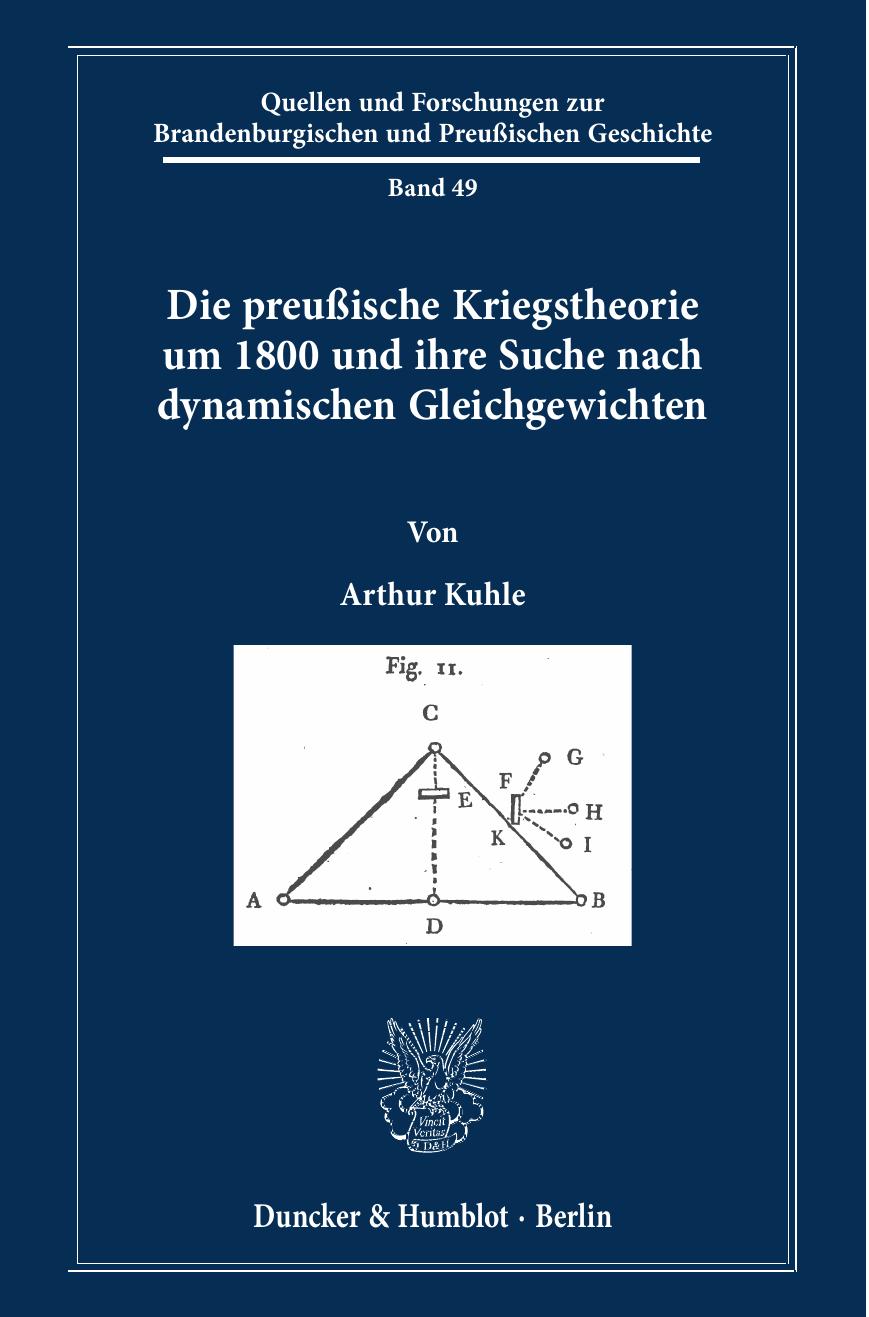
Die preußische Kriegstheorie um 1800 und ihre Suche nach dynamischen Gleichgewichten ~ Arthur Kuhle, Duncker & Humblot 2018