The behavior of the southern Italian and Roman nobility is also noteworthy. According to Benedetto Croce, in the south of the peninsula, “a large number of noble families” followed the Bourbons into Roman exile for several years. Croce further informed us that after 1870, they returned the same way “in groups or individually.” Towards the end of the century, the stay of the fashionable young Prince Vittorio Emanuele in Naples softened their opposition. Nevertheless, this behavior clearly demonstrates how alien the creation of the new state was to a large part of the nobility—especially those closely connected to the Bourbon court and who possessed the greatest wealth and influence!—during its crucial phase. More striking was the case of Rome, where after 1870, many families of the “black” pro-papal nobility remained hostile to a united Italy and the Savoy “occupiers” for a long time. In the capital, too, time healed wounds, but many maintained their hostile attitudes even until the conclusion of the Lateran Treaties. The divide between “black” pro-papal and “white” liberal nobles was of particular importance, as it affected the rich and prestigious families of the Roman princes, from whom popes and cardinals had emerged for centuries. They enjoyed a status almost comparable to royalty and were endowed with great wealth and strong social influence. These nobles of Naples and Rome together constituted 15 to 20 percent of the entire Italian nobility; the Piedmontese accounted for 10 percent. Elsewhere, too, where the dynasties and courts were less firmly established than the papacy in Rome, veritable sectors of aristocrats existed who—albeit less conspicuously—barely identified with the national cause.
From Hochkultur als Herrschaftselement – Italienischer und deutscher Adel im langen 19. Jahrhundert
Herausgegeben von: Gabriele B. Clemens , Malte König und Marco Meriggi
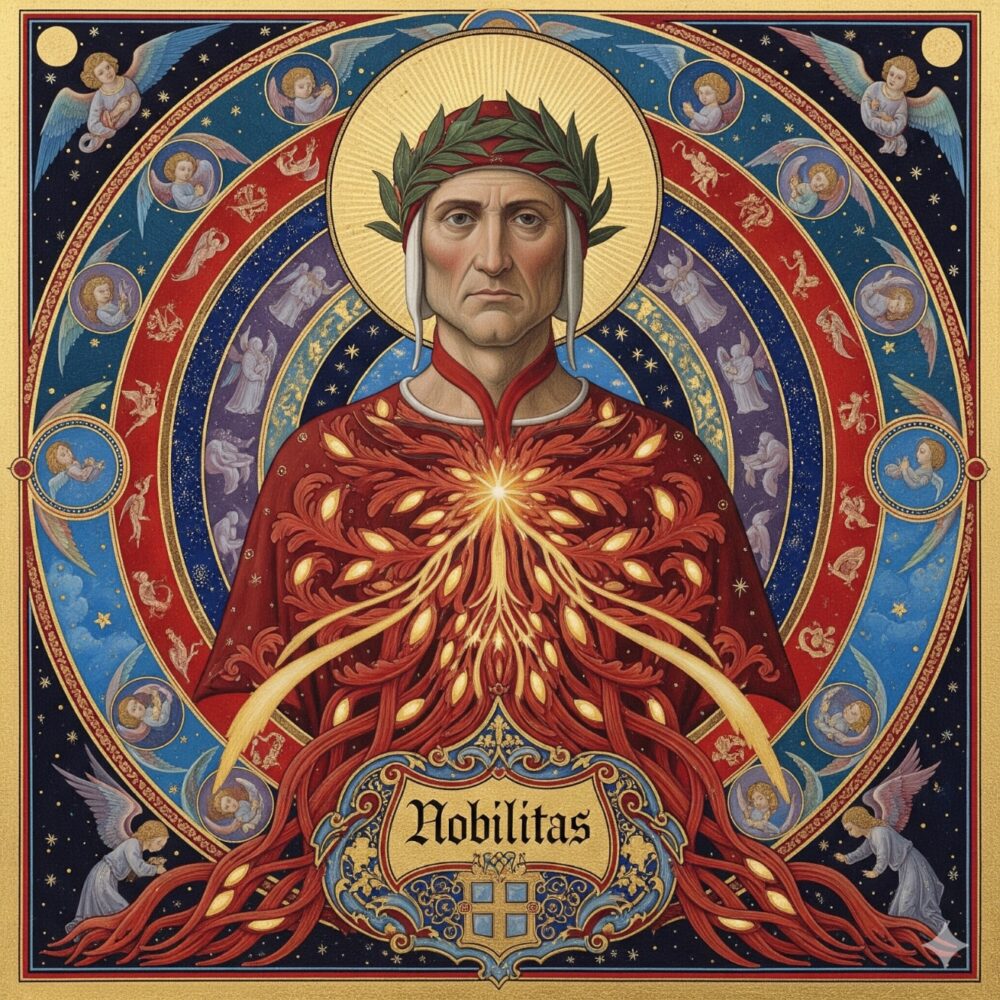
In Dante’s view – and here he again refers to Aristotle’s Politics – there is a natural, innate predisposition to rule that need not be limited to individuals, but can also apply to entire peoples. For him, the Roman people are destined by nature to rule over the whole of humanity.[…]
The central theme of the entire second book of the Monarchia is the question of whether the Roman Empire was or is legitimate as a dominion over the globe. However, Dante does not understand this to be human law, but divine law or natural law.[…]
The lineage, i.e. the bloodline, is ennobled. Against the background of the expanded concept of nobility, this is easy to understand, because the individual proves through his virtuous achievements that he was able to realize by divine intellect something that had previously been created and prepared by the virtus of the paternal seed. In this sense, the following also applies in the Monarchia: the Roman people as a whole – not automatically each individual member – is “nobilissimum” because its “father” Aeneas has ennobled the lineage. Now, the Trojan hero was certainly anxious to have a reproductive effect himself and to have his virtus – according to the physiological terminology outlined above – make impressions in the matter of women. The blood that had previously flowed into him from all parts of the world via his (pre-)paternal ancestors, he now exuded again (in the form of sperm as a derivative of blood) into the high women from all parts of the world: Creusa from Asia, Dido from Africa and Lavinia from Europe. With this “duplex concursus sanguinis”, the flowing in and out “in unum virum”, Dante performs precisely the reductio ad unum that he directs towards the world monarch throughout the treatise, now in the sign of blood. It has already been said that, in the Aristotelian-biological understanding, nature was regarded as the mover of conceiving matter by means of sperm. If Aeneas is the one who brings this movement into all parts of the world by means of his virtus, he functions as the proto-monarch, the “unicus motor”. Aeneas has extended his biological fatherhood to the globe through his partners, who together represent all parts of the world. He sowed his seed and with it the inherent formative power in the best possible way, namely on the sanguis menstruus of the women who conceived him, i.e. in the materia.[…]
In the Convivio, he had already proclaimed the Roman Empire as God’s chosen world dominion, because the sublime blood of the Trojans had been added to the people of the Latins (“l’alto sangue troiano era mischiato”), whereby the Roman people had acquired the best natural disposition to rule (“quello popolo che a ciò più era disposto”). It is important that Dante does not imagine the later translatio imperii as a mere succession of office that had passed from the Romans to the Germans – and certainly did not require the appointment of the pope or the people – but as a biological descent.[…]
The idea of the royal qualities and potential inherent in the blood of a dynasty was not invented by Dante; it had already been advocated before and had been developed very prominently around 80 to 90 years earlier in the circle of the Hohenstaufen Emperor Frederick II. Virgil – the undisputed patron of the essential figures of thought in Dante’s Monarchia – played a decisive role in modeling the closed bloodline with his lineage narrative, which extends from Aeneas to his son Ascanius/Iulus, then on through Julius Caesar to Augustus, the ruler of peace and the world (Aen. I 260-296). Dante was well acquainted with the written testimonies of the historians at the court of Frederick II and his heirs; for him, the Hohenstaufen was one of those rulers whose external signs (the frutti or signa) could be used to deduce the causa, i.e. the nobility of the soul. And even if his son Manfred was an illegitimate descendant according to human law, according to the understanding of Dante’s nobilitas naturalis described above, as the biological offspring of the noble, who was himself virtuous, he is consistently and rightly regarded as “well-born”. The fundamental characteristic of wellbornness in the sense described here is descent from the seed of Roman ancestors […]. This applies not only, but primarily, to the Florentines, who put up fierce resistance to the emperor. According to Dante’s conviction, it is not the inhabitants of his native town who are responsible for this, who – like himself and his ancestor Cacciaguida – are descended from the Romans, but the descendants of the Etruscan Fiesole, to whom the exiled Florentine attests that wickedness is practically in their genetic make-up and who are the ringleaders. However, this fixation on blood is not limited to these contexts: In his letter to “all and each individual king of Italy, senators of the venerable city [Rome] as well as dukes, margraves, counts and peoples”, the poet also implores the “Lombard blood” (i.e. the Italians) to renounce barbarism and make room for the seed of the Trojans and Latins, if there should still be any of it in those he addresses. This is linked to submission to the Roman king, whom God had predestined as ruler, as can be seen from miraculous signs. This is also the message that Dante addressed directly to Henry VII in April 1311: He, the successor to Caesar and Augustus, was the rightful lord whom the whole world awaited. This claim is again underlined by quotations from the Aeneid, which are intended to testify that Caesar comes from the Trojan lineage via the Aeneas offspring Ascanius or Iulus, whereby the line is abruptly extended to Henry’s son John, the “old Ascanius”. […] It is true that numerous princely families in the late Middle Ages sought to locate their origins in Troy and that the descendants derived from the Trojans can thus in principle be regarded as a common European starting point for the plural noble families. However, the reference back to the Trojans, who had fled their homeland and become active as city founders in various parts of Europe, often seems to have been motivated less by integration intentions than by veritable efforts to differentiate and demarcate themselves. In the numerous and varied genealogical narratives of the Middle Ages, three main separate lines can be identified in this sense: the descent of the Romans from Aeneas, who had married into the Latin ruling house and subsequently taken over the government; a second line founded by Brutus, the great-grandson of Aeneas, who had fled from Latium and established a new rule in the British Isles; a third branch around a group that had split off from the train of Aeneas and whose members, such as Francion, the son of Hector and grandson of the Trojan king Priam, became the progenitors of the Franks/Francophones, among others, by founding cities in Pannonia and then in Germania and Gaul. According to this scheme, numerous European cities and dynasties traced their origins back to the Trojan emigrants, such as the Venetians and Paduans to Antenor, who, like Hector and Francion, also had no closer relationship to Aeneas. Such origin stories were also used by the German nobility, especially those who harbored ambitions for the office of Roman king. It was around the time of the writing of the Monarchia that the Habsburgs began to perceive themselves as a collateral line of the Roman Colonna, whose origins could be traced back to Julius Caesar, which in turn meant that the latter’s ancestor Aeneas could be regarded as the progenitor of the Habsburgs. And for the Luxembourgs, whose first imperial representative was Henry, who was supported by Dante, there are also historical accounts from the 14th century that claim a descendant of Aeneas and his descendant Julius Caesar. The noble families competing with the Roman kings and emperors, who regularly – albeit always in a different form – referred to the other ancestors mentioned, were able to relativize the actually universal claim to power of the head of the empire by claiming supposedly equal and equally legitimate lines of nobility, because Aeneas had only been one of several Trojan princes. The situation becomes even more complicated when one considers that the Capetians as a French royal dynasty and their collateral line of the Angevins, who ruled Naples and Sicily, claimed a completely different genealogy. On the occasion of the canonization of the French king Louis IX in 1297, the tendency to characterize the entire family as beata stirps, i.e. as a dynasty that carried on the tendency to lead a saintly life through blood relations, was reinforced. This self-stylization via the saint – the grandfather of King Philip IV of France and great-uncle of King Robert of Naples, after all, two of Henry VII’s most powerful rivals – had the potential to neutralize, if not devalue, any reference to Trojan and Roman, i.e. decidedly pagan, forefathers. Dante’s design is clearly positioned within these genealogical-propagandistic constellations, and this also answers the question posed at the beginning about the physique of the world monarch: The monarcha necessarily comes from the lineage of Aeneas, because the virtus transmitted through his bloodline carries on the natural disposition to rule over the other peoples, as described in detail above. Anyone who cannot present himself as an Aeneid does not have the best natural disposition to hold the power of government over the entire globe. […] No Capetian or Angevin or any other house not descended from Aeneas can legitimately claim to govern Italy, let alone the world, on the basis of the family tree reconstructions cultivated up to that point, but these families are by nature destined to serve the descendants of Julius Caesar’s progenitor. This attitude is reinforced by Dante’s devaluation of Hugo Capet, when he describes the ancestor of the French royal house as the son of a butcher and, in the biologistic language that has already come to light more frequently, as the “root” (“radice”) of the “bad plant” (“mala pianta”), i.e. his descendants, but does not mention St. Louis anywhere. […]Through his fictions outlined above, which are not infrequently used, Dante creates the basis for Aeneas to be, in principle, the progenitor of a great plurality of different rulers; in this scheme, it would even be conceivable for an Asian or African prince to rise to the position of world monarch in the future, provided he can make his descent from Aeneas’ lineage credible.This could also be the reason why the argumentation of the Monarchia does not wish to associate itself with any contemporary rulers by naming them. By omitting this commitment to this or that particular noble family, which has just seen one of its offspring rise to emperor, Dante creates openness for other princes to also be considered world monarchs. However, the prerequisite is always that the pretender invokes the ruling blood of the Aeneids, as only this naturally entitles them to world domination and is thus legitimized by God. With sufficient literary creative will, it would even be conceivable that a Capetian, whose royal representatives in Dante’s time had repeatedly and justifiably hoped to assume the imperial kingship, would proclaim the natural descent of Aeneas and thus, in the event of his election by the electors, which was entirely possible, his legitimate, God- and nature-ordained world domination in the Dantean sense.
Christian Kaiser in Natur und Herrschaft: Analysen zur Physik der Macht
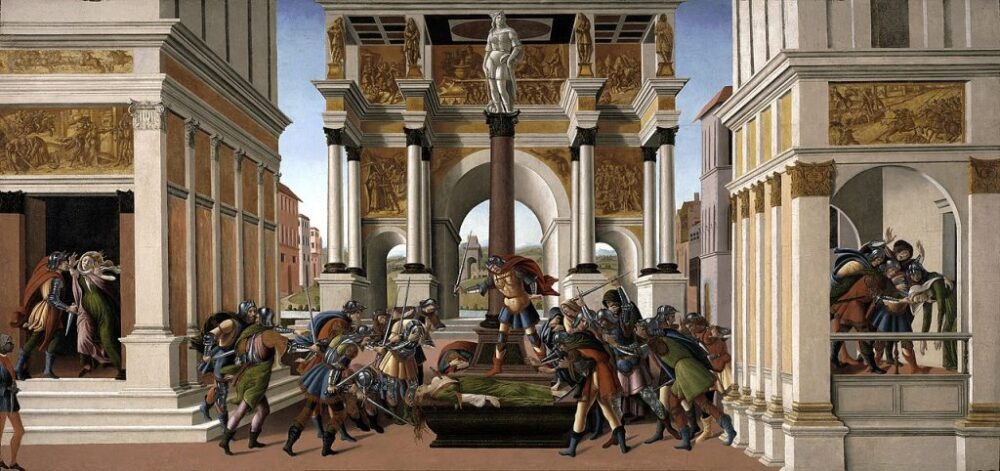
Our image of ‘kingship’ in Rome is shaped by a more or less uniform version of the beginnings of the city and the history of the res publica, which can be found in Cicero, Livy, Tacitus and Florus: After its foundation by Romulus and the reign of a total of six ‘good’ kings, the monarchy turned into a tyranny under Tarquinius Superbus. The tragedy surrounding Lucretia, who was ravished by the king’s son Sextus Tarquinius, was the trigger for the oppressed Romans to defend themselves against escalating violence and arbitrary rule and, under Brutusʼ leadership, expelled all members of the gens Tarquinia from the city. Afterwards, the citizens of the now free polity, traumatized by the previous despotism, swore an oath never to tolerate a king in their city again. This odium regni, sworn for all eternity, was to prove to be a constitutive characteristic of the newly founded res publica, whose internal and external policies were determined by the Romans’ collective hostility to everything associated with kingship and royal rule: “[T]he last Tarquin had given the name of king an evil ring to Roman ears for all time; rex and regnum were opprobrious terms”. This collective national Roman trauma triggered by Tarquinius Superbus was fueled in the 3rd and 2nd centuries BC by military conflicts with hostile kings of the East (Philip V, Antiochus III, Perseus), came to a head from the Gracchi onwards through the polemical use of the term ‘rex’ as a political invective in domestic power struggles and led to the assassination of C. Julius Caesar on March 15, 44 BC, who allegedly wanted to become king of Rome after his victory over Pompey. Octavian, who also emerged from the turmoil of a civil war as sole ruler a few years later, learned from the fate of his adoptive father and attempted to conceal the monarchical character of his reign by referring to himself not as rex but as princeps in consideration of the odium regni. However, this common image of the Romans’ hatred of kings contrasts with numerous positive uses of the terms ‘rex’ and ‘regnum’ in Roman literature as well as references to kings and kingship in political culture. This ambivalence, which had already been pointed out by Republican authors of the 1st century BC, has been demonstrated in research on individual phenomena: for example, attention has been drawn to the fact that the six ancient Roman kings before Tarquinius Superbus were always honored for their services to the genesis of Rome. The literature painted an extremely positive picture of foreign rulers (such as Cyrus or Hieron II) and even bitter enemies (for example Pyrrhus) and held them up as exemplary models. The terms ‘rex’ and ‘regnum’ were not only used to refer to the person(s) sitting in front of the drinking party, but a patron was also reverentially addressed as ‘king’ by his clients – like the parasite’s brother in ancient Latin comedies – without this form of address being offensive. The traditional divine apparatus of the Romans, headed by rex Iuppiter, also seems to contradict the theory of the odium regni, but like the positively connoted reminiscences of kingship in the sacred sphere (rex nemorensis, rex sacrorum, regia), it should be excluded insofar as old concepts (here: from the royal era) often persist unchanged in cult traditions despite changed circumstances (here: in Republican Rome). Furthermore, the Romans cooperated with reges socii and often (again) appointed ‘vassal kings’ to represent the interests of the Roman people in conquered territories. What is particularly remarkable, however, is that Roman senators were very close to Hellenic kings in many respects. Even Caesar’s assassination in 44 BC, the highest expression and culmination of the Romans’ rejection of the ‘monarchy’ form of government, did not detract from the many positive ways in which it was used. For example, the ‘Augustan’ poets only used terms from the word family ‘reg-‘ in a pejorative sense in the rarest of cases, and the attitude of the Romans towards the subject of ‘kingship’ was evidently far more differentiated than the image of blanket hatred of kingship would suggest.
From Königtum’ in der politischen Kultur des spätrepublikanischen Rom Christian Sigmund, De Gruyter 2014