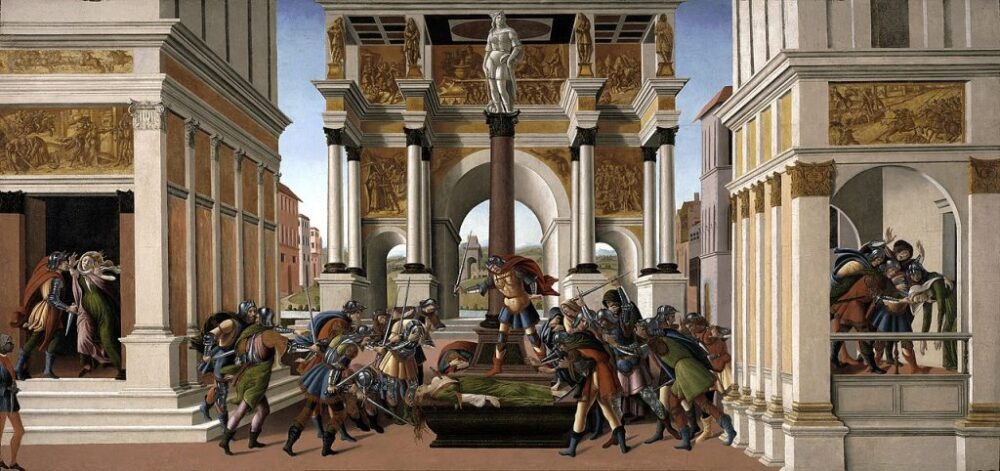
Our image of ‘kingship’ in Rome is shaped by a more or less uniform version of the beginnings of the city and the history of the res publica, which can be found in Cicero, Livy, Tacitus and Florus: After its foundation by Romulus and the reign of a total of six ‘good’ kings, the monarchy turned into a tyranny under Tarquinius Superbus. The tragedy surrounding Lucretia, who was ravished by the king’s son Sextus Tarquinius, was the trigger for the oppressed Romans to defend themselves against escalating violence and arbitrary rule and, under Brutusʼ leadership, expelled all members of the gens Tarquinia from the city. Afterwards, the citizens of the now free polity, traumatized by the previous despotism, swore an oath never to tolerate a king in their city again. This odium regni, sworn for all eternity, was to prove to be a constitutive characteristic of the newly founded res publica, whose internal and external policies were determined by the Romans’ collective hostility to everything associated with kingship and royal rule: “[T]he last Tarquin had given the name of king an evil ring to Roman ears for all time; rex and regnum were opprobrious terms”. This collective national Roman trauma triggered by Tarquinius Superbus was fueled in the 3rd and 2nd centuries BC by military conflicts with hostile kings of the East (Philip V, Antiochus III, Perseus), came to a head from the Gracchi onwards through the polemical use of the term ‘rex’ as a political invective in domestic power struggles and led to the assassination of C. Julius Caesar on March 15, 44 BC, who allegedly wanted to become king of Rome after his victory over Pompey. Octavian, who also emerged from the turmoil of a civil war as sole ruler a few years later, learned from the fate of his adoptive father and attempted to conceal the monarchical character of his reign by referring to himself not as rex but as princeps in consideration of the odium regni.
However, this common image of the Romans’ hatred of kings contrasts with numerous positive uses of the terms ‘rex’ and ‘regnum’ in Roman literature as well as references to kings and kingship in political culture. This ambivalence, which had already been pointed out by Republican authors of the 1st century BC, has been demonstrated in research on individual phenomena: for example, attention has been drawn to the fact that the six ancient Roman kings before Tarquinius Superbus were always honored for their services to the genesis of Rome. The literature painted an extremely positive picture of foreign rulers (such as Cyrus or Hieron II) and even bitter enemies (for example Pyrrhus) and held them up as exemplary models. The terms ‘rex’ and ‘regnum’ were not only used to refer to the person(s) sitting in front of the drinking party, but a patron was also reverentially addressed as ‘king’ by his clients – like the parasite’s brother in ancient Latin comedies – without this form of address being offensive. The traditional divine apparatus of the Romans, headed by rex Iuppiter, also seems to contradict the theory of the odium regni, but like the positively connoted reminiscences of kingship in the sacred sphere (rex nemorensis, rex sacrorum, regia), it should be excluded insofar as old concepts (here: from the royal era) often persist unchanged in cult traditions despite changed circumstances (here: in Republican Rome). Furthermore, the Romans cooperated with reges socii and often (again) appointed ‘vassal kings’ to represent the interests of the Roman people in conquered territories. What is particularly remarkable, however, is that Roman senators were very close to Hellenic kings in many respects. Even Caesar’s assassination in 44 BC, the highest expression and culmination of the Romans’ rejection of the ‘monarchy’ form of government, did not detract from the many positive ways in which it was used. For example, the ‘Augustan’ poets only used terms from the word family ‘reg-‘ in a pejorative sense in the rarest of cases, and the attitude of the Romans towards the subject of ‘kingship’ was evidently far more differentiated than the image of blanket hatred of kingship would suggest.
From Königtum’ in der politischen Kultur des spätrepublikanischen Rom
Christian Sigmund, De Gruyter 2014