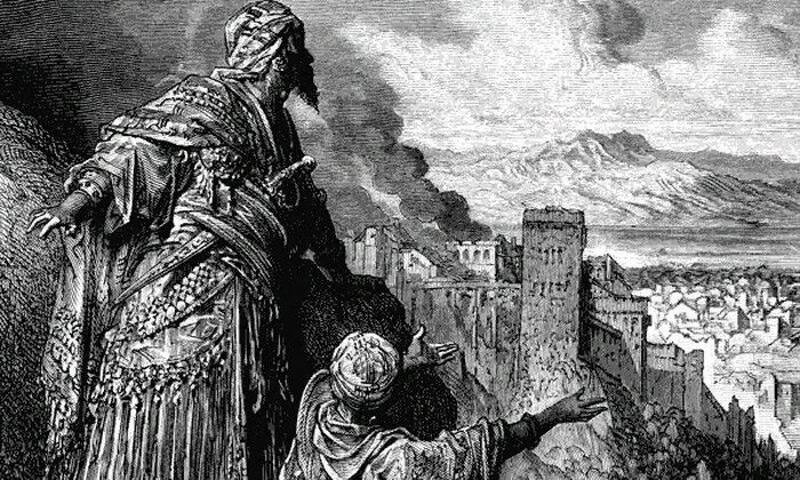
The Assassins were a special factor in the external relations of the Kingdom of Jerusalem in northern Syria. They were members of an ismāʿīlī Shiite sect known today as Nizārīya, which, under its Persian founder and leader Ḥasan-i Ṣabbāḥ, sought to spark a religious revolution in the Sunni ʿAbbāsid caliphate of Baghdad in the years 1078-1094 in the name of the Fāṭimid caliph al-Mustanṣir. After al-Mustanṣir, who had been revered as the only legitimate imam with a claim to spiritual and temporal supremacy over the entire Muslim world, died in 1094 and his rightful successor Nizār was deposed, they broke away from the new leadership in Cairo. In the following decades, the sect’s leaders constructed the legend that a grandson of the deceased imam, represented by them, was hiding in their headquarters, the fortress of Alamūt in north-east Persia, waiting for the appropriate time for his return.
Early on, the sect focussed on missionary work (daʿwa) in order to assert its own authority, which gave it a growing following, especially among the rural population, who lived scattered in numerous settlement areas between Persia and northern Syria. However, these converts, who were regarded as heretics, were usually met with rejection by the majority Sunni population, which was reflected at irregular intervals in the form of spontaneous pogroms, but sometimes also those organised by the respective ruling elite. As the sect had only a few regular armed forces, which were mainly deployed as garrisons of the fortresses, it was unable to defend itself against the persecution by conventional military means, which is why its leaders mostly sought to reach an understanding with the political and religious authorities of the Sunni-dominated ruling complexes. If this failed, however, they used targeted assassinations as a means of exerting pressure to strengthen their negotiating position. They trained elite fighters (fidāʾiyyūn) for this task, promising them eternal rewards in paradise, and smuggled them into the target’s environment as confidants. If these were high dignitaries such as the caliphs and viziers of Cairo or Baghdad, the assassins sometimes had to spend several years gaining their trust before they finally received the order to attack from the imam. The possibility of a surprise attack, combined with their religious determination and intensive training in the use of weapons, gave them a high success rate. This and the widespread effect that the sudden assassination of a publicly known leading figure usually had, caused fear of the sect to grow, which contributed significantly to ensuring its continued existence. The assassins were soon surrounded by an aura of invincibility and deadlyness, which became increasingly legendary over time. They were said to carry out their attacks under the influence of hashish (Arabic ḥašīš), especially in the later Latin-European reception, which was strongly influenced by Marco Polo’s travelogue (ca. 1254-1324), and their Arabic name was attributed to this in various variants of the word ḥašīšīya (singular ḥašīšī). This assumption prevailed in the Western world over the following centuries and is still sometimes found in popular culture today, but according to current research it is probably unfounded. In fact, the effect of hashish would have been extremely counterproductive for the execution of the attacks, as they required the utmost concentration, readiness to react and the ability to realistically assess the situation. The Arabic terms do not necessarily have to be attributed to the name of the drug either, but can also refer to a metaphorical term used in a derogatory sense as “rabble of the lower class” or “unbelieving outsiders of society”.
The missionary work in northern Syria, commissioned from Persia, had already begun at the turn of the 12th century and had fallen on fertile ground due to the social and political upheavals caused by the first crusades, the territorial fragmentation of the Muslim world into individual dominions and the resulting constant military conflicts. Nevertheless, despite intensive attempts, it was only in the years after 1132 that the sect succeeded in gaining permanent control over several fortresses and the area in between on the western Syrian mountain massif of Ǧabal Bahrāʾ (today also known as Ǧibāl al-Anṣārīya) north of the Lebanon Mountains, the headquarters of which was the castle of Maṣyāf on the south-eastern edge, conquered in 1141. With reference to this, the later Latin chroniclers in particular often referred to the leader of the sect as “Old Man of the Mountain” (Vetus de Montanis), while the early sources only wrote of senex or vetulus and thus literally translated the Arabic title of honour šaiḫ, which is still in use today. The exact extent of their territory and influence as well as the size of their followers can hardly be determined, but William of Tyre attributed ten fortresses and more than 60,000 believers to them in the 1180s in a quite realistic estimate. The growth of their settlement area took place in the immediate neighbourhood of the northern crusader states of Antioch and Tripoli and partly spilled over into them, but relations with the Franks initially remained friendly. Most recently, in 1148, Prince Raimund of Antioch (1136-1149) and the Assassin leader ʿAlī b. Wafāʾ had formed an alliance against Nūr ad-Dīn and died together in the Battle of Ināb in June of the following year. It was only when Count Raimund II of Tripoli transferred the border region around Tortosa to the Knights Templar in 1152 that violent border disputes apparently arose, as a result of which the sect had him and two of his companions murdered in the same year as the first known non-Muslims. This was followed by violent pogroms against the sect, similar to the Sunni-dominated societies of the Islamic ruling complexes, but after some time relations normalised again and the Assassins paid the order 2,000 Byzantines annually as compensation for controlling a territory claimed by the order. There is also little information from the following years about the relations between the crusader states and their Nizārītic neighbours, who, after the conquest of Damascus in 1154, were among the last Muslim actors independent of the Zengīds in the immediate vicinity. Although troops from all three crusader states besieged the ruins of Šaizar occupied by the sect at the end of 1157, the endeavour was as unsuccessful as it was inconsequential.
[…]
According to the chronicler’s account, which should of course be viewed with caution, the Master of the Assassins had made the [aforementioned] renunciation of the “false doctrine” of Islam on his own initiative after he had recognised Christianity as the only true religion by reading the Gospel and had decided to prepare the conversion of his followers to Christianity. In a next step, he sent a trusted follower named Abū ʿAbd Allāh (Boaldelle) as an envoy with a secret message to King Amalrich, whose main concern was the request to cancel the “tribute” of 2,000 gold pieces imposed by the Knights Templar for the settlement areas of the Assassins. In return, William continued, he offered to have himself and his followers baptised and converted to Christianity for good. The king was naturally delighted at the prospect of new Christian allies and immediately agreed to pay the annual payments to the Order of Knights from his own income. After extensive talks, he sent the messenger back north with his own envoy as personal escort to finalise the negotiations with Sinān. When the duo had already travelled beyond Tripoli and were about to cross into Assassin territory, they were suddenly ambushed by Templars from nearby Tortosa. They immediately attacked and killed the Assassin messenger regardless of his royal commission and escort. When the king became aware of this, outraged by the act, which he also considered a personal insult, he summoned the Haute Cour to discuss the necessary sanctions. It was agreed that this open sabotage of an imperial affair could not go unpunished, as it had violated the royal auctoritas, discredited the fides and constantia of Christianity and lost the growth of the Church, which had already seemed certain. Two envoys, Soherius of Memedeo and Gottschalk of Torhout, were now sent to the Master of the Order, Odo of St Amand in Sidon, to demand the extradition of the main culprit, allegedly a one-eyed knight named Walter of Maisnil (Mesnil). The master refused, citing the fact that the order was subject to papal jurisdiction alone, and informed the king that he had already fined the culprit and would send him to the papal curia for further judgement. King Amalrich then travelled to the city in person, had the wanted man forcibly removed from the Templar quarters and imprisoned in Tyre. He sent a new envoy to the Master of the Assassins to protest his regret and innocence, which was supposedly believed. However, no further progress was made either in the negotiations with the sect or in the proceedings against the Templars, against whom, according to the chronicler, he planned to take extensive action, as the king fell seriously ill shortly afterwards and died in July 1174.