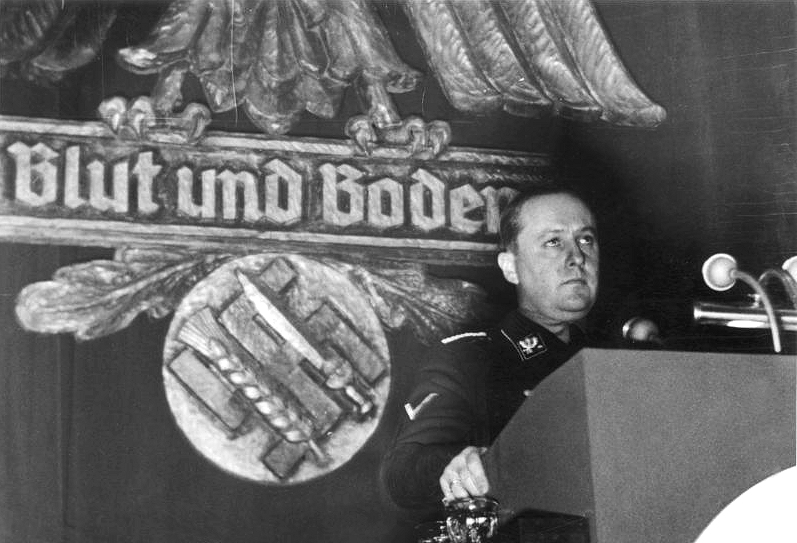
Friedrich v. Bülow demonstrated how aristocratic and National Socialist ideals could, with some effort, be presented as having the same essence in his speech at the Bülow Family Day in the summer of 1935. Bülow, retired senior president in Poznan, presided over one of the largest German family associations, at whose family days a growing group of young Nazi supporters had already attracted attention before 1933. The metaphorically charged presentation of alleged commonalities that the 66-year-old speaker offered his family circle here provides one of the most vivid proofs of the thesis that the aristocracy’s rapprochement with National Socialism must be written not least as the history of a misunderstanding:
Upon blood and soil the Führer is building his Reich. We have understood blood selection for seven centuries and have wisely chosen to build and continue our bloodstream on the basis of age-old race and culture. […] All the great ideals that the Führer has set for the German people stem from ancient Germanic heritage and not least from the deepest treasuries of the German nobility. Thus the German aristocracy is fundamentally akin to National Socialism in nature and origin. At the time of the red governments, the motto was: down with the aristocracy, we all want to be proletarians. Now it is the other way: the common man from the people should rise up, and we all want to meet again on the level of a true aristocracy. […] What the future will bring us, we leave in the hands of God and the enlightenment of the leader. But we know one thing. Our old lineage is not a foreign body in the Third Reich, rotting and decaying, it is a load-bearing block in the building, hardened over centuries. […] Sieg Heil! Sieg Heil! Sieg Heil!
[…]
As the most important heir to folk traditions and as a political force that was close to neo-aristocratic thinking in some respects, National Socialism had not abandoned the aristocracy either as an idea or as a concept. What remained were the concept and individual elements of aristocratic tradition, which could be bent and misused. “Nobility” remained an institution valued and needed by National Socialism – but only in the form of the mutations that Hitler, Günther, Darre, the SA and, above all, the SS leadership wanted and produced as “nobility”. Conversely, a large part of the nobility believed that they recognised a modern version of their own traditions in the guiding concepts and goals of the Nazi movement. As shown, the supposed closeness through the common talk of “blood” and “race” proved to be a fatal misinterpretation. In 1921, an Pan-German baron saw the EDDA project as
the deliberate continuation of the […] selective breeding […] that has always been practised by the nobility through the cultivation of pedigree and genealogy […]. The aristocracy’s attitude towards the idea of selection and race breeding is therefore not a new goal for the nobility, but actually a self-evident one.
The absurd perception of the Nazi movement as a contemporary continuation of the “best” aristocratic traditions was found everywhere in the aristocracy; its basis was the common use of key terms that were phonetically, but not semantically, identical. “We can only thank Adolf Hitler,” said an appeal in 1932, “if today the views corresponding to our best traditions have been reawakened in the widest circles of the people: Personality and race, habitation and down-to-earth mentality, warriordom and the will to fight for the honour and freedom of the nation.”
[…]
The Würzburg university lecturer Ernst Mayee defined the “conscious and associative unification of the nobility and the educated” as the most important goal; a union that the society’s conferences explicitly sought to promote. From the “political storms”, a “comprehensive new German nobility would emerge, in the oldest German sense nothing other than the lovingly leading elders of all the younger brothers in the entire German nation, conscious and yet supple, brave and finely educated, economically not depressed but also not opulent.” Regardless of all educational patents, however, German Jewry would have no place in the future “German upper class”. With a reference to the inbreeding of the French nobility, which led to decadence, and using the vampire metaphor typical of the time in nationalist jargon, the jurist recommended that the old nobility bring in “fresh blood from other classes” to supplement the “departures”. Here, too, there was a positive reference to the “elasticity” of the English gentry. Self-confidently emphasising his own abilities, the educated citizen Mayer called for the “relentless training” of the future upper class, from which all members who could not withstand the “sharp” educational selection were to be “mercilessly” expelled.
It was also DAB editor Walter v. Bogen who, a few months after this debate, naively and openly presented the concept of the new aristocracy, which was to prove indigestible for the entire old aristocracy and probably the most important conceptual challenge to aristocratic claims to leadership: Richard Walther Darre’s work “Neuadel aus Blut und Boden” (New Aristocracy of Blood and Soil), published in 1930. In his astonishingly positive review of the book, v. Bogen Darres praised the breeding fantasies of a newly created, racially pure and land-loving nobility as an endeavour that came very close to the aspirations of the aristocratic cooperative. In his reading of the book, v. Bogen had overlooked Darre’s extremely sharp criticism of the old aristocracy as well as the highlight of Darre’s concept, for Darre claimed nothing less than the necessity of replacing the old aristocracy with a new one. Although Darre also praised the old aristocracy as purveyors of certain ideals and individual leaders, Darres categorised the old aristocracy as a whole as useless, superfluous and in need of replacement as far as the necessary creation of a leadership of the future was concerned. The aristocracy’s dispute with Darres’ concept, which began a little later, must be discussed in more detail in connection with the differences between the aristocracy and the Nazi movement. Suffice it to say that Darre’s book had been a politically relevant concept for a new aristocracy since 1930, which had once again sharpened the völkisch-racist criticism of the aristocracy, as reflected in the Semi-Gotha, among other things, and transformed it into a detailed blueprint for an alternative aristocracy. In January 1933, the Adelsblatt reopened the debate on the new aristocracy with a völkisch article by the Pan-German baron Leopold v. Vietinghoff-Scheel. In the subsequent contributions to the discussion, however, only the familiar arguments were repeated. The concluding words of the editorial board once again laid down the line of the DAG – with the exception of members who were not “racially pure”, the entirety of the old nobility was to be retained as the crystallisation point of the future ruling class. Education, professional competence and material independence were thus once again rejected as indispensable criteria for membership of the “ruling class”. Ten days before the transfer of power, the DAB editorial board had found a formula that was at least compatible with Darres and other National Socialist elite concepts: “A nationalist state needs a ruling class that is racially pure, connected to the soil, rooted in its own ethnicity [… and] seeks the welfare of its people.”
The core content of the debates on the new nobility described in this chapter contained three different, often varied and differently weighted demands on the old nobility: education, property and (“pure”) blood. The first two terms referred to the actual and decisive weaknesses of the petty nobility, but were (or therefore) successively suppressed from the debate within the nobility. In contrast, the demand for racial purity adopted from the imaginative realms of völkisch thought came increasingly to the fore, further blocking a realistic assessment of the aristocracy’s chances of power in the modern age and soon proving to be an argumentative boomerang. Without going into the consequences of this development at this point, an example from 1924 will show that the idea of a “racial” improvement of the aristocracy as a substitute for an actual reform of the nobility was already being openly debated before the political breakthrough of the Nazi movement.
Six years before the horse breeding specialist Walther Darre published his fantasies of aristocratic breeding, the writer and castle owner Börries Frhr. v. Münchhausen, who was extremely prominent among the nobility and decorated with two doctorates, summarised the raison d’être of nobility in a simple formula: “If nobility is to have a meaning and value that goes beyond the external adornment of names, it can only be this: Human breeding.” Straightforward the writer compared the breeding work on the “well-built natural breed” of English thoroughbred horses with selecting a female partner as motivated by “breeding”. With the affirmative adoption of the “golden words” from Hans F. K. Günther’s “delicious” book and the guiding ideas of the Nordicist theory of race, the baron bid farewell to the centuries-old criteria of aristocratic principles of equality in cheerfully formulated sentences: “There is only one equality at all, and that is that of pure Nordic blood. The mixed-blood nobleman, for example, is not racially equal to a pure-blood Nordic peasant daughter. If nobility is to regain a racial sense, then the education of Nordic racial purity is assigned to it as its first task.” In future, young people would have to “recognise without immediatly: This is a Mongolian nose, that a Nordic figure, that an Eastern soft mouth. Only in this way can we understand and fulfil Nietzsche’s command: You should propagate yourself not only onward but upward. Non-“purebred” aristocrats, he demanded, should relinquish their aristocratic titles, as marriages between Jews and “Aryans” always produced “bastards”. The linguistic climax of the contribution, which also marked an intellectual low point in the aristocratic debates, stated:
I can breed pugs, and I can breed dachshunds, but if the malör (sic) happens to me and I get a basket full of young dachshund pugs, they will be drowned with good reason. This is neither anti-pug nor anti-dachshund, but a realization of the centuries-old experience that all bastards are inferior.
The baron made a clear statement regarding the criteria according to which a ruling class was to be built up: the “pure-bloodedness of the nobility [is] to be regarded as the most important question of each individual and of the entire estate, but beyond that: of our entire people.”