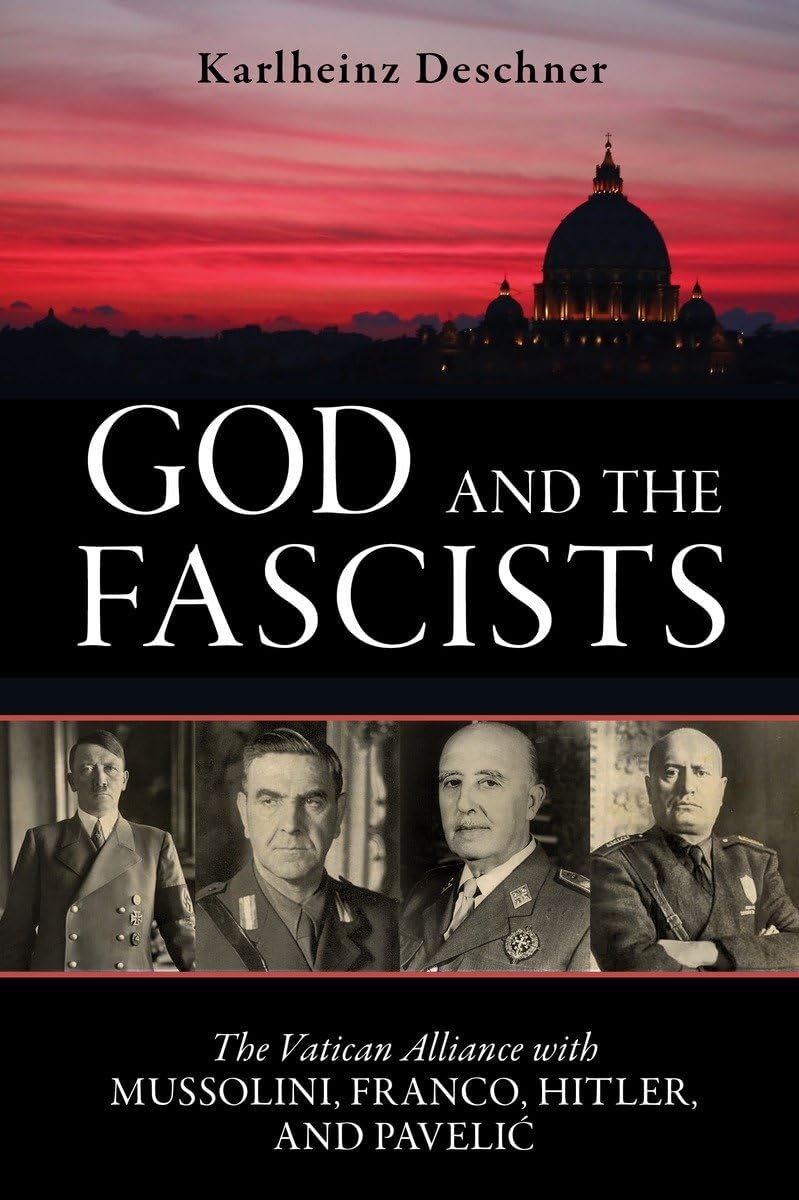
But slander from a church that not only persecuted and massacred millions in the Middle Ages but “repeatedly” and “most insistently” supported probably the greatest criminal of all time in the twentieth century; which in 1933 “would not withdraw the powers of the Church from him at any price,” but on the contrary, wanted to procure everyone for his “great development work,” which in 1935 “strictly [rejected] any action or position taken against the state by its members” and also promised “to support the ruler of the German Reich … with all means necessary” in 1936, which, one year before the war broke out, accompanied Hitler’s “work for the future with their highest blessings.” And, when the war started, the church ordered the Catholic soldiers “to do their duty out of obedience to the Führer and be prepared to sacrifice their entire person,” which followed his invasion of the Soviet Union in 1941 “with satisfaction” and affirmed: “We have repeatedly[!], and in the summer pastoral letter, called upon our believers to fulfill their duty with loyalty, to stand firm courageously, work in willingness to sacrifice and fight with all their might[!] in the service of our people in the most serious times of war,” only to condemn Hitler and the Nazis as soon as they collapsed. Well, I consider slander by a church like this an honor.
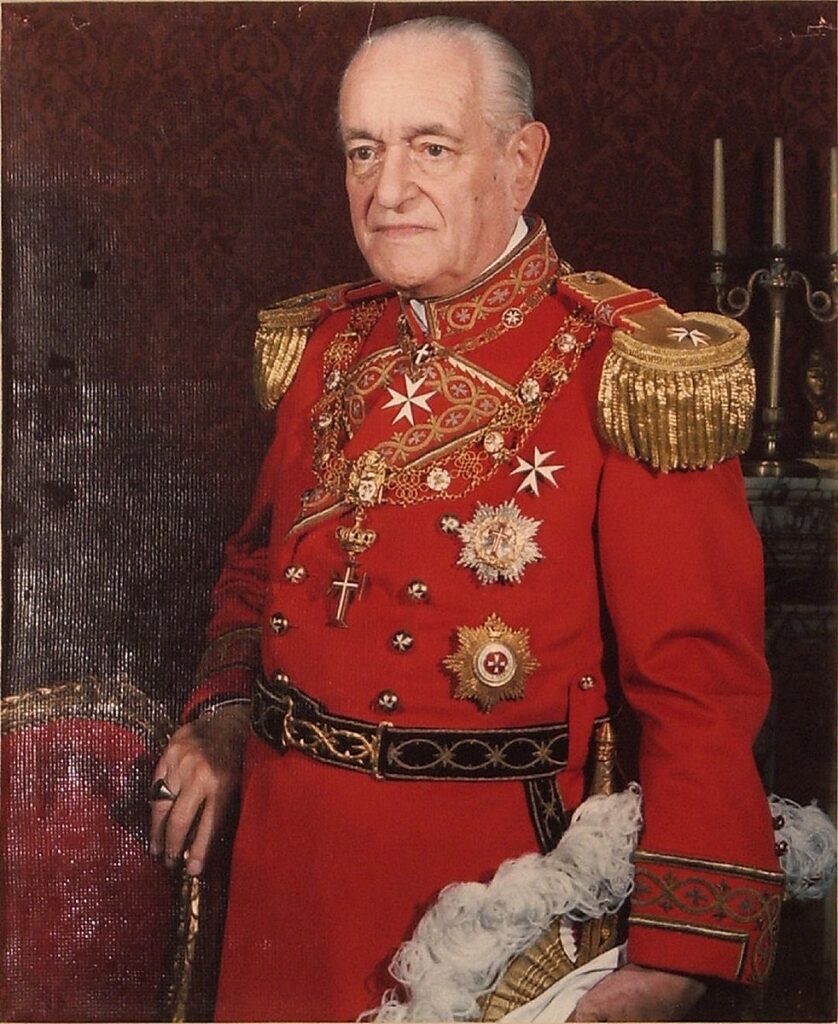
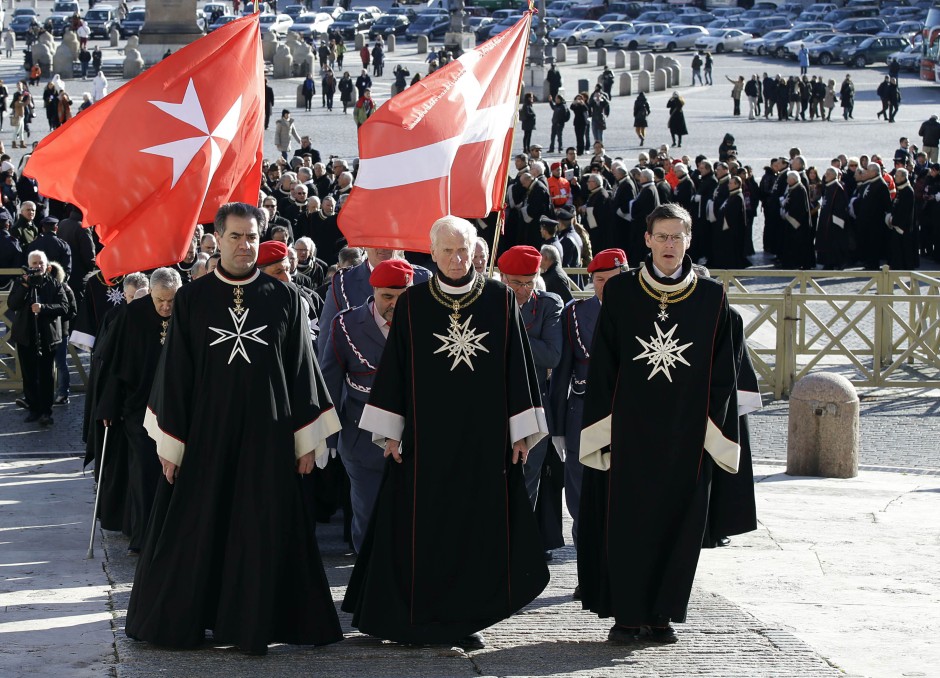
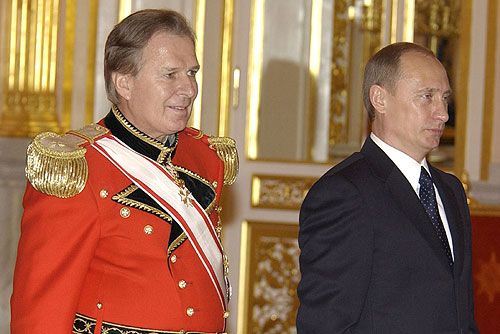
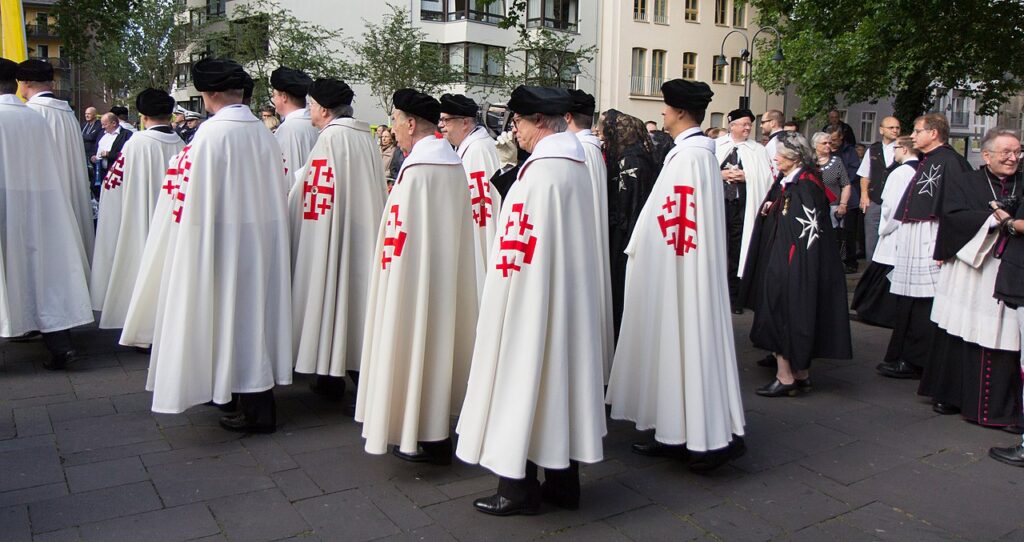
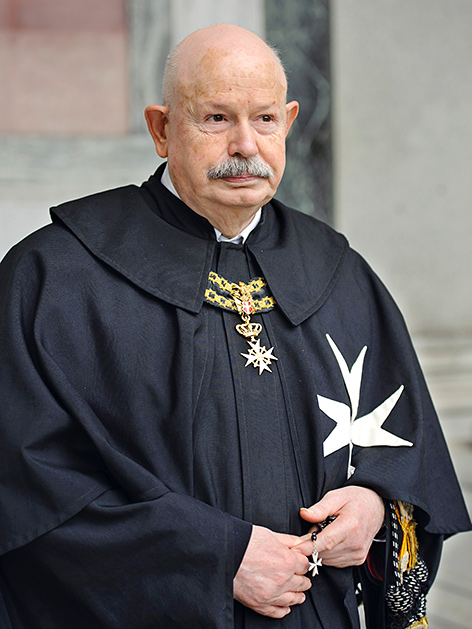
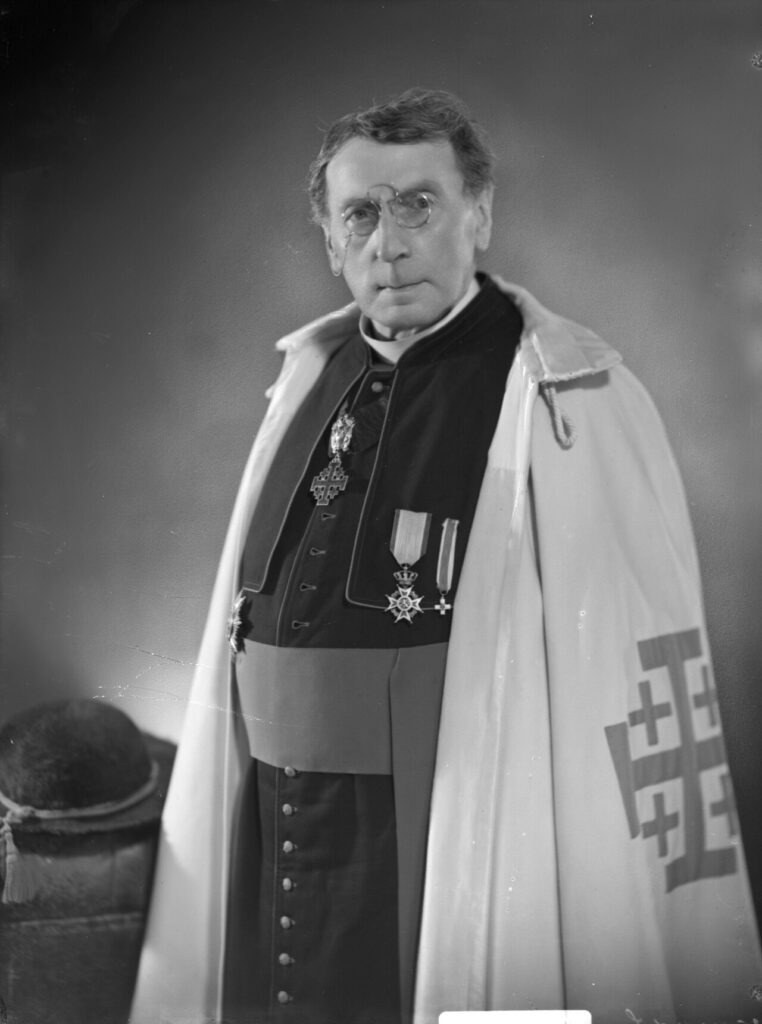
His Eminence and Highness, the Prince and 77th Grand Master of the Order, Fra’ Angelo de Mojana di Cologna, to whom this study is submitted with respect and devotion, was the kind patron of this work. The author owes his respectful thanks to His Most Excellent Obedience Grand Cross Bailli Quintin Jermy Gwyn, the Grand Chancellor of the Order, and to His Serene Highness, the Prince Grand Prior of the Grand Priory of Austria, Bailli Fra’ Friedrich A. Kinsky von Wchnitiz und Tettau, for their pioneering and supportive discussions on the structure and law, spirituality, and the spiritual-childared self-image of the research object in a technologically changing world. His Most Excellent Ambassador Count Robert de Billy and the immortalized Minister-Conseiller at the Order’s Embassy to the Republic of Austria, Dr. Leopold Hayden, whom the author had the privilege of assisting in diplomatic service, conveyed to him, during countless encounters, the unmistakable nobility-Melitsian spirit and familiarized him with the old and new imperatives of the eight-pointed Maltese Cross in our time.
Fra’ Angelo de Mojana di Cologna
The Director of the Vienna Diplomatic Academy, His Excellency Ambassador Baron Dr. Arthur Breycha-Vauthier de Baillamont, a member of the Magistral Commission for Foreign Affairs and Social Assistance of the Order, has, in a spirit of personal friendship, graciously and helpfully made his extensive private archives and his many years of experience of life in the Order of Malta available to the author. He also personally took the trouble to validate and correct the manuscript of this work, for which he is expressed his sincere gratitude. The author owes sincere and lifelong gratitude to his esteemed teachers, Prelate Emeritus Professor Dr. h. c. mult. Dr. Johannes Messner and the Nestor of International Law, Emeritus Professor Dr. h. c. mult. Dr. Alfred Verdross, from whom he was able to experience and receive insights into and inspiration for understanding the “bonum commune humanitatis” from a natural law and Christian perspective. The author remains equally sincerely grateful to the directors of the Institute for International Law and International Relations at the University of Vienna: Prof. Dr. Karl Zemanek and former Ambassador Prof. Dr. Stefan Verosta shared their knowledge of international law with him and accepted this study as a contribution to academic research.
Retired Senator Dr. Johannes Broermann, the owner of the publishing house Duncker & Humblot, and the Austrian Federal Minister of Science and Research, Dr. Hertha Firnberg, have made the publication of this study possible with their understanding and openness. In accordance with the spiritual intentions of the “Sovereign Order of Malta” as a subject of international law, this academic work is placed under the auspices of Saint John the Baptist, who gave this religious, noble, and socially hospital, worldwide community its original and still primarily binding name.
Now the question arises: does the noble character of the Order and its knights today “only” consist of the oft-cited “noble disposition,” or does the Order partially adhere to a blood nobility?
Both, as well as. For admission to the 1st and 2nd classes of the Order, certain nobility tests are required, which will not be described in detail in this work. However, some branches of the third class bear a special characteristic that corresponds to Melitian internal law: their members are “cavalieri die grazia magistrale,” that is, knights “by the grace of the Grand Master,” in the internal sense of personal “Melitian nobility” within the Order, without, however, receiving predicates, heraldic rights, or inheritance rights linked to this.
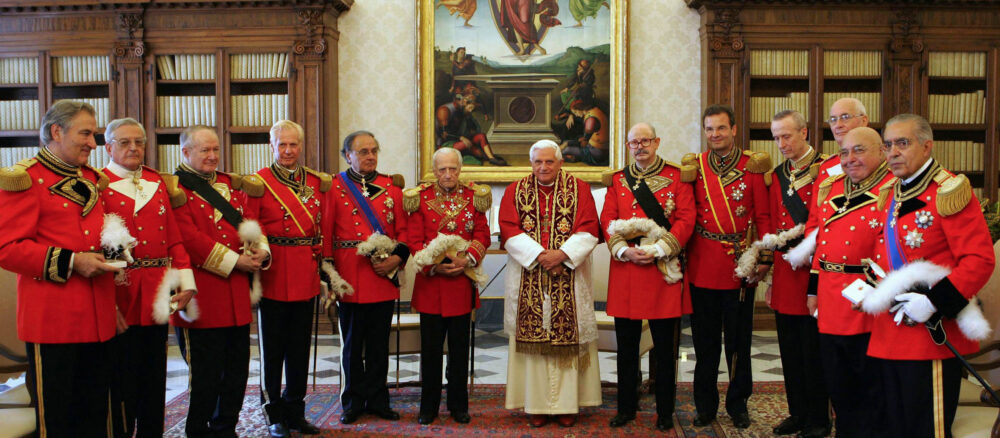
Without a doubt, the Order benefits from its “religious dependence” on the Holy See, as the latter accredits it on the basis of its international prestige and a priori relieves it of any suspicion of religious separation, social isolation, even schism and the existence of a religious sect. The Holy See grants the Order a spiritual credential by connecting it directly to the lifestream of the universal Catholic Church, keeping it bound, and feeding its religious channels. It is therefore only natural that, even in the secular-diplomatic sphere, the missions of the Holy See and the Order—namely, nunciatures and embassies, internuntiatures and legations, apostolic delegations, and Melitensian delegations—cooperate in the best possible way. For the Order of Malta is more “ecclesiastical” than any other subject of international law besides the Catholic Church, or rather the Holy See. R. A. Graham considers the Order of Malta to be one of those states (including those subjects of international law that are not states) in which there is no “separation of church and state”.
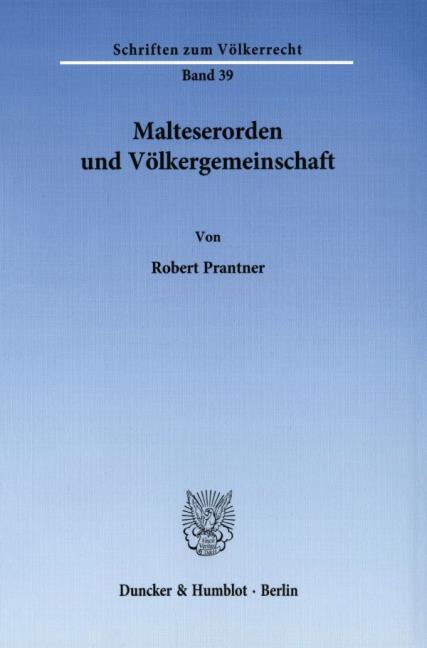
From Malteserorden und Völkergemeinschaft (Robert Prantner, 1974)
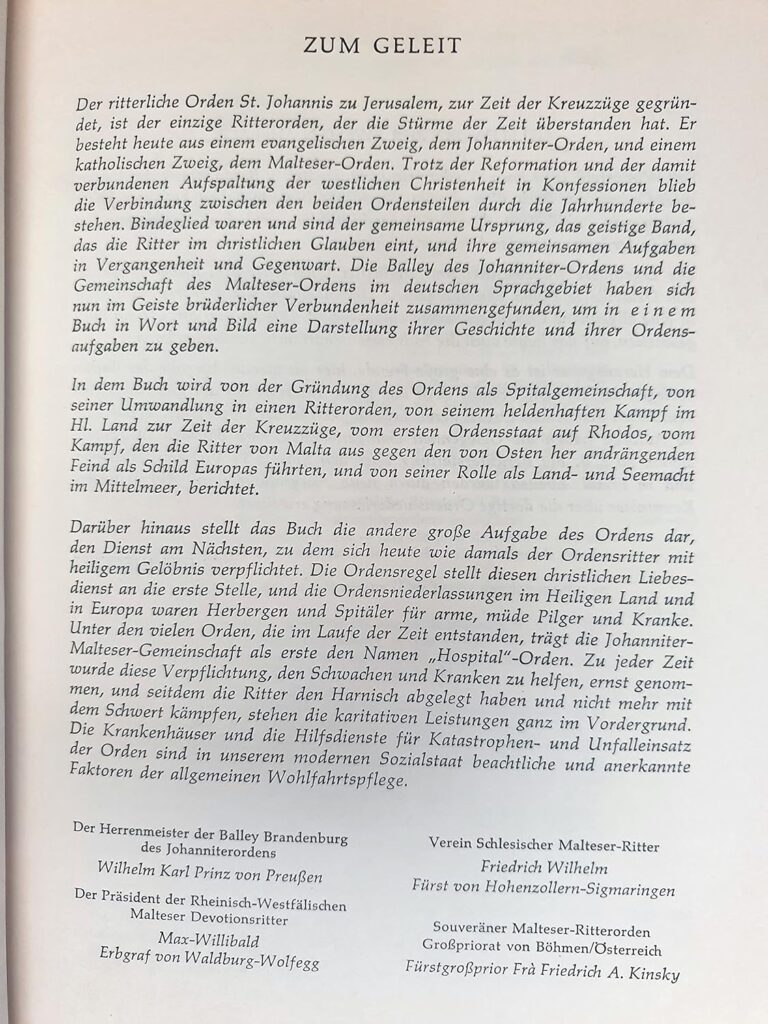
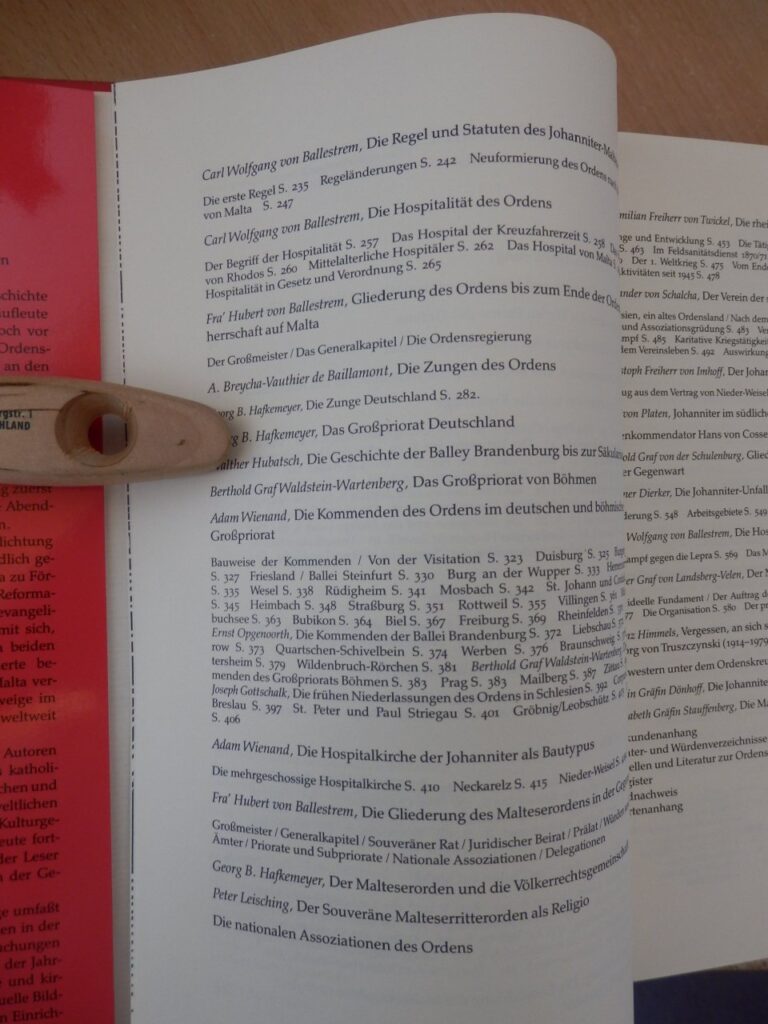
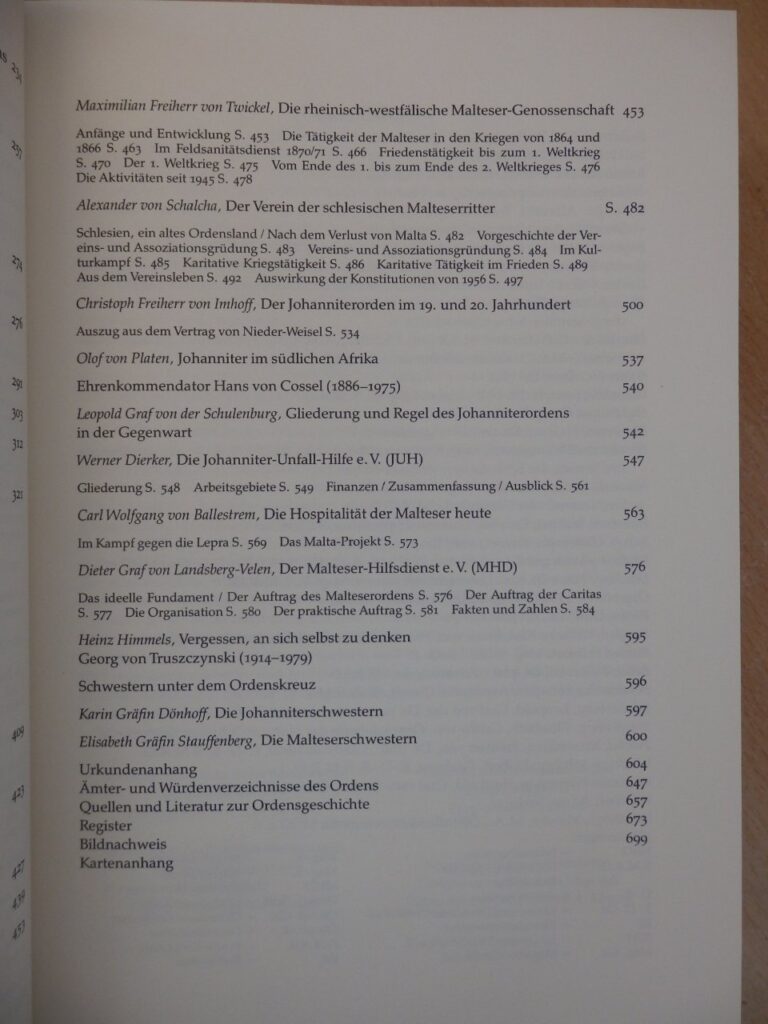
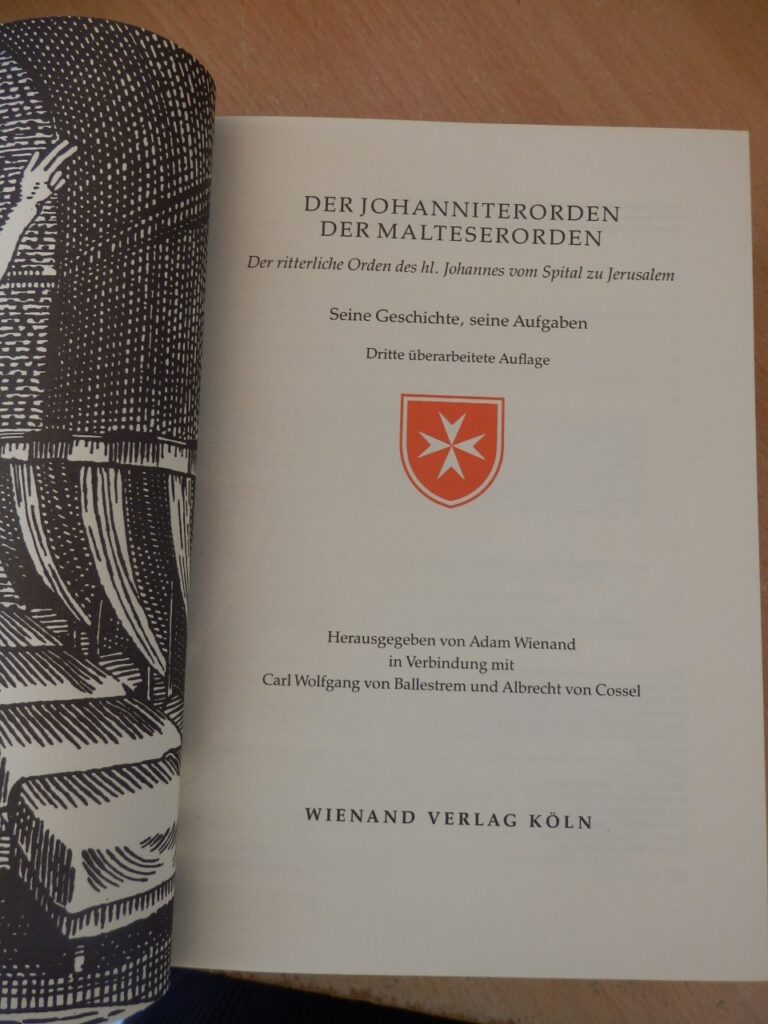
The work continuously cites for sources a book authored by the Order themselves at a publisher specialized on arts and museums. Numerous aristocratic members of the order are the authors of the chapters and they are cited individually by Prantner as if to appear like they are independent sources.
Robert Prantner later received the Papal Pontifical Equestrian Order of St. Gregory the Great.
Since the 1830s, the Order received offers to take on hospital duties and suggestions of the opportunity for increased charitable work, particularly from members of the Austrian Arch-House. However, the high regard for knightly-military splendor and prestige held by the Order’s leadership meant that this opportunity was either not seized or was seized too late. Indeed, the Knights of the Order, especially those who had served in Malta, did not like to see themselves working in a second-rate hospital in Modena or auditing the accounts of a medical institute. They much preferred to provide service befitting their status, but of only limited use, to the noble guard of the respective duchy or to the papal court. Therefore, another organization filled the gap in the market for military medical services. In 1863, the Swiss Henry Dunant (1828-1920) founded the International Committee of Relief Societies for the Care of the Wounded, whose symbol, the Red Cross, soon monopolized systematic military nursing. By remaining committed to the principle of social inequality and its often inherited aristocratic traditions with its discriminatory admission regulations, the Order of Malta missed a significant opportunity.
Until 1914, a Knight of the Order had an almost 50 percent chance of becoming a Commander and benefiting from the revenues of a commandery, which further improved their standard of living. Individual noble families successfully managed to retain the succession to the administration of the lucrative commanderies through multiple representation in the legal ranks and thus in the provincial chapter.
The motivations for membership as a Knight of Honor or Dame of Honor were broader. In the religious sphere, the Order created the opportunity for Catholic noblemen to fulfill their religious duties in an environment befitting their status. Political motivations for membership are also evident. Since traditional elites and the Catholic Church were preferred targets of liberal and socialist criticism throughout Europe, the Order of Malta served the clergy and the nobility as a transnational platform for demonstrating shared values. At the national level, honorary membership was also an expression of political commitment. For a long time, in the Grand Priory of Rome, it represented a special bond with the Pope and a relative distance from the Savoy royal house. This honorary membership in the Rhenish-Westphalian Order of Malta, which had a strong ultramontane orientation, indicated a political position just as clearly as that of parts of the former Polish nobility, who expressed anti-Prussian, anti-Russian, or anti-Austrian tendencies by belonging to a particular Grand Priory.
Until the last third of the 19th century, however, one could hardly speak of serious charitable work. The Order offered a befitting framework for charitable work, especially for women. The Knights of the Right, as the core group of the community, were little involved in the active hospitality of the Order. Active service to fellow human beings in need was partly left to institutions outside the Order. However, individual Knights of Honor gladly assumed the organizational and responsible leadership of charitable missions. Caritas thus served to provide the order with a contemporary justification for its existence in the public eye. In this way, the charitable activity fulfilled a task of central political importance for the order.
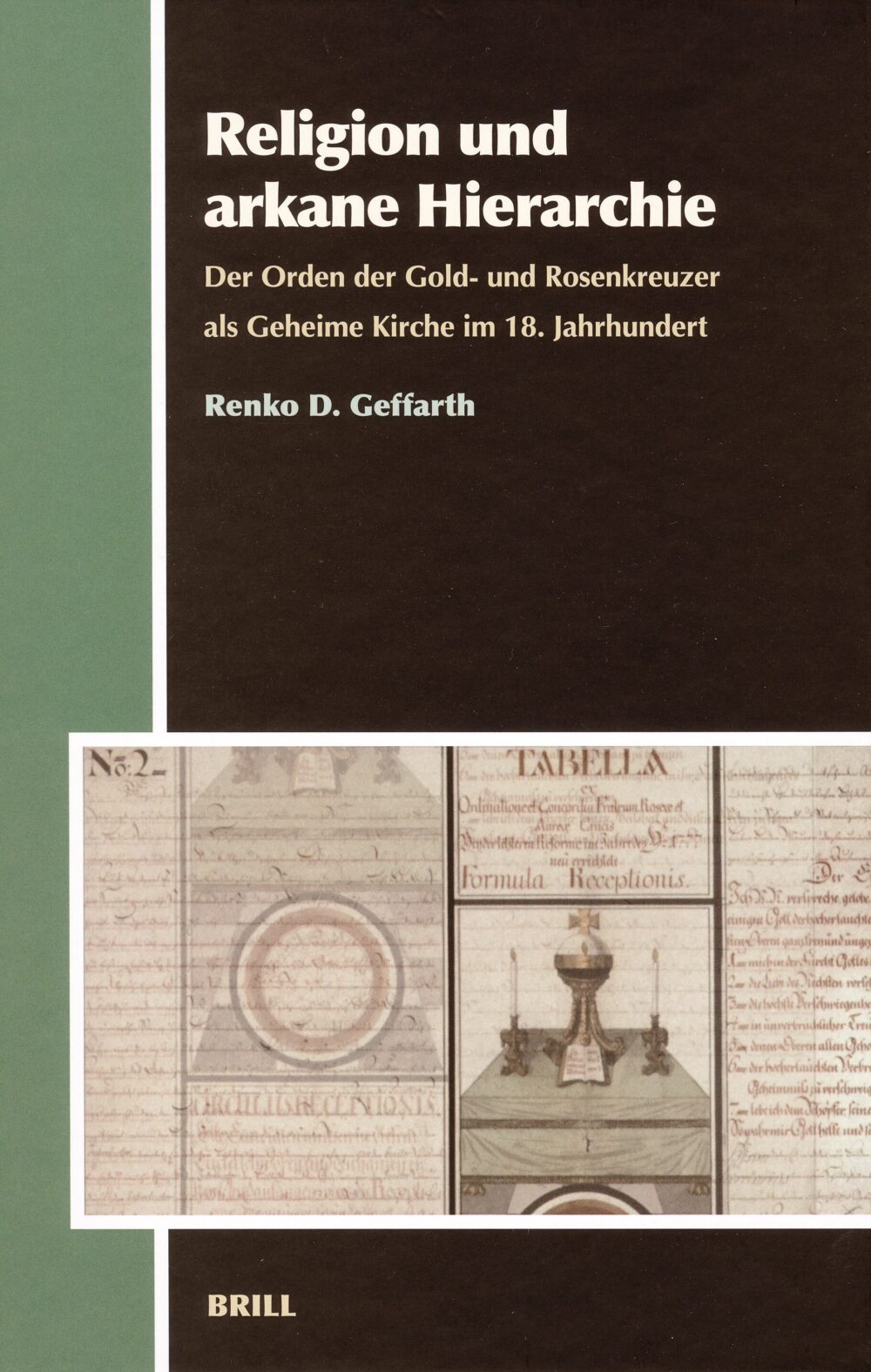
The order of the Gold- and Rosicrucians as a secret church in the 18th century
Renko D. Geffarth
Western esotericism began in the Italian Renaissance in the second half of the 15th century with the rediscovery of ancient writings, such as the late antique Corpus Hermeticum, whose originator was the mythical priestly figure of Hermes Trismegistos, and its translation into Latin by the philosopher Marsilio Ficino. […]
The reception of the Kabbalah, Platonism and Hermeticism in the German-speaking world ultimately gave rise to the early modern concept of magic of Heinrich Cornelius Agrippa von Nettesheim and subsequently, with the integration of alchemy, the Paracelsian natural philosophy, the theosophy of Jakob Böhme and the panosophy of the Rosicrucian writings of the 17th century. All of this was always in interplay and conflict with Christianity and its denominations, which also persecuted such heterodox currents as heresy.[…]
Schlögl also emphasizes the enlightened character of the esoteric secret societies, as they represented an “alternative to the salvation economy of the Christian churches” with their efforts to redeem ‘creation’ in this world and therefore accommodated the “self-confidence of people at the end of the 18th century”.[…]
In an overview essay on the Illuminati Order and the Gold and Rosicrucians in 1993, the Munich historian and professor Ludwig Hammermayer once again emphasized the contrast between the ‘radical Enlightenment’ Illuminati and the ‘theocratic’ Rosicrucians.[…]
Obviously challenging areas of social and cultural reform were the confessional and associated political tensions in the empire in the 16th century, the role of religion in culture and society and, last but not least, the perceived lack of understanding of ‘science’. With the help of the secret brotherhood of the Rosicrucians, these three core issues were now to be subjected to a renewal that followed a uniform ‘world view’. The Rosicrucian manifestos and the discourse that took place in the years following their first publication were thus not only the mediators of an early modern esoteric tradition that drew on the physician and hermeticist Theophrastus Bombastus von Hohenheim, known as Paracelsus (1493- 1541), and the hermeticism of the Renaissance, but also an expression of the perception of the crisis nature of the early 17th century.[…]
These first years after the publication of the Manifestos are considered the period of the ‘older’ Rosicrucians, followed by a ‘middle’ period resulting from the translation of the writings into other European languages and their reception in other countries, especially in England; the beginning of this second period is generally placed around the middle of the 17th century and its duration is extended into the early 18th century.For the ‘middle Rosicrucians’, there is initial speculation about actually existing brotherhoods or even just circles of people who considered or described themselves as Rosicrucians; for example, Gottfried Wilhelm Leibniz is said to have been a member of a circle of alchemists and Rosicrucians. However, it is still true for this phase of ‘Rosicrucianism’ that a real society, an order comparable to that of the late 18th century, very probably did not exist.[…]
The history of the development of Freemasonry presented in the following section does, however, show influences from the reception of Rosicrucian writings in 17th century England, which were passed on via Elias Ashmole (1617-1692), a member of the Royal Society founded in 1660 and one of the early Freemasons. The chronological order chosen in this study, ‘Older Rosicrucians’ – Freemasons – Gold and Rosicrucians, is therefore based on the well-founded assumption that there was a connection in terms of content between the Rosicrucian manifestos and early Freemasonry, just as there was a structural connection between 18th century Freemasonry and the Order of the Gold and Rosicrucians.[…]
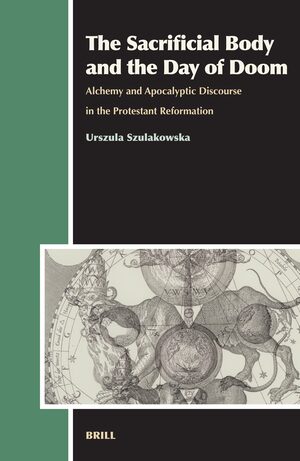
Alchemy and Apocalyptic Discourse in the Protestant Reformation
Urszula Szulakowska
It was Luther who first identified the Papacy with Antichrist and, on this basis, Lutheran artists had crowned the head of the Whore of Babylon with the papal tiara, as in the Wittenberg Bible of 1522 “(Revelation 17: 1–7). Furthermore, they equated the Pope with the Beast from the Bottomless Pit (Revelation 11: 7). The standard apocalyptic repertoire was created in Luther’s immediate social circle by Lucas Cranach in his woodcuts for the Passional Christi und Antichristi (1521) and for Luther’s Septembertestament (1522). Despite the international and historical prestige of Dürer’s apocalyptic engravings (1498), which were copied in the Wittenberg Bible (1522), later Protestant iconographydid not develop on his model, but on that of Cranach.[…]
Martyrdom was believed to resource the Church with the spiritual wealth of divine grace, the foundation for its future development on earth.[…]
According to this doctrine, the flesh was the ground of human salvation, its torment a necessity, whether in life as a martyr for Christ, or after death in the state of purgation.[…]
In medieval doctrine it was the Church alone that could authorise the survival of the subject (that is, the body) by ensuring that the soul and its temporary somatic body went either to Purgatory, or (infrequently) directly to heaven through the grace of the Church’s sacraments.[…]
Some Paracelsian alchemists, especially Heinrich Khunrath (ca. 1560–1605) and Stefan Michelspacher (active ca. 1615–23), were objects of persecution on the part of both Lutheran and Catholic authorities. Khunrath was an alchemist from Saxony, the heartland of the Reformation, but his theological stance was characteristic of the second generation of Protestants who felt that Luther’s work had been left incomplete and that another religious reform was essential.[…]
Dissenters from the established Protestant Churches were important precursors of a secular society, tolerant of religious divisions, in which Church and state were separated. In characterising these dissidents,Séguenny has adopted a concept from the philosopher Leszek Kolakowski, that of “religion without a Church”. I would add that a little known aspect of the history of secularism is the role of Paracelsian theosophy in creating a heterogeneous society supporting noncompliant religious views.[…]
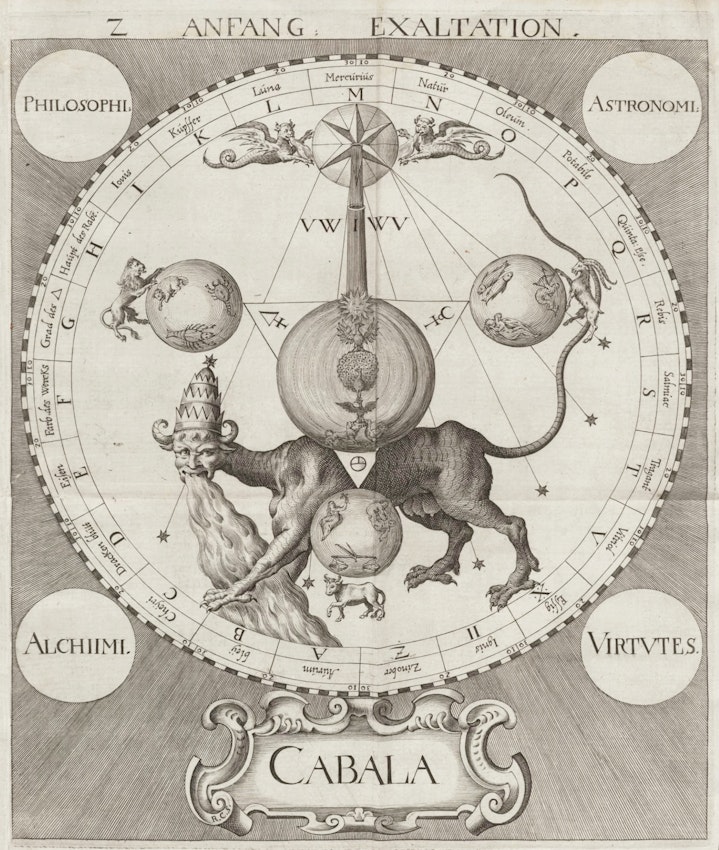
Anti-Christ, Stefan Michelspacher, Cabala: Spiegel der Kunst und Natur (Augsburg: David Francke, 1616), second engraving. The pope as the beast and whore of Babylon.
Historians such as Frances Yates in her investigation of the “Rosicrucian Enlightenment,” as well as Joscelyn Godwin in his analysis of the “Theosophical Enlightenment” have established the integral relation between esotericism and proto-democratic views. They have demonstrated the manner in which the Rosicrucians, or the eighteenth century “Illuminati,” characterised themselves as forerunners of enlightened thinking in their development of the intellectual traditions of classical humanism.[…]
Historians of Renaissance philosophy, such as Kristeller, have demonstrated that Renaissance Hermeticism also contributed to the emergence of a more individualistic faith. It had been Cosimo de Medici who had requested Marsilio Ficino in 1463 to translate into Latin the newly recovered Corpus Hermeticum. He completed only the first fourteen tractates and it was Lodovico Lazzarelli who translated the rest (tractates XVI–XVIII), publishing them as Diffinitiones Asclepii in Champier’s edition of 1507. This hermetic corpus mostly consisted of second century religious texts written by a variety of pagan groups in the late Hellenistic period. Some of them had been influenced by early Christianity, while others had been inspired by Middle Eastern beliefs. In the early Christian era they had been grouped under the pseudonymous authorship of “Hermes Trismegistus.” As a syncretic merger of diverse Hellenistic theosophical beliefs and practices, Hermetism had appeared in pre-Christian Egypt in the second century. Its sources included the Chaldean oracles, Orphism, the Sibylline prophecies, theogonies that united the Greek pantheon to those of Middle Eastern nations conquered by Alexander, initiatory rites and magical papyri originating in the proliferating cults of the Hellenistic Egypt, some of which had been influenced by concepts drawn from Christian soteriology. Hermetism was, thus, historically distinct from neo-platonism which was a theosophical discourse claiming direct descent from classical Platonic thought. In fact, the diversity of religious ideas in the late Roman Empire had stimulated Plotinus to evolve his own account of a triple-layered cosmology with an accompanying ontology inclined towards mystical experience. Plotinus had no interest whatsoever in magical ritual, but was intent on spiritual illumination for himself and his disciples. […]
In answer to earlier doubts concerning his religious beliefs, Fludd had written the Declaratio Brevis addressed to King James I in 1618–20. The alchemistic appropriation of the Christian sacraments of Baptism and Communion was not welcomed by the ruling Churches. None of them could accept a chemistry that claimed to produce substances equivalent to the body and blood of Christ, administering the same grace of spiritual and physical healing. The miracle of the bread and wine in the mass or Communion service was unique and could never be emulated by chemical means, no matter how devout and prayerful. Moreover, none of the Churches permitted unauthorised laity to perform the sacramental rite which was the prerogative of priests that had been formally appointed by a bishop through a direct apostolic transmission from Christ. Furthermore, if, like Fludd, they introduced kabbalistic angels (chiefly, Metatron) into the alchemical version of the rite, he was considered to be practising the most outrageous demonic magic, as Mersenne asserted. Good or bad purpose was irrelevant: the issue here concerned the question of who should control this powerful miracle. […]
The assertion that an individual human being guided by a purely inner grace could transform their own nature into that of Christ led to a second consequence, namely that the Church, whether Roman or Lutheran, became irrelevant to the work of spiritual salvation. In the organisation of dissident religious groups it was the laity who supplanted the ecclesiastical hierarchy as directors of the inner conscience. They were validating their efforts for independence of Church control by the sayings of Christ concerning the role of the Holy Spirit after his death.[…]
The Christian image of the Son of Man, specifically the one devised by the apostle Paul, was partly a historical inheritance from a pre-Christian Anthropos figure, whose cult had existed in the second century BC in Palestine, Syria and Egypt. Originating in Mesopotamia, this person had been translated to a Judaic context in the apocalyptic texts of Daniel, Ezekiel and Enoch 2.[…]
The image of the “Son of Man” (“Anthropos”) entered Judaism in the second century BC, appearing initially as a nameless, man-like person described in Daniel who subsequently became a messianic character in the account of Enoch. He was an Iranian element that was incorporated into the Jewish account of the creation of Adam. The “Son of Man” or “Anthropos” is a translation of the Hebrew term “bar nasha” which is found in the Synoptic Gospels and in the Hebrew Apocalypses of Daniel and Ezekiel. In the Semitic idiom “bar nasha” was not a first name, simply meaning “one,” or “someone”. It was the Hellenistic Christians who interpreted the term as meaning “the Son of Man” (“Anthropos”), following the Greek translation: “ὁ υἱὸς τοῦ ἀνθρώπου.” The original Jewish “bar nasha” is first encountered in the Book of Daniel 7: 13–14, which was also the first to mention the doctrine of the resurrection of the body. He subsequently re-appeared in the apocryphal Book of Enoch (first century BC) which added new elements to messianic prophecy, by integrating the non-Judaic Son of Man, the story of his concealment by God, his role in the revelation of secrets and his final task as universal Judge. Ezekiel, in turn, developed an eschatological account which prophesied a final conflict at Jerusalem followed by Judgement. The superhuman “Bar Nasha,” as God’s champion, represented the chosen people. Kraeling has, in fact, differentiated between the historical characters of the “Anthropos” and of the “Son of Man” that were fused together in subsequent Christian apocalypticism. As a victorious champion, Anthropos belonged to the history of creation, while the Son of Man “Bar Nasha” was an eschatological type.[…]
It was believed by many prophets and magicians that the Holy Spirit in the Last Days was revealing the concealed secrets of Nature, as Christ had foretold. These were available only to those of the true faith, namely, Lutherans. It is no coincidence that the alchemical resurgence of the late sixteenth century occurred in the Lutheran areas of Europe, particularly in the eastern German states through into Silesia, where there emerged lively groups of Paracelsian alchemists. Luther’s main disciple, the humanist Philip Melanchthon (who was also Reuchlin’s son-in-law) displayed a special interest in alchemy. He also encouraged the use of the new humanistic science of linguistics in order to mine sacred texts for further prophecies.
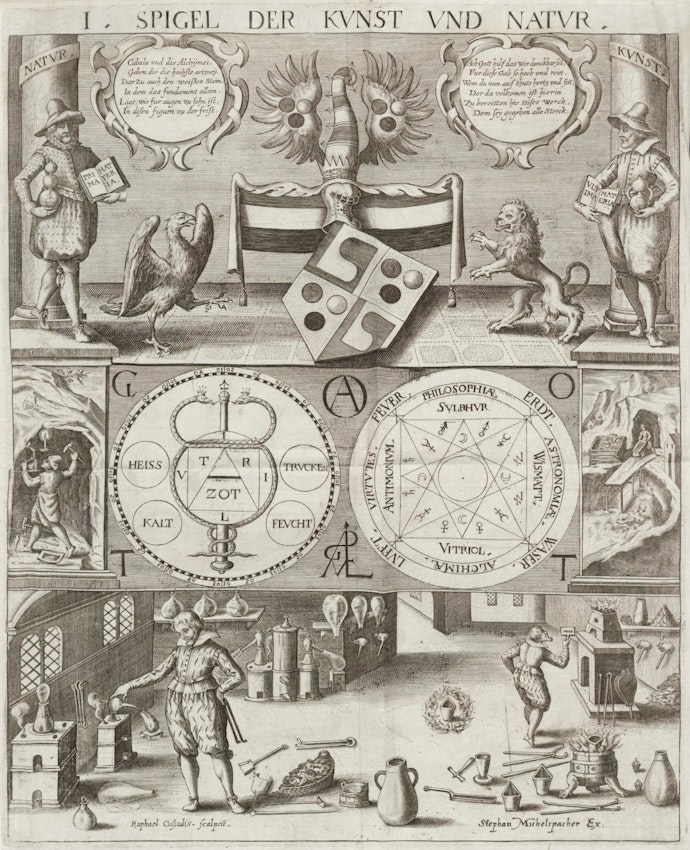
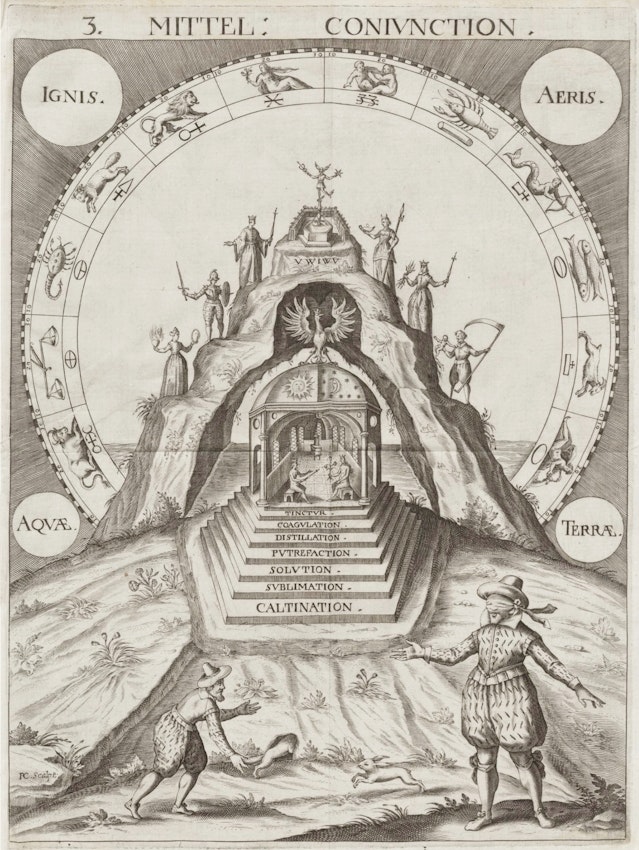
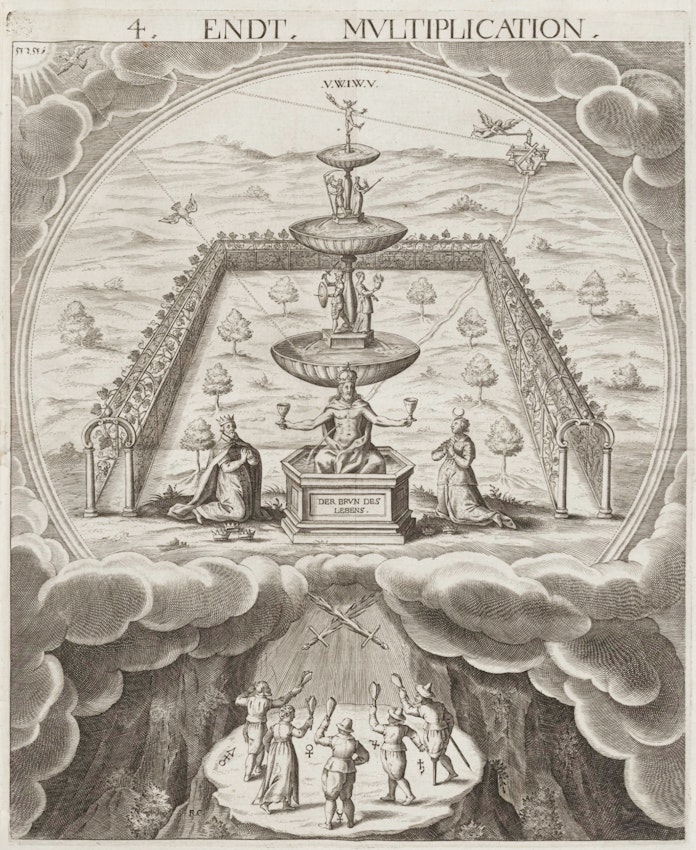
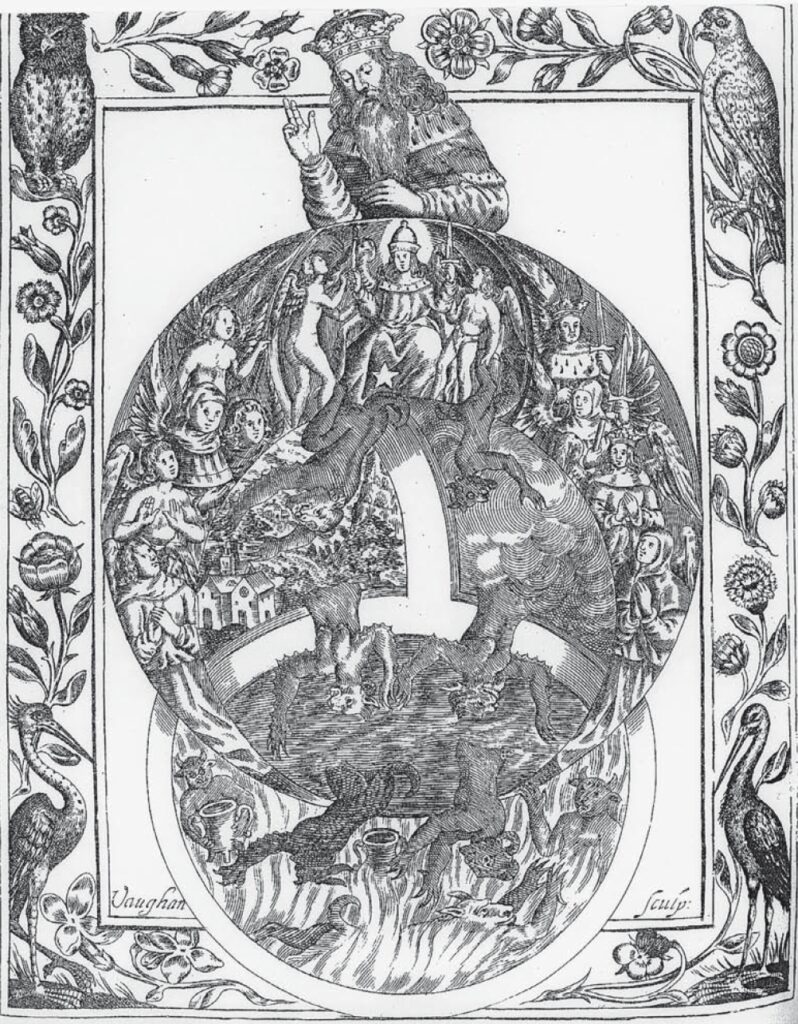
Allegory of Alchemy, Stefan Michelspacher, Cabala: Spiegel der Kunst und Natur (Augsburg:David Francke, 1616)The alchemical conjunction, Stefan Michelspacher, Cabala: Spiegel der Kunst und Natur (Augsburg: David Francke, 1616)Christ in the Fountain of Life, Stefan Michelspacher, Cabala: Spiegel der Kunst und Natur (Augsburg: David Francke, 1616)Robert Vaughan, “Christ in Glory” in Elias Ashmole, Theatrum Chemicum Britannicum (London: G. Grismond, 1652)
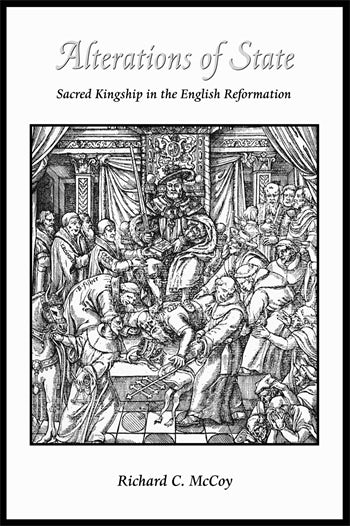
Kings were sacred figures for centuries in Europe, perceived as the Lord’s anointed deputies on earth. The Church and its sacraments were considered holier than the monarchy, but medieval rulers were still thought to have sacerdotal, spiritual, and even miraculous powers. Coronation was seen by some as a sacrament, akin to ordination; the royal touch was thought to have healing effects; and the mystical conception of the king’s two bodies implied that kingship never died. Moreover, rulers from Charlemagne to the Hapsburgs had claimed imperial autonomy from the papacy, causing tension between kings and clerics. The Reformation intensified this conflict while vastly expanding older notions of sacred kingship, making them simultaneously more grandiose and more problematic. In England, Henry VIII’s break with Rome was justified by new theories of royal supremacy that made the king the head of the church and clergy as well as the spiritual embodiment of the realm.
As the Reformation advanced, even the sacraments themselves were diminished and the Mass suppressed. These developments caused what John Bossy calls “a migration of the holy” in which “the socially integrative powers of the host” were transferred “to the rituals of monarchy and secular community.” Under the Tudors, the royal presence acquired some of the awesome sanctity of Christ’s real presence in the Eucharist and at times even threatened to replace it.Rood screens were dismantled and sometimes replaced with the royal coat of arms under Edward, and the feast of Corpus Christi was eventually suppressed and superseded by a cult of Elizabeth and its annual royal processions. Both old and new ideas of sacred kingship still provoked increasing ambivalence and even hostility, and challenges and conflicts intensified throughout the Reformation. “Because Protestantism rejected physical holiness,” as Paul Kléber Monod says in The Power of Kings, “. . . it could easily clash with a kingship that made the body sacred.” More zealous Protestants found veneration of the monarchy as idolatrous as adoration of the host and repeatedly criticized the shortcomings of godly rule under the Tudors. Under the Stuarts, Puritan opposition increased, helping to fuel the Civil War and leading to the execution of Charles I in 1649. The English Reformation’s struggle over sacred kingship was hardly resolved by regicide and republican rule. To John Milton’s horror, the blood shed by Charles I only increased England’s tendency toward “a civil kinde of Idolatry in idolizing thir Kings.” The king proved more popular in death and defeat than he ever had in life, inspiring support for the restoration of Charles II in 1660. Nevertheless, the Stuarts’ papist sympathies became increasingly unpalatable, and James II was deposed in 1688. By challenging hereditary divine right, the Glorious Revolution seriously damaged more traditional ideas of sacred kingship and inaugurated a new era of constitutional monarchy.
As this brief summary indicates, conflicts over the English monarchy grew more tumultuous throughout the early modern period. It was a time, in the words of different contemporary accounts, of “many great changes, and terrible alterations,” marked by “days of shaking.” Even a relatively smooth transition could arouse dire fears.In his chronicle of 1603, ironically entitled The Wonderful Year, Thomas Dekker conveys the anxieties surrounding the death of Elizabeth and the succession of James by exclaiming “What an EarthQuake is the Alteration of a State!” Any change of regime could arouse acute anxieties because, throughout the English Reformation, political change often entailed religious changes as well. King James understood these fears and tried to assure his new subjects that such drastic alterations were behind them when he spoke at Hampton Court in 1604: “in this land, King Henry VIII towards the end of his reign altered much, King Edward VI more, Queen Mary reversed all, and lastly Queen Elizabeth (of famous memory) settled religion as it now standeth. Herein I am happier than they, because they were fain to alter all things they found established, whereas I see yet no such cause to change as confirm what I find settled already.” However, James’s own hostility to Puritans aggravated sectarian conflicts throughout his reign, and his heirs only further inflamed them.
Charles I’s religious policies helped provoke the Civil War that cost him his head, and James II’s conversion to Catholicism caused the Glorious Revolution that cost him and eventually the Stuart dynasty the throne. For many in England, these alterations must have felt like earthquakes indeed.
I give today’s politics a wide berth, it is still authoritarian paternalism and there is no real dialogue anyway. In a democracy, everyone would be a politician, but when people have no time day in, day out because they have to spend their lives doing repetitive work that they themselves have nothing to gain from, for people they don’t even know just to pay for the same concrete box and the same car time and time again, then they simply don’t have the time and energy to study current issues in depth themselves and form their own opinions and statements. In the absence of their own insights, all that remains is to adapt one of the prefabricated opinions, to choose between democrats or republicans. People are not being brought up to be emancipated at all. You could encourage participation in political debates every 2-3 weeks from an early age, actively involve them in politics and give them time off from work and commitments accordingly, so that politically educated people would be brought up. At the age of 6, children are put in a penitentiary where they are told to sit still and keep quiet, in school and education it is completely irrelevant what is correct, the only thing that matters is saying what they want to hear, it’s about obedience. You are taught that you can not, you are not taught that you can learn foreign languages with ease, but that it is tedious and difficult, that it requires expensive teachers and courses and, in short, that it is best to abandon the idea and go to work. Every child would love to study maths and build ingenious robots, vehicles or clever houses because it’s a pleasure if you are not de-graded, not penalized if you don’t perform “well enough”, but these are the really valuable things in life and are taken away from everyone from an early age. Want to develop your own vehicle or housing? No authorisation. Nobody voluntarily sells kebabs day in, day out in the street, people are broken as children and pressed into these moulds because this system needs cleaners and mechanics. Truth is these jobs are not actually mandatory for anybody to do all day, if people had to clean up their mess themselves instead of paying others to do it, then they would certainly make less mess and think about what’s actually worth it. Nobody would have to flip burgers at McDonalds all day if people could go there and do it themselves. We could also automate and abolish a lot of the jobs, Ford developed the conveyor belt and the automated factory and thus mass production, we wanted to develop these machines to do the work for us, but that benefit was never handed down to the people, instead the factory owner, the capitalist, the corporation keeps it to themselves, that’s their profit. Now that it is no longer really necessary for everyone to spend their lives working (and in fact never was), billions are literally burnt in pointless wars because the citizen has to work for the money that the national banks print. Likewise, nobody would use their free time to examine eczema every day or write expert opinions, be it doctor, lawyer or carpenter, everybody needs to buy almost everything because they themselves know almost nothing, they aren’t even a doctor, but only an ENT, especially of politics they have no clue, only real politicians can do this, they need to let others decide in their stead, they need to be governed. What that means is you haven’t even accomplished Marx’ idea yet and that’s while it’s 160 years old. Why doesn’t Marxism work? Because those who profit from the established system do not want the workers to rise up, free themselves from their chains and take their capital and their rights into their own hands. Paradise is possible, that’s where we come from, but then we forget all the negative things, the problems and difficulties of life and open the door to them, Marxism is not a miracle solution and therefore not a utopia.
When, in the course of the French Revolution, His Most Serene Highness the King of France Louis XVI was only a “citoyen Capet”, a citizen at the tribunal, this meant that even the highest nobility suddenly had to deal with civil rights and ideas. The aristocratic dynasties cant be squeezed into the petty-bourgeois idea of the nation state; they defined themselves through their widely ramified kinships at the international courts. What happened with the revolution dealt a blow to the aristocracy of the whole of Europe, it was clear that it would repeat itself in the Holy Roman Empire of German Nation and so it was pre-empted by making the nobody, the blank slate from Corsica emperor against all class differences and thus dissolving the HRE, he marched on Paris to fanfare and ended the revolution and waged wars across Europe to fight back the forthcoming changes.
[…] with the subjugation of the working class, accomplished in the days of February and March, 1848, the opponents of that class – the bourgeois republicans in France, and the bourgeois and peasant classes who were fighting feudal absolutism throughout the whole continent of Europe – were simultaneously conquered; that the victory of the “moderate republic” in France sounded at the same time the fall of the nations which had responded to the February revolution with heroic wars of independence; and finally that, by the victory over the revolutionary workingmen, Europe fell back into its old double slavery, into the English-Russian slavery. The June conflict in Paris, the fall of Vienna, the tragi-comedy in Berlin in November 1848, the desperate efforts of Poland, Italy, and Hungary, the starvation of Ireland into submission – these were the chief events in which the European class struggle between the bourgeoisie and the working class was summed up, and from which we proved that every revolutionary uprising, however remote from the class struggle its object might appear, must of necessity fail until the revolutionary working class shall have conquered; – that every social reform must remain a Utopia until the proletarian revolution and the feudalistic counter-revolution have been pitted against each other in a world-wide war. In our presentation, as in reality, Belgium and Switzerland were tragicomic caricaturish genre pictures in the great historic tableau; the one the model State of the bourgeois monarchy, the other the model State of the bourgeois republic; both of them, States that flatter themselves to be just as free from the class struggle as from the European revolution.
Frederick Engels
Wars are a much more suited to suppress and control one’s own population than foreign enemies, war is always the same class struggle and so it is clear that the last two major wars were about nothing else. Emperor Wilhelm wanted to end the November Revolution in 1918 by marching on Berlin like Napoleon did on Paris, but what stopped him was the extremely bloody deposition of the tsars by the Russian revolutionaries. The fact that he then retreated to his villa in Doorn was seen as desertion by the old nobility and never forgiven, they said he had better died heroically for the empire. The lower nobility were hit particularly hard after 1918, many now had to work as gas station attendants or secretaries or were even dependent on donations from the DAG and accordingly were angry about the defeat and especially the republic, they radicalized themselves towards the national right. Although the high nobility also had to accept losses, they continued to enjoy enormous wealth and possessions; of course, they hated the Republic no less, but they were able to fight the battle on a completely different level, they were able to bring committees of lawyers and doctors who were able to stop the dissolution of the Fideikommisse, for example, and were of course well represented in all important positions in the Republic and the Third roman-german Reich; Hindenburg’s family could certainly live carefree.
A few impressive passages from Stephan Malinowski’s dissertation/book from 2003 Vom König zum Führer:
According to the information passed on to the exiled emperor’s “house minister” by the Reich Defence Minister Werner v. Blomberg, who was present, Hitler had made vague but far-reaching promises: “As the conclusion of his work, [Hitler] sees the monarchy,” it said in the minutes of the meeting. However, only the Hohenzollern monarchy would come into question; a restoration of the thrones in the federal states was to be rejected. However, the time for restoration had not yet come and the monarchy was only conceivable as the result of a victorious war.
In October 1933, retired Lieutenant General August v. Cramon had written a memorandum to the Reich President proposing the reinstatement of Wilhelm II to his royal rights, as a kind of present for his 75th birthday in January 1934. Wisdom and dignity of age would now be added to the “hereditary wisdom of the lineage”. The “Führer concept” must inevitably end “in immortal leadership, the hereditary monarchy” and Hitler would help with this: “Adolf Hitler himself is, as far as is known, a monarchist.”
A grotesque variant of aristocratic attempts to direct the ubiquitous desire for leadership towards themselves is provided by a speech from 1930, in which Wilhelm II lamented the inflation of the leadership concept in Doorn:
To be a leader! Everyone wants that nowadays. Leaders present themselves everywhere. Many people pose as leaders […]. And yet the cry for leaders is omnipresent!
In a strange mixture of Christian and neo-right-wing motifs, Wilhelm II renewed his claim to leadership. The idea of leadership was first ‘revealed’ by God to the Sumerians. King Hammurabi was given the “leadership profession” by God 5,000 years ago, his own ancestors 500 years ago. “Only to these leaders is the leader Jesus Christ!” Spatially and mentally far removed from all political realities, the exiled emperor appointed Jesus as the otherworldly “leader” and himself as the earthly “leader”. The imperial leader referred to himself in the preceding passage from the Gospel of John, which had given the speech its title: “I am the vine; you are the branches. If a man remains in me and I in him, he will bear much fruit; apart from me you can do nothing.”
A “mobile” interface was created by the activities of Wilhelm II’s second wife, Princess Hermine v. Reuß, who socialised in the most important circles of the political right during her visits to Germany. She apparently made contact with the NSDAP leadership in 1929, on the fringes of the Nuremberg Party Congress. The date of her first meeting with Hitler is unclear, but a meeting with Hitler in the salon of Baroness Tiele-Winckler in November 1931 is well documented. In the presence of the “Empress”, Göring and the aristocratic chief advisors of Wilhelm II, Hitler held a monologue lasting several hours in which he explained his intention to have “all November criminals […] publicly strangled”. The lecture delighted the hostess and guests alike, and the Kaiser’s wife spoke favourably of the “likeable” Hitler, “also about his good and straight facial expression and his good eyes and their expression without falseness.” Pleased with the outcome of the meeting, Magnus v. Levetzow summarised his impressions of Hitler in a letter to Prince v. Donnersmarck: “He was good on the plate, by golly.”
etc, the book contains a wealth of intriguing source material. See Books
The Republic was thus hated and so once again a nobody, a blank slate, was brought in to eliminate it. It had to be a nobody who had no connections to existing powerful structures, otherwise old alliances and rivalries would make effective action impossible. The Republic as an enemy may have been a common front of the high nobility, but old ties and rivalries were far from forgotten:
In agreement with his Westphalian peers, Abbot Augustinus von Galen, a brother of the later famous bishop, described the monarchy problem in 1926 as a cura posterior and considered the claims of the House of Habsburg to be justified in contrast to those of the Hohenzollerns: ,,As far as the Hohenzollerns were concerned, their emperorship had not the slightest thing to do with that of the old empire […]. The Hohenzollerns were therefore in no way the legal successors of the old emperors and from this point of view, they could therefore absolutely not be considered as favoured candidates for the future crown.”
For the south-west German nobility association, which maintained friendly relations with the Bavarian associations, Attila Graf v. Neipperg explained to a fellow Bavarian that the nobility in the south-west was also monarchist, but unlike in Bavaria, which was loyal to Wittelsbach, their loyalty only partly belonged to the houses of Württemberg and Zähringen, while many West German nobles had not forgotten the “sins” of the princes from the Napoleonic era. The monarchism that Count Neipperg outlined here also resembled a vague basic attitude rather than a practicable programme: “These people are fully Holy Roman Empire of the German Nation. And to a certain extent, cum grano salis, I am also with this side. Our stance is that we want to show and prove that the nobility is necessary in the republic, even more necessary than in the monarchy, where everything went its more or less regular course. But officially we are not monarchists.”
As late as the 1930s, Churchill said that the Russians were the greatest threat to Europe, so it may have been unthinkable before the war for the Allies and Russians to forge an alliance. When they faced each other after the war without a common enemy, the old antipathy broke out again, but the peace treaties that had now been signed made further warfare impossible and so it smouldered instead as a Cold War, which was fought preferentially on the loser country, Germany (and other puppets): it was torn apart into the Allied West and the Russian East. How the story ended is now well known: today everything in Germany is English-American, American banks and corporations as far as the eye can see. The first changes after the war included things like removing the Brothers Grimm from the classroom as “too German” (“anti-Semitic”, throughout all editions of Grimms Fairy Tales three of 200 tales contain Jews, the Christian is not shelt at all, on the contrary) and that newspapers and press agencies had to request their concessions from the occupying forces. In this way, education and news were made allied and, accordingly, historiography and politics today are allied, in which the German is the absolute enemy, the Nazi, about whom there can be nothing good. Yet the political constellation of a nationalist, socialist German workers’ party (NSDAP) in and of itself has nothing to do with anti-Semitism or dictatorship. In fact, the system of nation states is nationalism, that is the New World Order that has also created new elites. Under international pressure and competition, nationalism shows its problematic facets, such as a tendency towards xenophobia, because the state puts its own citizens before all foreigners. The state is a covenant of people that excludes others, strangers; the highest covenant today is the covenant with oneself, so freedom for individuality tends towards egoism that puts oneself before all others. In the past, the covenant with God was the highest, the Lord is more important than one’s own life, Christians are martyrs, servants of their masters, that is why religions have been spread so readily, Islam literally means submission, submitting to Allah the Lord. The “immortal leadership” mentioned in the quote earlier indicates an important facet of the nobles’ self-image: they are “immortal” through their bloodline as long as it continues to exist, “the king is dead, long live the king”, while the testament of the common people is that their lives and their achievements are inherited by the Lord and not by themselves.
The world of the stories of Holy Scripture is not content with the claim to be a historically true reality – it claims to be the only true world, the world destined for sole dominion. … The stories of Scripture do not court our favor, as Homer’s do, they do not flatter us in order to please and charm us – they want to subjugate us, and if we refuse, we are rebels”. The belief in the one God who reveals himself to the world in Israel’s fate is imperious and exclusive.
Otto Kaiser – Zwischen Athen und Jerusalem
The people of the Christian state is only a non-people, which no longer has a will of its own, but possesses its true existence in the head to which it is subject, which, however, is originally and by its nature alien to it, i.e. given to it by God and has come to it without its own intervention.
Bruno Bauer, On The Jewish Question, 1843
The only man who counts, the king, is a being specifically different from other men, and is, moreover, a religious being, directly linked with heaven, with God.
Karl Marx, On The Jewish Question, 1844
By its very nature, the Christian state is incapable of emancipating the Jew; but, adds Bauer, by his very nature the Jew cannot be emancipated. So long as the state is Christian and the Jew is Jewish, the one is as incapable of granting emancipation as the other is of receiving it.
Karl Marx, On The Jewish Question, 1844
To have a thought about how it all began, another book: This is an international lecture series at the University of Heidelberg
I (am) Darius the great king, king of kings, king of Persia, king of the countries, the son of Hystaspes, the grandson of Arsames, an Achaemenid. Proclaims Darius, the king: my father (is) Hystaspes; the father of Hystaspes (is) Arsames; the father of Arsames (was) Ariaramnes; The father of Ariaramnes (was) Teispes; the father of Teispes (was) Achaemenes. Proclaims Darius, the king: For this reason we are called Achaemenids; from ancient times we are noblemen; from ancient times our family has been kings. Proclaims Darius, the king: (There are) eight in my family who formerly have been kings; I (am) the ninth; (thus altogether) nine, now as ever, are we kings.
(Schmitt 1991: 49 lines 1–11)
This genealogy is particularly significant because Darius, like Cyrus, claims that his right to the throne is based on his family line. Also, like Cyrus, he claims that his family had been kings for a long period of time, in succession. What can one make of these statements? There are conspicuous absences in this genealogy, including Cyrus and Cambyses. Herodotus comments in a story concerning Cambyses in Egypt that Darius was a member of Cambyses’ guard and a “man of no great importance” (III.139–40). Thus, according to Herodotus, Darius was not in line for the throne, although he was of noble birth. Yet David Stronach argues that Darius’s ancestors may have had control of certain areas of Fars, and thus he was from a family of monarchs (2003: 256). Hence, his claim is not necessarily a lie. What then is Darius attempting to do in his genealogy? There are clear examples of usurpers who did not attempt to create a genealogy in order to justify their right to the throne. The classic case is the Neo-Assyrian ruler, Sargon II, who never provides a genealogy to support his right to the throne. Yet Darius did not claim that he had no royal pedigree but, rather, justifies his right to the throne through his family. Still, he provides no specifics except for family names. Unlike Cyrus, he gives no geographical location for his ancestors’ supposed kingdom. Hence, Darius attempted to redefine what it meant to be the rightful monarch through the use of his genealogy. Briant observes, “It was not because he was Achaemenid (in the clan sense) that Darius achieved power; it was his accession to royalty that allowed him to redefine the reality of what it meant to be ‘Achaemenid’” (2002: 111).
Judah and the Judeans in the Achemenid Period – Negotiating Identity in an International Context
It was also Darius and Darius II who called themselves Aryan and their homeland the land of the Aryans (Iran). It is early human history and Wilhelm was probably not far from the truth with his chronological and geographical classification of the origins of kingship. Genesis mentions Nimrod as the first to become mighty, the first of all Kings (in the Hebrew perception), he can’t be clearly identified but was probably either a King of Babylon or Assyria. These ancient actors had a decisive influence on the further course of history and shaped the concepts and structures that prevailed for a long time, the later nobility may have made up something about the “Aryan” origin of their ruling caste and, as a reaction to the new sciences such as the biological-zoological theory of heredity, postulated a racial one that was supposed to confirm the superiority of their own descent. If they were actually convinced of this is another question, as mentioned in the quote above, it was also about “proving that the nobility is necessary in the republic”, so they were aware of the changing times and wanted to preserve their own position as an elite by redefining themselves as leaders, with programs such as “New nobility of blood and soil” and “The nobility its right”.
Upon blood and soil the Führer is building his Reich. We have understood blood selection for seven centuries and have wisely chosen to build and continue our bloodstream on the basis of age-old race and culture. […] All the great ideals that the Führer has set for the German people stem from ancient Germanic heritage and not least from the deepest treasuries of the German nobility. Thus the German aristocracy is fundamentally akin to National Socialism in nature and origin. At the time of the red governments, the motto was: down with the aristocracy, we all want to be proletarians. Now it is the other way: the common man from the people should rise up, and we all want to meet again on the level of a true aristocracy. […] What the future will bring us, we leave in the hands of God and the enlightenment of the leader. But we know one thing. Our old lineage is not a foreign body in the Third Reich, rotting and decaying, it is a load-bearing block in the building, hardened over centuries. […] Sieg Heil! Sieg Heil! Sieg Heil!
Friedrich v. Bulöw, 1935
In 1921, an Pan-German (Alldeutsch) baron saw the EDDA project as the deliberate continuation of the […] selective breeding […] that has always been practised by the nobility through the cultivation of pedigree and genealogy […]. The aristocracy’s attitude towards the idea of selection and race breeding is therefore not a new goal for the nobility, but actually a self-evident one.
Stephan Malinowski
I can breed pugs, and I can breed dachshunds, but if the malör (sic) happens to me and I get a basket full of young dachshund pugs, they will be drowned with good reason. This is neither anti-pug nor anti-dachshund, but a realization of the centuries-old experience that all bastards are inferior.
Börries Frhr. v. Münchhausen
There are other interesting paradigm shifts in the course of the modern era. You can only call someone wealthy compared to someone who has less, there can only be rich if there are poor, they have too much that is lacking elsewhere. The powerful were only powerful when they were above others, for the mighty require the oppressed, the formulation that their power comes from the people is the very idea of republic and democracy. It can be seen that it is merely a paradigm shift, that what changes is merely people’s attitude towards the subject matter, that politics is merely a set of instruments that can vary. In reality, every one *is* a politician and influences the course of society with his decisions every day, whether this is recognized and promoted in the political apparatus or not. In the same way, socialism and communism are much more a quantity than a decision, no one can live their life alone, everyone draws from society and what they do with their life is what they give back, whether this can be quantified depends on the value system used.
So to jump from the ancient era in which claims to rulership by descent were established to the time of ancient Judaism discussed in the article, I quote the book again:
Von Rad suggested a three-part structure for the Priestly Document. He differentiated between “three big concentric circles . . . which move from the outside inwards towards the salvific mystery of God—the circle of the world, the circle of Noah, and the Abrahamic circle” (“drei mächtige konzentrische Kreise . . . die von außen nach innen fortschreitend in das Heilsgeheimnis Gottes einführen: der Weltkreis, der Noahkreis und der abrahamitische Kreis”).
[…]
The circle of Abraham includes “the Abrahamic household,” consisting of the Arabs (“Ishmael”), Israel (that is, “Samaria”) and Judah (“Jacob”), and Edom (“Esau”).
[…]
This Abrahamic circle is defined by the Abrahamic covenant of Genesis 17, which promises the participating covenant partners fruitfulness, land inheritance (which seems to imply a right to use rather than to possess), and proximity to God. The circle of Israel narrows the focus down to the nation of God alone. It is generally concerned with the establishment of the sanctuary, which enables the sacrificial cult of Israel. This sacrificial cult alone is what allows Israel to achieve atonement. The sanctuary and the implementation of the cult seem to function as the partial restoration of the initial creation, in the sense of a second “creation within creation.” The circle of Israel is not established by its own covenant because the foundational promise of the presence of God (“I will be your God”) was already given in Gen 17:7 (cf. Exod 6:7, 29:45–46).
[…]
Whether the Priestly writer’s Abraham is aware of it or not, what he asks is that Ishmael become Yhwh’s priest; and it is that request that is denied to Ishmael and offered instead to the yet to be born Isaac. In this whole exchange (vv. 18–21), the question therefore is not whether Ishmael will be allowed to live in the land of Canaan—the right of Ishmael to live in Canaan has been settled once and for all in v. 8—but the question is only whether there is a need for a further son, i.e. for a further category among Abraham’s multi-nation descendants. And the answer to that question is yes. Sarah’s son Isaac will beget those descendants of Abraham who are destined to become Yhwh’s priestly nation.
Judean Identity abd Eucumenicity, Konrad Schmid
A further striking feature of the book of Esther is the virtual absence of God in the book. This has, of course, given rise to manifold speculation about hidden references, double entendres, and so on. On the other hand, it is incorrect to view the apparent “secular” nature of the book as an indication of the book’s being of lesser quality. I think, if we approach the Esther story with the remarks about God in mind that were made above when dealing with Genesis 20, some light will be shed on the issue. The personal God of the patriarchs was changed in Genesis 20 into a universal divine being to whom Israelites and pagans can speak and to whose universal laws even apparently foreign kings can adhere. This change from a personal to a universal God is taken a step further in Esther. Because none of the actions that lead to an endangerment of the Jews in Persia are explicitly linked to the religious factor, the absence of any direct divine intervention might be understandable. Only in passing can we mention that the apparent noninvolvement of Persia in the religious affairs of its subject people makes Persia an ideal setting for the legitimation of a new festival, which seems to defy the common notions of biblical festivals. For any issues of religion, the conflict between Mordecai and Haman reported in Esth 3:1–15 is often interpreted by drawing attention to Exod 20:1–5. True, חוה is used in the stipulation of Exod 20:5, but nothing in the text of Esther suggests that Haman had any divine quality, and only the Targum adds this aspect by stating that Haman wore a portrait of an idol on his clothes. [The motif of Haman’s divinity only occurs in Judg 3:8, where Nebuchadnezzar claims divine honors: “And he destroyed all of their sanctuaries and ravished their cultic groves. He was given the order to extinguish all the gods of the earth so that all people of the earth serve Nebuchadnezzar alone and all tongues and tribes should worship him alone as god”] Despite Mordecai’s statement that he is a Jew (Esth 4:4bβ), we have instances in the Hebrew Bible in which it is perfectly acceptable to bow down before another man (see Gen 23:7, 27:29; 1 Kgs 1:31). The combination of the Hebrew verbs חוה and כרע is normally reserved for God (Ps 22:30, 95:6; 2 Chr 7:3), “but if idolatry is the cause of Mordecai’s noncompliance, the text is strangely silent about this. In addition it is difficult to see why the king commands that an underling be treated as god when he himself is not.” Esth 3:4bβ (כי הגיד להם אשר הוא יהודי ) seems to look forward to Esth 3:8–15 rather than serving as an adequate reason why Mordecai refuses to bow down.
The Absent Presence, Anselm C. Hagedorn
To judge a story’s historicity by its degree of realism is to mistake veri-similitude for historicity.
Adele Berlin
What are fairy tales and myths to us today were the only real reality for our ancestors. There is no doubt that the light bulb, medicine, hygiene and education defeated the devil, and yet even if you think he is a figment of the imagination (the beast and the animal in man are hardly a figment of the imagination) he had an enormous influence on human history. The world we see through our eyes is an image in our head, we experience our own senses, our own perception, not an external world “in itself” (Kant). Nature, the animal and plant world cannot adhere to the borders that we print on a map because they do not exist, in the world there are neither speed vectors nor meters or minutes. They are concepts of the human mind. Logic is a discipline of philosophy, mathematics is a discipline of logic, this is the Greek school and the origin and fundament of ours, therefore it is clear and easy for us to understand when the ancient Greeks speak of cosmos and chaos, order and disorder, but when the Jewish Kabbalah speaks of the Sephiroth or the Vedantas speak of Brahman, this is not logical and therefore not correct, because right or wrong is a very specific logical operation. So in order to understand foreign and ancient cultures, you have to be able to detach yourself from your own world view. We always like to assume that we are superior to all past people, after all we have all their experiences behind us, in reality this is a fallacy, nobody has had all the experiences, we rely on the statements of others in almost everything. Progress is preached today as a mantra, forgetting that too rapid growth cannot be sustained or that something is lost at the other end, so a lot of things have fallen by the wayside in the course of history, such as closeness to nature. “It’s not weapons that kill people, it’s people who kill people”, technology is only superficial, much more causal and therefore more important are the more fundamental, simpler things and so the earliest questions of mankind are also the longest lasting and our “superiority” over our ancestors is also just one that we would like to confirm to ourselves.
The first article of the omnipotence of the Creator produces a childlike fear of God, the second of the only begotten Son produces love for God, receiving the Holy Spirit produces shame and horror of sin, being born of the Virgin produces chastity and serious practice of virtue, suffering produces a willing endurance of all repugnance. The question: How did Pontius Pilate come to be included in the symbol? They had pointed to him as the head of the government in the Holy Land, had spoken of his alleged homeland of Pontus and much more. The pious man of the 15th century refrains from all this unfruitful scholarship. To him it simply says: Under Pontius Pilate, the right obedience to all men is worked in us. The historical note therefore means nothing other than Paul’s words: Let everyone be subject to the authorities who have authority over him. Furthermore, the crucifixion causes us to turn away from the world and its evil lust, the death of Jesus causes us to die to all sins, vices and our own nature. His burial brings us peace of heart without all strife, his descent into hell the right brotherly love, by means of which we come to the aid of all men and diligently remember in our prayers the souls in purgatory as well as the people on earth. Christ has risen from the dead: so we rise from all evil habits and the influence of the stars and direct our three spiritual powers towards God and useful things. He ascended to heaven and thereby made it possible for us to live a life of true vision. In the detailed way in which the five degrees of vision are described, the special interest of the mystic is clearly revealed. The thought of Christ’s return for judgement educates us to righteousness. We owe to the article on the Holy Spirit a purity of heart by virtue of which we wont become bad again, nor can we become bad again.
The pious man knows nothing of a holy Catholic Church, whose world-embracing power other expositors prefer to contrast with the limited conventicles of the heretics. He only knows a holy Christianity whose goods consist in our becoming children of God, brothers of Jesus Christ, disciples of the Holy Spirit and comrades of the apostles. The article on eternal life fills us with hope and longing for the hereafter, protects us from the sorrows of this life and makes us willing to part from it. With the Amen, however, we surrender ourselves to God’s will to want what he wants from us.
It will not be difficult to prove all these sentences from Eckart or other mystical writers of the 14th century.
The so-called Christian state is the Christian negation of the state, but by no means the political realization of Christianity. The state which still professes Christianity in the form of religion, does not yet profess it in the form appropriate to the state, for it still has a religious attitude towards religion – that is to say, it is not the true implementation of the human basis of religion, because it still relies on the unreal, imaginary form of this human core. The so-called Christian state is the imperfect state, and the Christian religion is regarded by it as the supplementation and sanctification of its imperfection. For the Christian state, therefore, religion necessarily becomes a means; hence, it is a hypocritical state. It makes a great difference whether the complete state, because of the defect inherent in the general nature of the state, counts religion among its presuppositions, or whether the incomplete state, because of the defect inherent in its particular existence as a defective state, declares that religion is its basis. In the latter case, religion becomes imperfect politics. In the former case, the imperfection even of consummate politics becomes evident in religion. The so-called Christian state needs the Christian religion in order to complete itself as a state. The democratic state, the real state, does not need religion for its political completion. On the contrary, it can disregard religion because in it the human basis of religion is realized in a secular manner. The so-called Christian state, on the other hand, has a political attitude to religion and a religious attitude to politics. By degrading the forms of the state to mere semblance, it equally degrades religion to mere semblance.
In order to make this contradiction clearer, let us consider Bauer’s projection of the Christian state, a projection based on his observation of the Christian-German state.
“Recently,” says Bauer, “in order to prove the impossibility or non-existence of a Christian state, reference has frequently been made to those sayings in the Gospel with which the [present-day] state not only does not comply, but cannot possibly comply, if it does not want to dissolve itself completely [as a state].” “But the matter cannot be disposed of so easily. What do these Gospel sayings demand? Supernatural renunciation of self, submission to the authority of revelation, a turning-away from the state, the abolition of secular conditions. Well, the Christian state demands and accomplishes all that. It has assimilated the spirit of the Gospel, and if it does not reproduce this spirit in the same terms as the Gospel, that occurs only because it expresses this spirit in political forms, i.e., in forms which, it is true, are taken from the political system in this world, but which in the religious rebirth that they have to undergo become degraded to a mere semblance. This is a turning-away from the state while making use of political forms for its realization.” (p. 55)
Bauer then explains that
the people of a Christian state is only a non-people, no longer having a will of its own, but whose true existence lies in the leader to whom it is subjected, although this leader by his origin and nature is alien to it – i.e., given by God and imposed on the people without any co-operation on its part.
The political emancipation of the Jew, the Christian, and, in general, of religious man, is the emancipation of the state from Judaism, from Christianity, from religion in general. In its own form, in the manner characteristic of its nature, the state as a state emancipates itself from religion by emancipating itself from the state religion – that is to say, by the state as a state not professing any religion, but, on the contrary, asserting itself as a state. The political emancipation from religion is not a religious emancipation that has been carried through to completion and is free from contradiction, because political emancipation is not a form of human emancipation which has been carried through to completion and is free from contradiction.
The limits of political emancipation are evident at once from the fact that the state can free itself from a restriction without man being really free from this restriction, that the state can be a free state [pun on word Freistaat, which also means republic] without man being a free man.
Bauer himself tacitly admits this when he lays down the following condition for political emancipation:
“Every religious privilege, and therefore also the monopoly of a privileged church, would have been abolished altogether, and if some or many persons, or even the overwhelming majority, still believed themselves bound to fulfil religious duties, this fulfilment ought to be left to them as a purely private matter.” [The Jewish Question, p. 65]
It is possible, therefore, for the state to have emancipated itself from religion even if the overwhelming majority is still religious. And the overwhelming majority does not cease to be religious through being religious in private.
But, the attitude of the state, and of the republic [free state] in particular, to religion is, after all, only the attitude to religion of the men who compose the state.
It follows from this that man frees himself through the medium of the state, that he frees himself politically from a limitation when, in contradiction with himself, he raises himself above this limitation in an abstract, limited, and partial way. It follows further that, by freeing himself politically, man frees himself in a roundabout way, through an intermediary, although an essential intermediary. It follows, finally, that man, even if he proclaims himself an atheist through the medium of the state – that is, if he proclaims the state to be atheist – still remains in the grip of religion, precisely because he acknowledges himself only by a roundabout route, only through an intermediary. Religion is precisely the recognition of man in a roundabout way, through an intermediary. The state is the intermediary between man and man’s freedom. Just as Christ is the intermediary to whom man transfers the burden of all his divinity, all his religious constraint, so the state is the intermediary to whom man transfers all his non-divinity and all his human unconstraint.
[…]
Man emancipates himself politically from religion by banishing it from the sphere of public law to that of private law. Religion is no longer the spirit of the state, in which man behaves – although in a limited way, in a particular form, and in a particular sphere – as a species-being, in community with other men. Religion has become the spirit of civil society, of the sphere of egoism, of bellum omnium contra omnes. It is no longer the essence of community, but the essence of difference. It has become the expression of man’s separation from his community, from himself and from other men – as it was originally. It is only the abstract avowal of specific perversity, private whimsy, and arbitrariness. The endless fragmentation of religion in North America, for example, gives it even externally the form of a purely individual affair. It has been thrust among the multitude of private interests and ejected from the community as such. But one should be under no illusion about the limits of political emancipation. The division of the human being into a public man and a private man, the displacement of religion from the state into civil society, this is not a stage of political emancipation but its completion; this emancipation, therefore, neither abolished the real religiousness of man, nor strives to do so.
By its very nature, the Christian state is incapable of emancipating the Jew; but, adds Bauer, by his very nature the Jew cannot be emancipated. So long as the state is Christian and the Jew is Jewish, the one is as incapable of granting emancipation as the other is of receiving it.
The Christian state can behave towards the Jew only in the way characteristic of the Christian state – that is, by granting privileges, by permitting the separation of the Jew from the other subjects, but making him feel the pressure of all the other separate spheres of society, and feel it all the more intensely because he is in religious opposition to the dominant religion. But the Jew, too, can behave towards the state only in a Jewish way – that is, by treating it as something alien to him, by counterposing his imaginary nationality to the real nationality, by counterposing his illusory law to the real law, by deeming himself justified in separating himself from mankind, by abstaining on principle from taking part in the historical movement, by putting his trust in a future which has nothing in common with the future of mankind in general, and by seeing himself as a member of the Jewish people, and the Jewish people as the chosen people.
[…]
The most rigid form of the opposition between the Jew and the Christian is the religious opposition. How is an opposition resolved? By making it impossible. How is religious opposition made impossible? By abolishing religion. As soon as Jew and Christian recognize that their respective religions are no more than different stages in the development of the human mind, different snake skins cast off by history, and that man is the snake who sloughed them, the relation of Jew and Christian is no longer religious but is only a critical, scientific, and human relation. Science, then, constitutes their unity. But, contradictions in science are resolved by science itself.