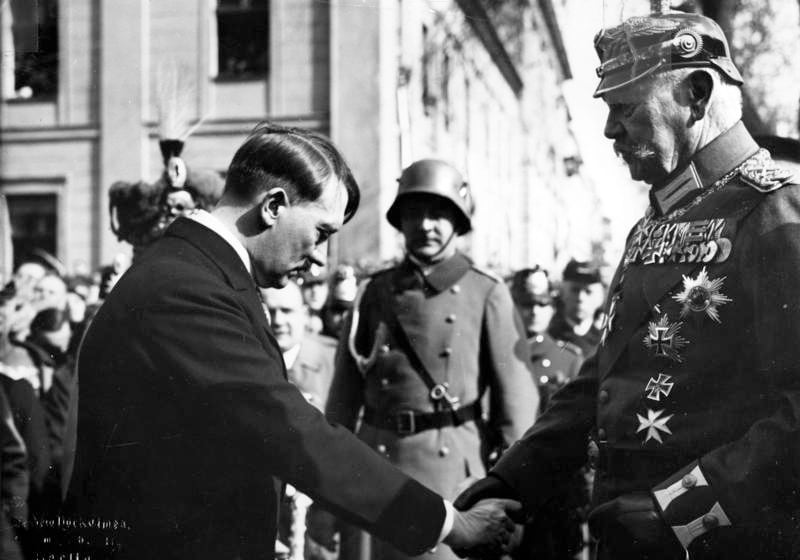
[…] A large part of the prussian nobility embarked on its intellectual and political journey from king to leader. In a mixture of anger, disappointment and weary hope, Count v. Schulenburg spoke in April 1928 of the duty of the Hohenzollern dynasty “to provide us with the pretender and then heaven grant us the man who, at the given moment, will use the power factor in our favour”. The Count aptly registered that neither the one nor the other was in sight. The successive transformation of monarchist dreams into hopes of a leader becomes very clear in the Count’s correspondence: “Only a titan,” he wrote a few months later, “can still master things, a titan that we possess neither on the right nor on the left. ” In 1924, the Crown Prince himself had come to the conclusion “that ultimately only a dictator could pull the cart out of the mud”. Hardly anyone within the Prussian aristocracy believed the son of the Emperor could fulfil this role. For some time, Count Schulenburg had been full of hope about the prospects of his “master”, who had “matured into a serious man” through the hardships of the times.
With this view, however, the general was already going against the judgement of his close friend Arnim and “the conservative faction of the House of Lords”. In agreement with the last President of the Prussian House of Lords, Prince Salm had internally described Wilhelm II and the Crown Prince as “intolerable”, the latter because of his lifestyle and especially “because he went to Holland and left the army as a sort of deserter”. Internally, Schulenburg described the crown prince as early as 1920 as a “wimp” and a “weakling” who could no longer be counted on in the future.
Even for those sections of the Prussian aristocracy who would have been predestined to carry the monarchist idea, the Emperors desertion led to an early mental flight into an initially diffuse myth of leadership. Due to the unresolved question of pretenders, all monarchist avowals remained vague. “I am a monarchist and will remain one”, Graf Arnim formulated in 1926. Arnim saw the overcoming of the “system” by a “dictator”, who was not to be supported by parliament but by “armed power” and who was to co-operate with “individual outstanding minds”, as a concrete short-term goal.
Although the diffuse “monarchical idea” remained central to Arnim’s rhetoric, in the 1920s Arnim moved ever closer to an intransigent anti-republicanism that used the terms “conservative” and “anti-system” synonymously. To interpret his work in the “main association” of conservatives, his rapprochement with the völkisch wing of the DNVP and his support for Hugenberg as an expression of a consistently “conservative” opposition would overlook the profound change in Arnim’s thinking. Behind the rhetorical and symbolic façade, to which the Arnims’ Boitzenburg castle provided an impressive backdrop, the count was turning away from the monarch in a way that was constitutive of this change and characteristic of much of the Prussian aristocracy. Conservative thinkers, to whom this description still applied, had realised that in the main association of conservatives there was more talk about the Jews than about the king. While the name and profile of a potential pretender to the throne were discussed cautiously or not at all, the idea of the coming “Führer”, “dictator” or “titan” became increasingly clear, as in the following diary entry by Count v. Bernstorff:
Only a dictator can still help us, one who steps in with an iron broom among all this international scrounging rabble. If only we had a Mussolini, like the Italians!
Within the widespread idea of first eliminating the parliamentary system before a restoration would be possible in a “second phase of the struggle”, only the first part of the task took on clear contours. Due to the structural weaknesses of the monarchist movement, seriously considering the immediate introduction of a monarchy was regarded even by Wilhelm II’s political staff as “a thing of such utter derangement and a crime against the crown that it could not have been worse.” This sentence, formulated in 1927, indicates a general tendency: While the conservative hopes for new royal glories were expressed in ever more diffuse formulas, the new right-wing ideas of leadership were also becoming increasingly popular among the nobility. The aristocracy never forgave the king and the crown prince for their “departure” and political monarchism never overcame the debacle it had caused. The detachment of the Prussian nobility from the king as a person corresponded to the dissolution of monarchism as a political movement. As an ideal, the king was replaced by the “Führer”, the monarchy by vague ideas of the “Third Reich”.
