Cultural Responses to Persian Presence in the Eastern Mediterranean
[…]
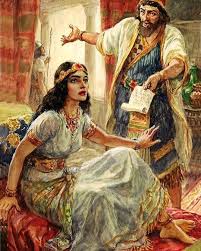
Throughout the book, the continued existence of Jewish communities in Persia is never questioned. Also, a return to the homeland is never debated and we encounter a cosmopolitan Judaism in Esther where—just as in Genesis 20—ethnic identity is no longer tied to the land. This, however, does not preclude any connection to Palestine. The ties of the Diaspora community at Susa with the people in Palestine and especially in Jerusalem are emphasized in the figure of Mordecai, who is introduced as a Benjaminite who had been exiled from Jerusalem in the group that was carried into exile with king Jeconiah of Judah, who had been driven into exile by Nebuchadnezzar, king of Babylon (Esth 2:5–6). Taken literally, Mordecai would then have been roughly 115 years old and hardly able to have a very beautiful niece. As in the case of Sarah in Genesis 20, too close a reading blinds us to the literary intention and purpose of the narrative. The genealogy of Mordecai stresses that he is both a יהודי and a member of the tribe of Benjamin and it is precisely this connection to which we need to draw our attention. In the book of Ezra (Ezra 1:5, 4:1), Judah and Benjamin (together with Levi) represent the continuation of the Southern Kingdom of Judah and are regarded as the only true community. This means by the parameter set by the book of Ezra, Mordecai is an authentic Jew of the Exile. With his genealogy, he fits the description of other prominent members of the Diaspora, because both Daniel (Dan 2:25) and Tobit (Tob 1:1–2) are described as being exiled from Judah or Israel. As is common in Diaspora discourse, status and identity are related to the level of connection with the homeland as well as with a certain expression of “cosmopolitanism.” As far as Jewish identity is concerned, we find a curious interplay between concealing and revealing one’s lineage. It starts with Mordecai’s order given to Esther to conceal her ethnic identity (Esth 2:10; cf. Esth 2:20), and she must have done it remarkably well, because the Persian king appears oblivious to the fact that he has taken a Jewish wife. When she finally reveals her identity (Esth 7:4), the king is untroubled by the fact. In contrast to Genesis 20, the authors of the book of Esther can imagine that a Jewish woman would have intercourse with someone outside her own ethnic group (the fact that Esther is unmarried might have helped here). All in all, the reader gets the impression that religion as an ethnic marker does not seem to matter anymore— this fact is clearly a cultural response to the (proposed) Persian setting, where theology is only the starting point for an otherwise secular political economy.
A further striking feature of the book of Esther is the virtual absence of God in the book. This has, of course, given rise to manifold speculation about hidden references, double entendres, and so on. On the other hand, it is incorrect to view the apparent “secular” nature of the book as an indication of the book’s being of lesser quality. I think, if we approach the Esther story with the remarks about God in mind that were made above when dealing with Genesis 20, some light will be shed on the issue. The personal God of the patriarchs was changed in Genesis 20 into a universal divine being to whom Israelites and pagans can speak and to whose universal laws even apparently foreign kings can adhere. This change from a personal to a universal God is taken a step further in Esther. Because none of the actions that lead to an endangerment of the Jews in Persia are explicitly linked to the religious factor, the absence of any direct divine intervention might be understandable. Only in passing can we mention that the apparent noninvolvement of Persia in the religious affairs of its subject people makes Persia an ideal setting for the legitimation of a new festival, which seems to defy the common notions of biblical festivals. For any issues of religion, the conflict between Mordecai and Haman reported in Esth 3:1–15 is often interpreted by drawing attention to Exod 20:1–5. True, חוה is used in the stipulation of Exod 20:5, but nothing in the text of Esther suggests that Haman had any divine quality, and only the Targum adds this aspect by stating that Haman wore a portrait of an idol on his clothes. [The motif of Haman’s divinity only occurs in Judg 3:8, where Nebuchadnezzar claims divine honors: “And he destroyed all of their sanctuaries and ravished their cultic groves. He was given the order to extinguish all the gods of the earth so that all people of the earth serve Nebuchadnezzar alone and all tongues and tribes should worship him alone as god”]
Despite Mordecai’s statement that he is a Jew (Esth 4:4bβ), we have instances in the Hebrew Bible in which it is perfectly acceptable to bow down before another man (see Gen 23:7, 27:29; 1 Kgs 1:31). The combination of the Hebrew verbs חוה and כרע is normally reserved for God (Ps 22:30, 95:6; 2 Chr 7:3), “but if idolatry is the cause of Mordecai’s noncompliance, the text is strangely silent about this. In addition it is difficult to see why the king commands that an underling be treated as god when he himself is not.” Esth 3:4bβ (כי הגיד להם אשר הוא יהודי ) seems to look forward to Esth 3:8–15 rather than serving as an adequate reason why Mordecai refuses to bow down.
