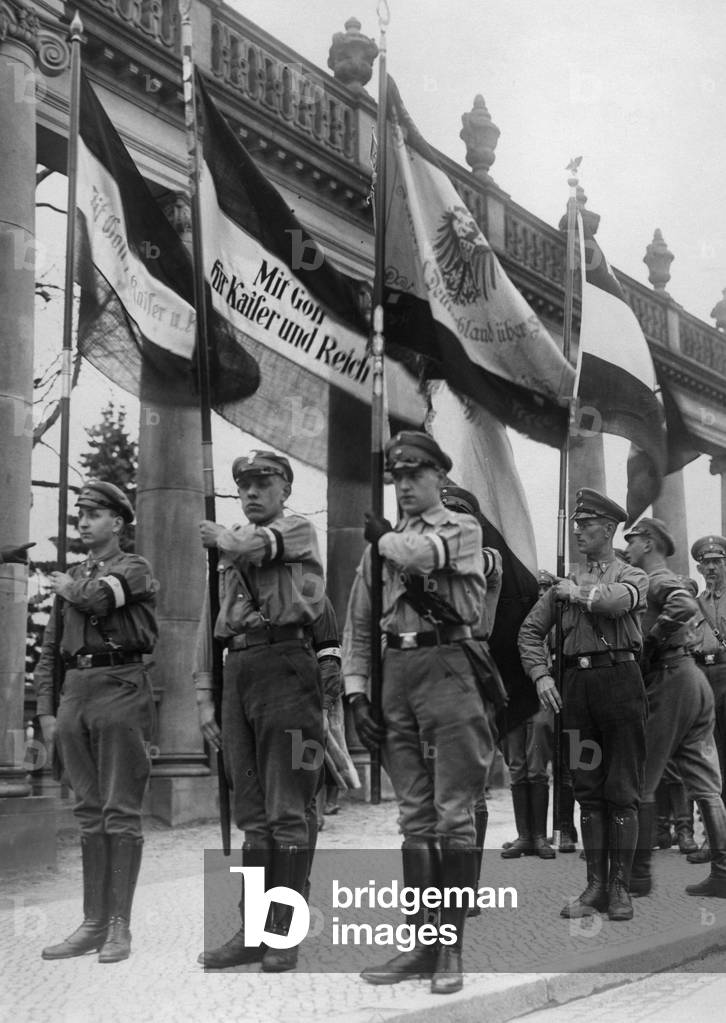
The failed mesalliance between the Hohenzollern dynasty and the Nazi movement before the seizure of power had an aftermath lasting several months, during which the imperial loyalists tried one last time to articulate their restoration plans. After the pseudo-monarchist mummery staged by the Nazi leadership on the Day of Potsdam, the “royal question” was raised with Hitler several times between May 1933 and April 1934 by the official representatives of Wilhelm II. Leading monarchists appeared four times during this period as petitioners to explore the possibilities of a restoration, and once the DAG chairman Prince Bentheim also touched on the monarchical question in a personal conversation with Hitler. Unlike Prince Bentheim, whose anticipatory obedience was able to immunise the DAG against the ban on monarchist associations in February 1934 and obtain a Reich law against the misuse of aristocratic names, Hitler allowed the messengers of monarchism to bite the dust. According to the information passed on to the exiled emperor’s “house minister” by the Reich Defence Minister Werner v. Blomberg, who was present, Hitler had made vague but far-reaching promises: “As the conclusion of his work, [Hitler] sees the monarchy,” it said in the minutes of the meeting. However, only the Hohenzollern monarchy would come into question; a restoration of the thrones in the federal states was to be rejected. However, the time for restoration had not yet come and the monarchy was only conceivable as the result of a victorious war. At a second meeting with Hitler in October 1933, held by the general plenipotentiary of the exiled emperor, retired General Wilhelm v. Dommes, the tone was already much more aggressive. Hitler “passionately” rejected the monarchist insistence of his interlocutor: the task was to defeat communism and Judaism. The Crown Prince as a person and the monarchy as an institution were not “tough enough” for this task. In February 1934, Hitler finally rejected the emissaries in extremely harsh terms. The climate for the talks had become charged in the run-up to the meeting with harsh anti-monarchist speeches in which Baldur v. Schirach and Richard Walther Darre, among others, had derided Wilhelm II as a coward. Dommes’ plan to “stand up in arms” for the honour of his “attacked master” failed, as did his attempt to get through to Hitler with his complaints. In a lofty tone, Hitler now forbade himself to be continually disturbed in his “reconstruction work” by the German princes. To achieve these goals – “eradicating the criminals of the November Revolution” and building up the Reichswehr – he would need 12-15 years.
While Berg’s and Dommes’ enquiries already revealed an astonishing degree of political naivety, this was far surpassed by prominent colleagues. The complete misjudgement of the political situation by aristocratic monarchists from the former inner circle around the Kaiser is illustrated by a petition to Hindenburg written in the autumn of 1933 – even if this form of obviously age-related blindness to reality cannot be applied to an entire generation.
In October 1933, retired Lieutenant General August v. Cramon had written a memorandum to the Reich President proposing the reinstatement of Wilhelm II to his royal rights, as a kind of present for his 75th birthday in January 1934. Wisdom and dignity of age would now be added to the “hereditary wisdom of the lineage”. The “Führer concept” must inevitably end “in immortal leadership, the hereditary monarchy” and Hitler would help with this: “Adolf Hitler himself is, as far as is known, a monarchist.”
Surrounded by advisors who had a better understanding of the new era, Hindenburg had replied that the moment for the return of the Kaiser had not yet arrived. Apart from the absurd petitions of military-monarchist fossils, the slogan “wait and see” was issued within the aristocratic associations and in private correspondence wherever restoration was still being discussed at all. For the DAG leadership, Prince Bentheim rejected the “unrealisable demands” on the “monarchical question” and the “church question” in 1937: the monarchical question, said the Prince, “is not up for debate for the DAG as such, regardless of the personal attitude of the individual.”
A few months after Cramon’s memorandum, the old and new Right clashed sharply in Berlin on the occasion of the monarchist celebrations to mark the 75th birthday of Wilhelm II on 27 January 1934. While the assembled “royalty in their old, colourful uniforms and the fabulous jewellery of the ladies” could once again be admired in faraway Doorn, the central festive event at Berlin Zoo was stormed by marauding SA thugs. Hitler took the public demonstrations of monarchist “selfishness” as an opportunity to have the monarchist organisations banned.
The report that Rüdiger Graf v. d. Goltz, chairman of the Reich Association of German Officers and a party member since May 1933, wrote about the events bears witness to the shock of the older generation. Outraged, the 70-year-old retired Major General described the events after his birthday speech to “our former Supreme Warlord”: “Two hours after the speech, a horde broke in, partly in civilian clothes, partly abusing the brown shirt, and took up residence like Bolsheviks, maltreating officers and their wives, destroying furniture and firing mock pistols and fireworks with loud bangs that ruined the ladies’ clothes. […] I then said to those assembled: Adolf Hitler will never approve of what you have just done. Don’t let your loyalty to him be misled.” The displayed outrage of the present nobles is less evidence of political differences than of the drastic misjudgement of the aged monarchists, who had misjudged not only the National Socialist goals but also the brutality of the associated methods.
Most notably, with Magnus v. Levetzow the storming of the Kaiser’s birthday celebrations took place under an aristocratic police chief who had been the chief political coordinator of the exiled Kaiser for four years and who in National Socialism had seen the vehicle with which Wilhelm II would one day roll back to the throne. Also noteable, Levetzow was replaced as early as 1935 by the SA and SS leader Wolf Heinrich Graf v. Helldorf, a fellow member who had been “part of the movement” for some time.
According to a report by columnist Bella Fromm, a brown-uniformed “horde” invaded a Berlin ball organised by the aristocratic society in January 1934, bringing down several of the older gentlemen, playing football with the helmets of the aristocratic officers and threatening the ladies present with revolvers. The party badge, which many of the aristocratic ball guests now wore openly and no longer “bashfully under their skirts”, as Fromm noted cynically, proved to be insufficient insurance against the unleashed petty-bourgeois proletarian resentment. The retired lieutenant general August v. Cramon, president of the Guards Cavalry Club quoted above, now turned to the crown prince for help and protested to an NSDAP party office: “Unfortunately, I must confess to you that the indignation about these events in our and not the worst circles, which are absolute supporters of Chancellor Hitler, is very great […]”. The reply Cramon received from an aristocratic party member shows how little the old guard of monarchists loyal to the emperor had understood of the “fascist style” (Mohler). In an emphatically disrespectful tone, Cramon was informed that “the majority of us […] are not at all monarchically minded, but are committed to Hitler and the National Socialist programme. Moreover, I am not betraying a secret to Your Excellency when I state the fact that the National Socialist movement’s direction of struggle was and is always directed against Marxism and reaction. […] It is with bitter pain that our comrades can today already see that opponents from the bourgeois-nationalist camp are managing to push themselves forward with great skill in every corner. But it was not them who we have gone into the streets fighting for, have been wounded for, have been arrested for. We have the right to assert the right of revolution too, which is a National Socialist revolution. We owe this to our conscience, especially to the many thousands of comrades from the young labour force who stood beside us when we were still indiscussable hooligans and swastika bandits for the good society.”
Cleanup Squad of the SA
An explanation for the sharpness of the attacks used can be found less in political than in socio-cultural differences. It is important to contemplate the enormous social and cultural distance that lay between the castle, manor house and casino on the one hand and the SA home and “Sturmlokal” on the other. As was to be expected, the Bavarian aristocracy found it particularly difficult to cope with the mimicry required after 1933. Here is another meaningful example: in 1936, the announcement by the newspaper Angriff that it intended to publish a series of articles entitled “Menschen, die in Schlössern wohnen” (People who live in castles) caused nervous unrest among the Bavarian aristocracy. The paper had announced that it was sending a “flying editorial team” to visit an old aristocratic family who had “owned castles for generations”. In a circular letter, the DAG’s chief executive v. Bogen had warned with concern that the editorial team would “probably not fail to mention any actual grievances.” The Bavarian DAG management quickly agreed not to put “the snobby Fugger […] in the foreground”. The search for a cousin loyal to the Nazis who was prepared to have his castle and his loyalty to the Nazis inspected took some time: “So let your trusted eyes glide over the men and make your choice wisely and carefully. In any case, it might be advisable to gather the ‘chosen ones’ in one place beforehand for precise instructions […].” Prince Öttingen asked the Berlin DAG leadership for more time to find “palace owners who seemed particularly suitable”, rejected the date requested by Berlin and suggested “first sending the ‘flying editors’ on trips to other, especially northern German [regions], so that we in Bavaria can prepare the matter particularly carefully in the meantime”. Having been informed that the “Angriff” was “not exactly a sentimental publication”, they looked for comrades whose behaviour would stand up to the stern gaze of old fighters. With a mocking undertone, it was planned to send the NS editors “to Pöttmes, Thüngen or Aystetten”, three estates whose owners were relatively rare party members among the Bavarian nobility. In fact, a visit to the castle of the Franconian Baron Aufseß seems to have been suggested to the “flying editors” in the end.
The barriers between the Catholic grand seigneurs and the majority of party members remained as high as ever after 1933. A bizarre example of the preservation of such barriers was provided in autumn 1938 in an attempt by the Regensburg NSDAP to seize the steel fences around the impressive palace grounds of the Princes of Thurn und Taxis. In a letter to the princely court marshal’s office, the “scrap metal task force” of the local NSDAP district leadership decided to suggest to the prince that the fences be completely demolished: “The fences and bars […] are often completely superfluous, unsightly remnants of a bygone era and taste and should disappear if possible.” In fact, the “clearing out” propagated here was part of a programme to supply steel to the German arms industry. Symbolically, however, the initiative can also be read as a call for the demolition of aristocratic distinctions: The “scrap metal task force” is rattling the castle fence of one of Germany’s richest princes. The planned “clearing out” of the iron differences was a reminder to the princely family to finally become part of the national community. The reference, formulated as an offer rather than a threat, to “a cleanup squad from the SA”, which would “demolish the front garden fence free of charge”, embarrassed the princely administration. After some debate about the appropriate wording, the court marshal’s office informed the “scrap metal task force” “that for aesthetic reasons, as well as for security reasons, it does not seem possible for us to remove the iron fences around our estates […].” The SA commando stayed away from the castle and its owner from the Nazi movement. The prince’s efforts to adapt do not appear to have gone beyond the appearance of the prince at local “solstice celebrations”, which the district leadership had urged, and an arrangement with the local SS cavalry, which was allowed to use the riding arena in the castle free of charge. Other than five members of the Princely family who joined the party in 1938, neither the Prince nor the Hereditary Prince came close to the party. “I never joined the party because, as a devout Catholic, I didn’t want to compromise myself”. The Hereditary Prince’s explanation in the context of his denazification proceedings is entirely plausible when supplemented by the distance from his position as a high aristocratic multimillionaire.
…but officially we are not monarchists
As in Bavarian monarchism, nobles also played a decisive role in Guelph (Welf) particularist monarchism. Both currents contained an anti-Borussian element, for the symbolic accentuation of which Guelph-orientated aristocratic families sent their sons in leather trousers and noble white embroidered trouser braces to run the gauntlet among their Lower Saxon classmates.
In addition to the most influential monarchist currents in Bavaria, Prussia, Saxony and Hanover, there was another influential line in the Catholic nobility of south-west and west Germany, which was orientated towards the old imperial idea. In agreement with his Westphalian peers, Abbot Augustinus von Galen, a brother of the later famous bishop, described the monarchy problem in 1926 as a cura posterior and considered the claims of the House of Habsburg to be justified in contrast to those of the Hohenzollerns: ,,As far as the Hohenzollerns were concerned, their emperorship had not the slightest thing to do with that of the old empire […]. The Hohenzollerns were therefore in no way the legal successors of the old emperors and from this point of view, they could therefore absolutely not be considered as favoured candidates for the future crown.” The orientation towards the idea of empire, combined with good relations with the high clergy and an attitude critical of the Hohenzollern and in favour of the Habsburgs, which the Westphalian count represented here, was characteristic of influential members of the south-west German nobility, especially the local mediatized princes.
The supporters of the unrealistic idea of empire in particular were often characterised by a relaxed attitude towards the republic. For the south-west German nobility association, which maintained friendly relations with the Bavarian associations, Attila Graf v. Neipperg explained to a fellow Bavarian that the nobility in the south-west was also monarchist, but unlike in Bavaria, which was loyal to Wittelsbach, their loyalty only partly belonged to the houses of Württemberg and Zähringen, while many West German nobles had not forgotten the “sins” of the princes from the Napoleonic era. The monarchism that Count Neipperg outlined here also resembled a vague basic attitude rather than a practicable programme: “These people are fully Holy Roman Empire of the German Nation. And to a certain extent, cum grano salis, I am also with this side. Our stance is that we want to show and prove that the nobility is necessary in the republic, even more necessary than in the monarchy, where everything went its more or less regular course. But officially we are not monarchists.”
