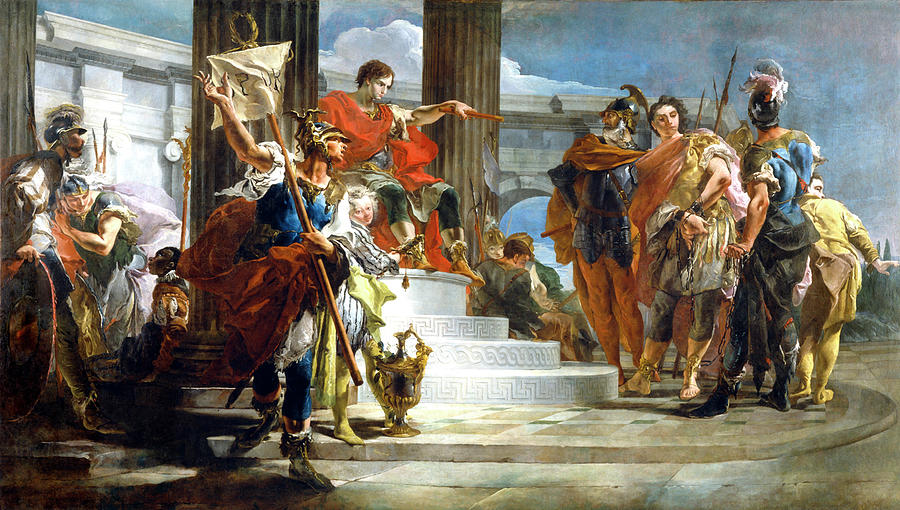
From Niccolò Macciavelli The Prince, Chapter 19
There is first to note that, whereas in other principalities the ambition of the nobles and the insolence of the people only have to be contended with, the Roman emperors had a third difficulty in having to put up with the cruelty and avarice of their soldiers, a matter so beset with difficulties that it was the ruin of many; for it was a hard thing to give satisfaction both to soldiers and people; because the people loved peace, and for this reason they loved the unaspiring prince, whilst the soldiers loved the warlike prince who was bold, cruel, and rapacious, which qualities they were quite willing he should exercise upon the people, so that they could get double pay and give vent to their own greed and cruelty. Hence it arose that those emperors were always overthrown who, either by birth or training, had no great authority, and most of them, especially those who came new to the principality, recognizing the difficulty of these two opposing humours, were inclined to give satisfaction to the soldiers, caring little about injuring the people.
Which course was necessary, because, as princes cannot help being hated by someone, they ought, in the first place, to avoid being hated by every one, and when they cannot compass this, they ought to endeavour with the utmost diligence to avoid the hatred of the most powerful.
Therefore, those emperors who through inexperience had need of special favour adhered more readily to the soldiers than to the people; a course which turned out advantageous to them or not, accordingly as the prince knew how to maintain authority over them.
From these causes it arose that Marcus, Pertinax, and Alexander, being all men of modest life, lovers of justice, enemies to cruelty, humane, and benignant, came to a sad end except Marcus; he alone lived and died honoured, because he had succeeded to the throne by hereditary title, and owed nothing either to the soldiers or the people; and afterwards, being possessed of many virtues which made him respected, he always kept both orders in their places whilst he lived, and was neither hated nor despised.
But Pertinax was created emperor against the wishes of the soldiers, who, being accustomed to live licentiously under Commodus, could not endure the honest life to which Pertinax wished to reduce them; thus, having given cause for hatred, to which hatred there was added contempt for his old age, he was overthrown at the very beginning of his administration. And here it should be noted that hatred is acquired as much by good works as by bad ones, therefore, as I said before, a prince wishing to keep his state is very often forced to do evil; for when that body is corrupt whom you think you have need of to maintain yourself—it may be either the people or the soldiers or the nobles—you have to submit to its humours and to gratify them, and then good works will do you harm.
But let us come to Alexander, who was a man of such great goodness, that among the other praises which are accorded him is this, that in the fourteen years he held the empire no one was ever put to death by him unjudged; nevertheless, being considered effeminate and a man who allowed himself to be governed by his mother, he became despised, the army conspired against him, and murdered him.
Turning now to the opposite characters of Commodus, Severus, Antoninus Caracalla, and Maximinus, you will find them all cruel and rapacious-men who, to satisfy their soldiers, did not hesitate to commit every kind of iniquity against the people; and all, except Severus, came to a bad end; but in Severus there was so much valour that, keeping the soldiers friendly, although the people were oppressed by him, he reigned successfully; for his valour made him so much admired in the sight of the soldiers and people that the latter were kept in a way astonished and awed and the former respectful and satisfied. And because the actions of this man, as a new prince, were great, I wish to show briefly that he knew well how to counterfeit the fox and the lion, which natures, as I said above, it is necessary for a prince to imitate.
Knowing the sloth of the Emperor Julian, he persuaded the army in Sclavonia, of which he was captain, that it would be right to go to Rome and avenge the death of Pertinax, who had been killed by the praetorian soldiers; and under this pretext, without appearing to aspire to the throne, he moved the army on Rome, and reached Italy before it was known that he had started. On his arrival at Rome, the Senate, through fear, elected him emperor and killed Julian. After this there remained for Severus, who wished to make himself master of the whole empire, two difficulties; one in Asia, where Niger, head of the Asiatic army, had caused himself to be proclaimed emperor; the other in the west where Albinus was, who also aspired to the throne. And as he considered it dangerous to declare himself hostile to both, he decided to attack Niger and to deceive Albinus. To the latter he wrote that, being elected emperor by the Senate, he was willing to share that dignity with him and sent him the title of Caesar; and, moreover, that the Senate had made Albinus his colleague; which things were accepted by Albinus as true. But after Severus had conquered and killed Niger, and settled oriental affairs, he returned to Rome and complained to the Senate that Albinus, little recognizing the benefits that he had received from him, had by treachery sought to murder him, and for this ingratitude he was compelled to punish him. Afterwards he sought him out in France, and took from him his government and life. He who will, therefore, carefully examine the actions of this man will find him a most valiant lion and a most cunning fox; he will find him feared and respected by every one, and not hated by the army; and it need not be wondered at that he, a new man, was able to hold the empire so well, because his supreme renown always protected him from that hatred which the people might have conceived against him for his violence.
But his son Antoninus was a most eminent man, and had very excellent qualities, which made him admirable in the sight of the people and acceptable to the soldiers, for he was a warlike man, most enduring of fatigue, a despiser of all delicate food and other luxuries, which caused him to be beloved by the armies. Nevertheless, his ferocity and cruelties were so great and so unheard of that, after endless single murders, he killed a large number of the people of Rome and all those of Alexandria. He became hated by the whole world, and also feared by those he had around him, to such an extent that he was murdered in the midst of his army by a centurion. And here it must be noted that such-like deaths, which are deliberately inflicted with a resolved and desperate courage, cannot be avoided by princes, because any one who does not fear to die can inflict them; but a prince may fear them the less because they are very rare; he has only to be careful not to do any grave injury to those whom he employs or has around him in the service of the state. Antoninus had not taken this care, but had contumeliously killed a brother of that centurion, whom also he daily threatened, yet retained in his bodyguard; which, as it turned out, was a rash thing to do, and proved the emperor’s ruin.
But let us come to Commodus, to whom it should have been very easy to hold the empire, for, being the son of Marcus, he had inherited it, and he had only to follow in the footsteps of his father to please his people and soldiers; but, being by nature cruel and brutal, he gave himself up to amusing the soldiers and corrupting them, so that he might indulge his rapacity upon the people; on the other hand, not maintaining his dignity, often descending to the theatre to compete with gladiators, and doing other vile things, little worthy of the imperial majesty, he fell into contempt with the soldiers, and being hated by one party and despised by the other, he was conspired against and was killed.
It remains to discuss the character of Maximinus. He was a very warlike man, and the armies, being disgusted with the effeminacy of Alexander, of whom I have already spoken, killed him and elected Maximinus to the throne. This he did not possess for long, for two things made him hated and despised; the one, his having kept sheep in Thrace, which brought him into contempt (it being well known to all, and considered a great indignity by every one), and the other, his having at the accession to his dominions deferred going to Rome and taking possession of the imperial seat; he had also gained a reputation for the utmost ferocity by having, through his prefects in Rome and elsewhere in the empire, practised many cruelties, so that the whole world was moved to anger at the meanness of his birth and to fear at his barbarity. First Africa rebelled, then the Senate with all the people of Rome, and all Italy conspired against him, to which may be added his own army; this latter, besieging Aquileia and meeting with difficulties in taking it, were disgusted with his cruelties, and fearing him less when they found so many against him, murdered him.
Niccolò Macciavelli – The Prince (PDF) 🇬🇧 :
Niccolò Macciavelli – Das Buch vom Fürsten (PDF) 🇩🇪 :

![Asgårdsreien [The Wild Hunt of Odin] (1872) by Peter Nicolai Arbo](https://wp.audiopathik.net/wp-content/uploads/2024/02/1280px-La_caza_salvaje_de_Odin_por_Peter_Nicolai_Arbo-1000x684.jpg)