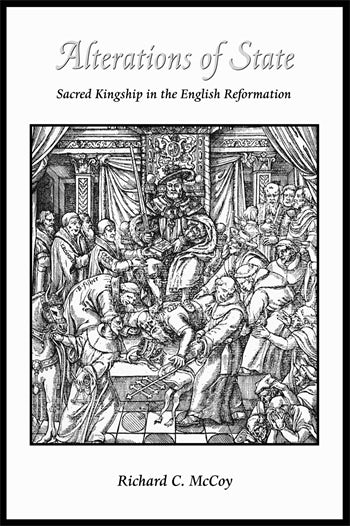
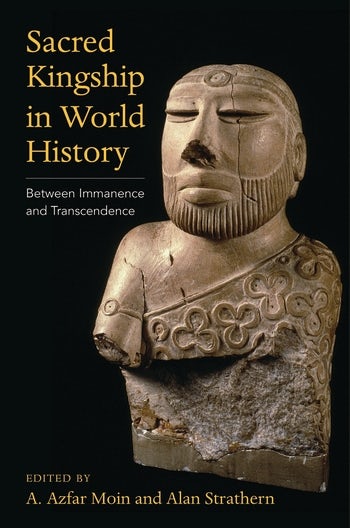
Kings were sacred figures for centuries in Europe, perceived as the Lord’s anointed deputies on earth. The Church and its sacraments were considered holier than the monarchy, but medieval rulers were still thought to have sacerdotal, spiritual, and even miraculous powers. Coronation was seen by some as a sacrament, akin to ordination; the royal touch was thought to have healing effects; and the mystical conception of the king’s two bodies implied that kingship never died. Moreover, rulers from Charlemagne to the Hapsburgs had claimed imperial autonomy from the papacy, causing tension between kings and clerics. The Reformation intensified this conflict while vastly expanding older notions of sacred kingship, making them simultaneously more grandiose and more problematic. In England, Henry VIII’s break with Rome was justified by new theories of royal supremacy that made the king the head of the church and clergy as well as the spiritual embodiment of the realm.
As the Reformation advanced, even the sacraments themselves were diminished and the Mass suppressed. These developments caused what John Bossy calls “a migration of the holy” in which “the socially integrative powers of the host” were transferred “to the rituals of monarchy and secular community.” Under the Tudors, the royal presence acquired some of the awesome sanctity of Christ’s real presence in the Eucharist and at times even threatened to replace it.Rood screens were dismantled and sometimes replaced with the royal coat of arms under Edward, and the feast of Corpus Christi was eventually suppressed and superseded by a cult of Elizabeth and its annual royal processions. Both old and new ideas of sacred kingship still provoked increasing ambivalence and even hostility, and challenges and conflicts intensified throughout the Reformation. “Because Protestantism rejected physical holiness,” as Paul Kléber Monod says in The Power of Kings, “. . . it could easily clash with a kingship that made the body sacred.” More zealous Protestants found veneration of the monarchy as idolatrous as adoration of the host and repeatedly criticized the shortcomings of godly rule under the Tudors. Under the Stuarts, Puritan opposition increased, helping to fuel the Civil War and leading to the execution of Charles I in 1649. The English Reformation’s struggle over sacred kingship was hardly resolved by regicide and republican rule. To John Milton’s horror, the blood shed by Charles I only increased England’s tendency toward “a civil kinde of Idolatry in idolizing thir Kings.” The king proved more popular in death and defeat than he ever had in life, inspiring support for the restoration of Charles II in 1660. Nevertheless, the Stuarts’ papist sympathies became increasingly unpalatable, and James II was deposed in 1688. By challenging hereditary divine right, the Glorious Revolution seriously damaged more traditional ideas of sacred kingship and inaugurated a new era of constitutional monarchy.
As this brief summary indicates, conflicts over the English monarchy grew more tumultuous throughout the early modern period. It was a time, in the words of different contemporary accounts, of “many great changes, and terrible alterations,” marked by “days of shaking.” Even a relatively smooth transition could arouse dire fears.In his chronicle of 1603, ironically entitled The Wonderful Year, Thomas Dekker conveys the anxieties surrounding the death of Elizabeth and the succession of James by exclaiming “What an EarthQuake is the Alteration of a State!” Any change of regime could arouse acute anxieties because, throughout the English Reformation, political change often entailed religious changes as well. King James understood these fears and tried to assure his new subjects that such drastic alterations were behind them when he spoke at Hampton Court in 1604: “in this land, King Henry VIII towards the end of his reign altered much, King Edward VI more, Queen Mary reversed all, and lastly Queen Elizabeth (of famous memory) settled religion as it now standeth. Herein I am happier than they, because they were fain to alter all things they found established, whereas I see yet no such cause to change as confirm what I find settled already.” However, James’s own hostility to Puritans aggravated sectarian conflicts throughout his reign, and his heirs only further inflamed them.
Charles I’s religious policies helped provoke the Civil War that cost him his head, and James II’s conversion to Catholicism caused the Glorious Revolution that cost him and eventually the Stuart dynasty the throne. For many in England, these alterations must have felt like earthquakes indeed.
If a state that is conceived internally as a democracy and also functions as such establishes an occupation regime, it can function externally, namely in relation to the occupied state, as a dictatorship. After 1945, for example, the Western Allied victorious powers (who were not legitimized by the German sovereign) exercised a dictatorship in the Western zones of Germany that was designed from the outset to eliminate a non-democratic regime and to create the conditions for the establishment of a democratic constitutional state. Insofar as the occupation regime operated by a democratic constitutional state observes its own political and constitutional principles and exercises its dictatorship, which is designed to transform a non-democratic predecessor system, exclusively for the purpose of establishing a democratic constitutional order, this is also a constitutional dictatorship. Of course, not every occupation regime must aim to transform the political or social system of the occupied country. The decisions and actions of a hegemonic power that exert influence on other states and their people without them being in a position to directly influence the hegemonic power’s decision-making constitute a special case. The United States of America currently possesses such a hegemonic power, which is present in many parts of the world. Insofar as the USA makes internationally significant decisions as an authoritarian ruler, it has also been described as a “world dictatorship”. Of course, it is essential that and how this form of imperial dictatorship is restrained by its internal democratic, constitutional and fundamental rights control mechanisms and for what purpose it is exercised.
By succeeding in influencing the will of those subject to domination in such a way that they submit to the influencing will in the awareness of voluntariness, a system of rule exercises “conditioned power”. While repressive power is based on the threat or execution of sanctions for non-conformist behaviour and compensatory power on the prospect and distribution of goods and positions for conformist behaviour, conditioned power is based on the ability to restructure the beliefs, the architecture of needs and interests as well as the judgement and will of those subject to domination in accordance with the predetermined system ideology or in the sense of their internalization. Ideally, conditioning through indoctrination is successful if allegiance is not paid because people want to avoid punishment or gain rewards, but because they agree with the content of the system ideology and the exercise of power by the leaders out of conviction.
Ideology-led dictatorships aim to implement a system ideology in practice and, to this end, aim to create a general belief in this ideology among the members of the community. An essential and constitutive characteristic of ideological dictatorships must therefore be the typical way in which the subjects of rule are influenced mentally and psychologically. This way of exercising power is a state-organized and monopolized indoctrination, a formation of convictions and consciousness in the sense of the system ideology.
However, hardly any ideological dictatorship is likely to get by without repression. Fundamental social transformations are very likely to meet with unwillingness and resistance. Moreover, the importance of a system of ideas that has yet to be communicated is not necessarily recognized from the outset, even by those who profit directly from it. Under these conditions, ideological dictatorships resort to violence and terror. However, the exercise of terroristic rule is neither a necessary nor a sufficient characteristic of this type of dictatorship. This is true even though the two dictatorships that shaped the 20th century, the Communist-Bolshevik as well as the National Socialist, can be regarded as prototypical ideological dictatorships and these systems were characterized by an excessive use of violence and terror. Based on these experiences, the significance of mass terror has been overestimated in the debate on totalitarianism to date. In order to better understand what essentially characterizes these systems of rule, we should view them as members of a species for which terror is not constitutive. It is true that those subjected to domination must be made to behave as desired – in conformity with the system or ideology – but terror is only one way of achieving this. Terror can be dispensed with if people behave of their own accord, i.e. subjectively voluntarily, in a way that is necessary to build the new society in accordance with the ideology. To this end, the ideas guiding the actions of those subject to rule must be adapted to the ideas of those in power. The members of the community must be influenced in such a way that they form the convictions and desires corresponding to the system ideology, which guide their behavior in accordance with the ideology. The exercise of terror can therefore be dispensed with if the threat of terror itself generates behavior that conforms to the ideology, or if the indoctrination of those subject to rule in line with the system ideology is so effective that they unconditionally consent to the exercise of rule. Repression can become superfluous through a more effective exercise of power based on ideological conditioning. The aforementioned forms of power are mutually substitutable.
Since ideology-led dictatorships seek legitimacy through consent, they must produce methods of rule that can fulfill this function. As a rule, however, they at best achieve consent on the basis of irrational convictions. Dictatorships based on ideology – this should only be mentioned here in conclusion – regularly turn into dictatorships of education, conviction and mobilization.
Worldview or ideological dictatorships (“Weltanschauungsdiktaturen”) organize consent to their rule and exercise of power through consent to the system ideology. The most important means of achieving this is indoctrination. However, ideology-led dictatorships are not only interested in acting in accordance with the ideology – i.e. ensuring that the members of the community comply and follow the applicable rules. In the interest of permanently stabilizing their rule, they aim to form convictions that conform to their ideology. Accordingly, they are interested in community members who have internalized the system ideology and are openly and honestly committed to it. At the same time, however, the leaders of such dictatorships are not solely interested in community members who have internalized the system ideology. One can also be convinced of the content of the system ideology through one’s own reflection or research. For this reason, someone who is convinced in accordance with the ideology can remain intellectually autonomous and recognize errors at any time. Moreover, an intellectually autonomous and rational actor will not agree to an exercise of power based on indoctrination. For these reasons, ideology-led dictatorships insist not only on conformity in external behavior and not only on an inner conviction of the truth and correctness of the system ideology, but also try to use means of mental manipulation to create a member of society whose thinking and feeling conform to the ideology and who accepts both the rule and the way in which the rule is exercised. Worldview dictatorships are geared towards replacing repressive and compensatory power with conditioned power. They are therefore interested in people who do not behave in accordance with the system for private gain, but because they are convinced of the content of the system ideology without reservation or criticism. The purpose of indoctrination is to create people with narrow-minded convictions – people who are absolutely sure of their convictions and can therefore be controlled. Opportunists, on the other hand, who are recognizable as such, undermine the credibility of the leaders’ claim that people follow them on the basis of voluntary consent. However, ideological dictatorships must also rely on people who are able to think and act independently within the boundaries set by the system ideology. Therefore, indoctrination should also pursue the goal of generating dispositions to form convictions that conform to ideology. Since ideology-led dictatorships pursue projects of political and social transformation and are therefore already confronted with unforeseen problems, they cannot set out to completely destroy human autonomy. Rather, they are dependent on people who think within the framework of the system ideology and develop their own initiative, but do not question the established ideological certainties. In this inner contradiction of their project lies the seed of their self-destruction.
From Herrschaft und Indoktrination: Zur Logik der Weltanschauungsdiktatur II; Lothar Fritze
Herrschaft und Indoktination: Zur Logik der Weltanschauungsdiktatur II
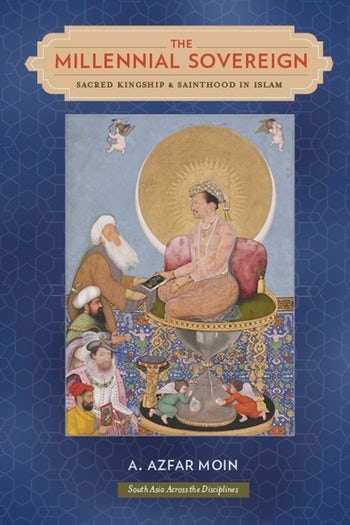
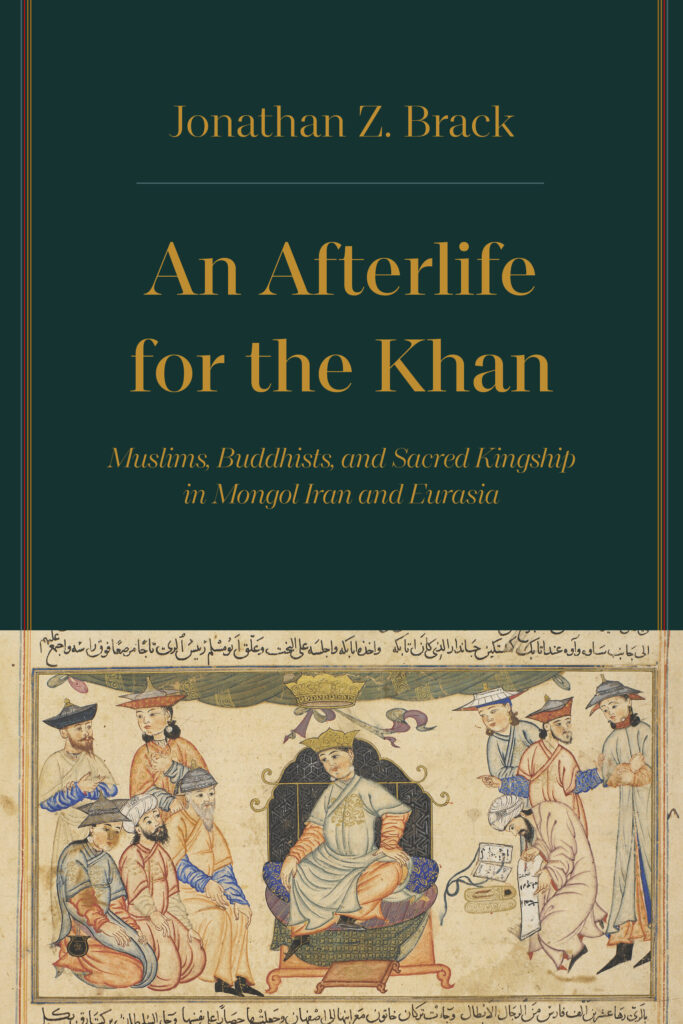
This book brings into dialogue two major fields of scholarship that are rarely studied together: sacred kingship and sainthood in Islam. In doing so, it offers an original perspective on both. In historical terms, the focus here is on the Mughal empire in sixteenth-century India and its antecedents and parallels in Timurid Central Asia and Safavid Iran. These interconnected milieus offer an ideal window to explore and rethink the relationship between Muslim kingship and sainthood. For it was here that Muslim rulers came to express their sovereignty and embody their sacrality in the manner of Sufi saints and holy saviors. The Mughal dynasty of India (1526–1857) and the Safavid one of Iran (1501–1722) exemplified this mode of sacred kingship. The early and foundational monarchs of these two lineages modeled their courts on the pattern of Sufi orders and fashioned themselves as the promised messiah. In their classical phases, both the Mughals and the Safavids embraced a style of sovereignty that was “saintly” and “messianic.” Neither a coincidence nor a passing curiosity, this similarity resulted from a common pattern of monarchy based upon Sufi and millennial motifs. There developed in this period an ensemble of rituals and knowledges to make the body of the king sacred and to cast it in the mold of a prophesied savior, a figure who would set right the unbearable order of things and inaugurate a new era of peace and justice—the new millennium. Undergirded by messianic conceptions and rationalized by political astrology, this style of sovereignty attempted to bind courtiers and soldiers to the monarch as both spiritual guide and material lord.
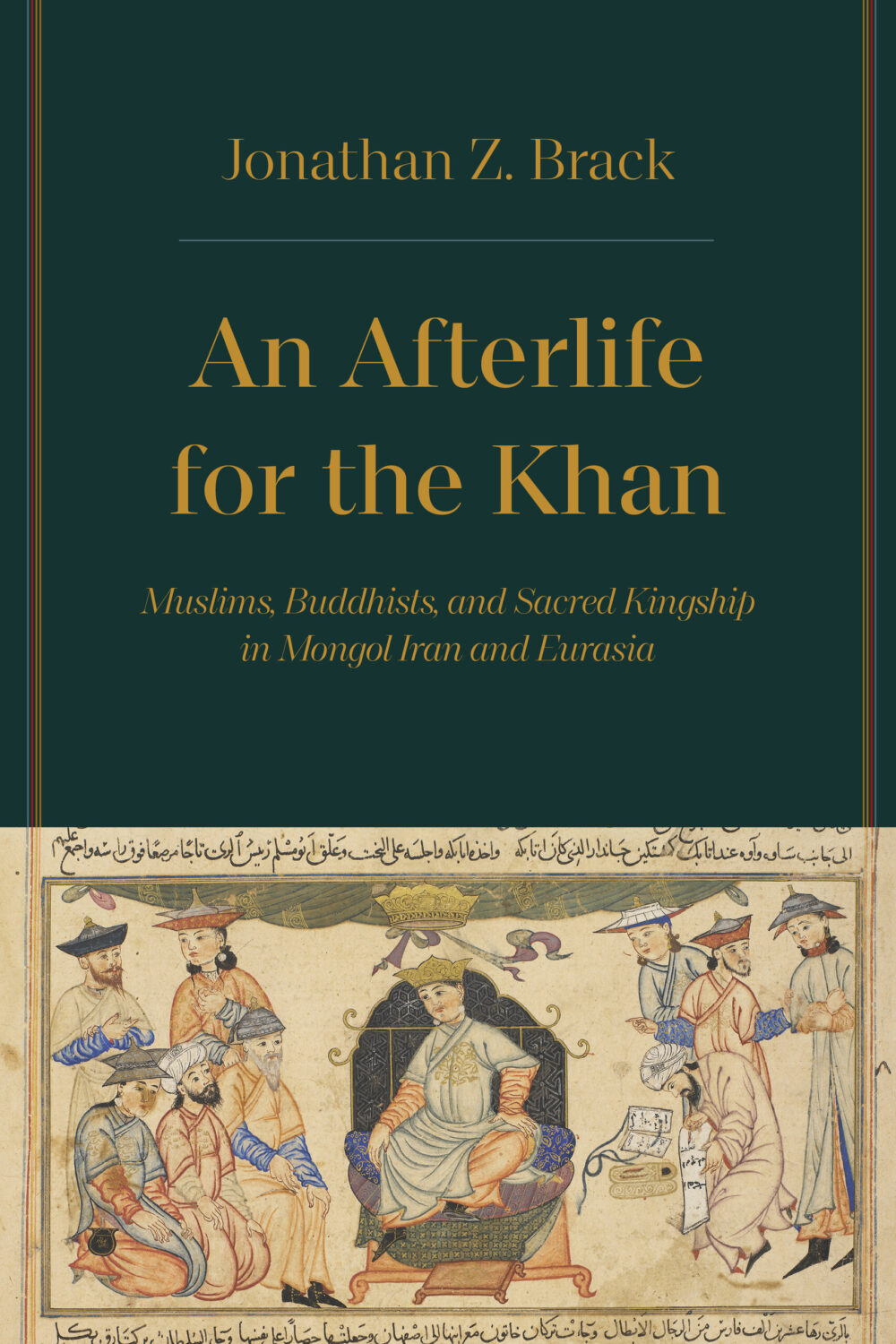
In 1254, after a long and anxious wait at the Mongol Empire’s capital of Qaraqorum, the Flemish friar and missionary William of Rubruck (ca. 1220–ca. 1293), finally got his wish to preach in person to the Mongol Qa’an Möngke (r. 1251–59). Before meeting the emperor, however, there was one final obstacle to overcome: outperforming his Muslim and Buddhist contenders in an interreligious debate. This multilateral court disputation was the first documented debate of its kind that included Christians (both Catholics and Nestorians), Muslims, and Buddhists. For William and for the Catholic Church more broadly, the encounter with Buddhism was entirely new. For the Muslim debaters, it was by no means the first interaction with Buddhists: Islam and Buddhism had a prolonged history of religious, intellectual, and commercial encounters and exchanges, but one that was fraught with friction and rivalry as well. From our historical hindsight, however, this 1254 exchange in Mongolia can be seen as marking a new page in Muslim-Buddhist relations, not in the eastern territories of the Mongol Empire (China and Mongolia), but rather further west, at the other end of Mongol-dominated Eurasia, in Iran, which would shortly become the seat of the independent Mongol state of the Ilkhanate (1260–1335). Established by Chinggis Khan’s (r. 1206–27) grandson, Hülegü (r. 1260–65) in Iran, Iraq, and Azerbaijan—areas with a predominantly Muslim population—the Ilkhanate would become a destination for Buddhist monks from across Eurasia. These Buddhist experts would travel great distances to spread the Dharma and take advantage of the opportunities of patronage that the new Mongol rulers of Iran, the Ilkhans, offered. In the late 1280s, some thirty years after William’s visit to Qaraqorum, the Ilkhanid court in Iran experienced the height of interfaith exchanges. Learned monks gathered at the court of Buddhist enthusiast Ilkhan Arghun (r. 1284–91), and debated with Muslims and possibly others. It is against this backdrop that this book’s protagonist, Rashid al-Din (d. 1318), then still a court physician and an up-and-coming bureaucrat, found himself embroiled in a disputation with one of the Mongol king’s cherished monks. Rashid al-Din describes his exchange in a treatise written nearly two decades after the event, and under very different circumstances. He was at the height of his tenure as vizier, the most powerful civil servant in the Ilkhanid state, and Islam had already prevailed over Buddhism to become the official religion of the Ilkhanid rulers. Rashid al-Din does not name his contender and refers to him only as a bakhshī, Buddhist priest. The Buddhist asked Rashid al-Din the following question in Arghun’s presence: “What came first, the bird or the egg?” Rashid al-Din notes that this was a “famous fable” among the Buddhists. The monk indeed evoked a well-known Buddhist enigma that appeared in the “Questions of Mellinda,” a Pali dialogue between a Buddhist sage and the Greek king Menander of Bactria, probably composed between 150 BC and 100 AD. Rashid al-Din writes that while the monk believed that he would fail to solve the riddle, he was confounded by it for only a moment before God divulged to him the answer. He does not tell us what answer he ended up providing nor whether the Buddhist offered a rebuttal. Instead, Rashid al-Din downplays his Buddhist rival, dismissing the monk as ignorant of the true meaning of his own riddle. Yet he does not disregard the question itself as a catalyst of a theological inquiry. Rashid al-Din is “inspired” by it, and in the remainder of this treatise, he proceeds to contemplate Islamic philosophical points regarding issues such as the createdness of Adam and the divine source of primordial human knowledge. Rashid al-Din’s account of this debate certainly differs from the Flemish friar William’s report to the Pope about his multilateral debate at Möngke’s court in Mongolia. For one, William provides more detail about how the debate with the Chinese Buddhist representative evolved and about the type of arguments that each party employed. We know they debated the existence and unity of God and the cause of evil. The differences between the Persian Muslim’s and the Flemish Christian’s accounts notwithstanding, there are also striking parallels between the two. Both downplay the intellectual fortitude of their Buddhist opponents. And both emphasize their recourse to their own scholastic traditions of rational argumentation to overcome the challenges mounted by their Buddhist contenders, rather than relying on Muslim or Christian scriptures. Whereas both might have underscored cultural and linguistic disparities, whether explicitly or implicitly, their accounts ultimately give the impression of a common vocabulary—that of rational argumentation. Scholastic disputation indeed emerges from their reports as a shared currency enabling a certain exchange of ideas. Yet how far did such exchanges go? William’s account suggests that the debates went beyond the exchange of riddles and parables and could include hefty theological arguments. It also gives the impression, however, that the two parties remained ingrained in their own scholastic traditions. Rashid al-Din’s account, on the other hand, leaves more to the imagination. He gives the impression that few meaningful intellectual exchanges between Muslims and Buddhists took place under Mongol rule in Iran. And this impression is amplified by the general dearth of Muslim Ilkhanid descriptions of such exchanges, as well as the complete absence of any Buddhist textual documentation from the Ilkhanate. Yet it is hard to reconcile this impression with what we know of the prevalence of Buddhism and the flourishing of the Buddhists during the Ilkhanate’s first four decades. As this book shows, a thorough examination of the Ilkhanid vizier Rashid al-Din’s extensive theological works demonstrates that Buddhist, Muslim, and Mongol exchanges have left deeper and more consequential impressions than the silence of contemporaneous Muslim authors implies. Muslims at the court were exposed to and made a considerable effort to respond to Buddhist concepts. These might not have been the finer points of the Dharma, but rather, as we will see, Buddhist methods of engaging with political authorities and conversion strategies. An Afterlife for the Khan explores the Ilkhanid court of the late thirteenth and early fourteenth century as an arena of interreligious exchange and rivalry, where the conceptual differences and equivalences between various Eurasian structures of power and sacrality—Islamic, Buddhist, and Mongol—were debated and deployed. It unearths the various subtle ways in which cultural and religious agents employed their religious and political resources to accommodate, translate, manipulate, and subvert the symbols and structures of the religious Other. Focusing on the theological-philosophical works of a Persian Muslim vizier active in the intellectual scene of the Ilkhanid court at the turn of the fourteenth century, An Afterlife for the Khan shows how the Persian-Muslim experience of Buddhism and its system of karmic-righteous kingship, on the one hand, and the accommodation of and resistance to the Mongol model of divinized kingship, on the other, generated and informed processes of creative experimentation in new modes of Islamic sacral kingship. Buddhists marketed concepts and models of karmic kingship as means of translating, reaffirming, and converting their Chinggisid patrons’ claims to deified kingship. The Islamic challenge entailed, therefore, not only winning their Ilkhanid patrons to the Muslim faith or cementing their commitment to Islam in the case of the Mongols who had already converted, but also uprooting their previous Buddhist education. Jewish convert, Persian vizier, historian, and Muslim theologian Rashid al-Din stood at the center of the Muslim conversion efforts. In his theological and historical writings, invigorated by the lively atmosphere of an intellectually rigorous and religiously competitive royal court, Rashid al-Din not only engaged in the translation and assimilation of Buddhist narratives and concepts, or painstakingly attempted to dispute and disprove the Buddhist doctrine of reincarnation. He was also inspired and informed by his Buddhist competitors and their strategies of conversion and domestication of the Chinggisid rulers. To this end, he experimented with a model of Mongol-Muslim kingship that paralleled Buddhism’s structure of karmic-righteous rulership. This book argues that Rashid al-Din’s Buddhist- and Mongol-informed experimentation in Islamic theological discourses formed a crucial, intermediate stage between the two more dominant frameworks for legitimizing Islamic, sultanic authority—the pre-Mongol phase of a restrictive, legalistic, and genealogical-based caliphal structure, and the post-Mongol independent model of universal and sacral Islamic rulership buttressed by saintly and messianic discourses. The Mongol occupation of Baghdad and the consequent elimination of the ʿAbbasid caliphate in 1258 represented a dramatic event that shattered the religiopolitical foundation of the Sunni majority’s world. This cataclysm inaugurated an era of unprecedented constitutional crisis that exacerbated after the collapse of the Ilkhanid state in 1335. In subsequent centuries, new strategies for legitimizing sultanic authority were formulated to resolve this crisis. To that end, Muslim intellectuals increasingly made use of and elaborated on an innovative, comprehensive, and compelling vocabulary of sovereignty that effectively shifted the discourse of sultanic legitimacy away from the pre-Mongol restrictive genealogical and juridical parameters of Sunni authority. In its place, there emerged a new discursive realm of universal Islamic kingship that referenced and interlinked a variety of intellectual fields—from philosophy and theology to astrology, mysticism, and the occult. Rashid al-Din’s works marked the end of caliphal authority and the beginning of this new age of Islamic authority. In the remainder of this introduction, we first explore the central theoretical foundation of this research into sacred kingship and the strategies of religious agents with the Mongol rulers.
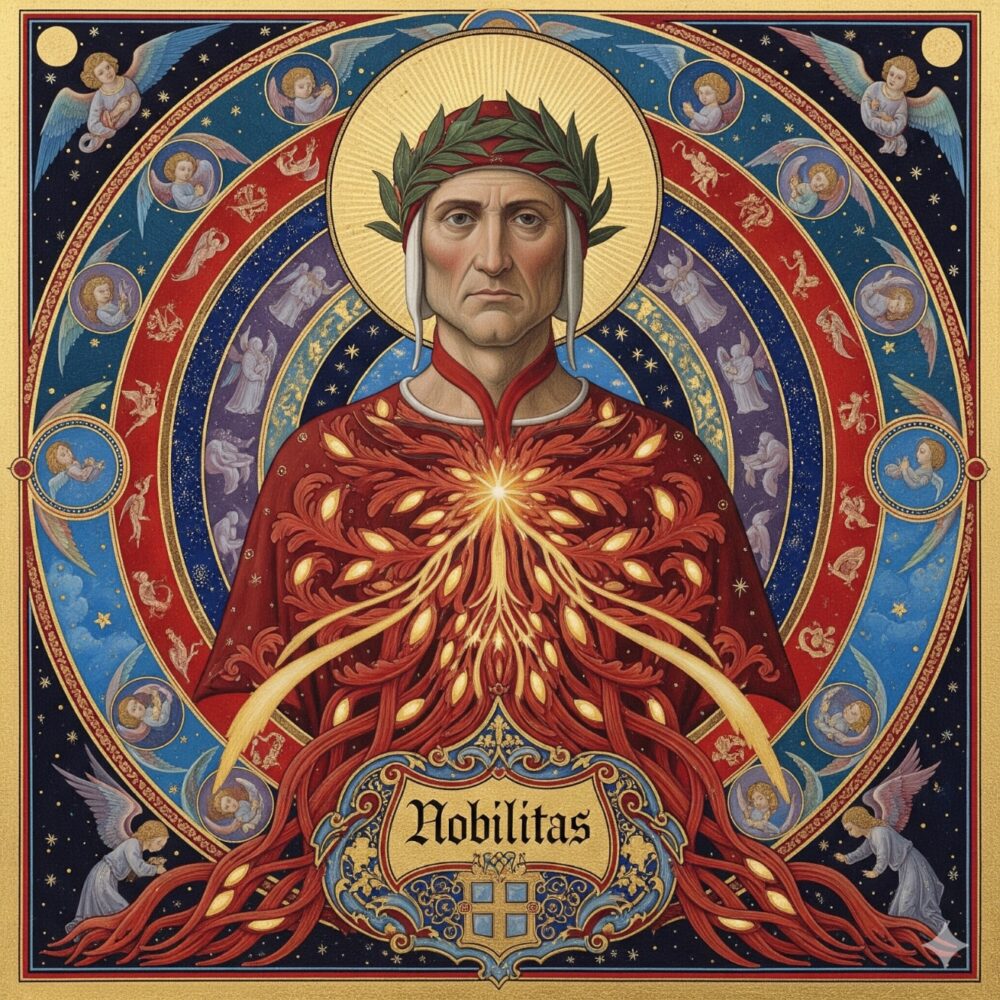
In Dante’s view – and here he again refers to Aristotle’s Politics – there is a natural, innate predisposition to rule that need not be limited to individuals, but can also apply to entire peoples. For him, the Roman people are destined by nature to rule over the whole of humanity.[…]
The central theme of the entire second book of the Monarchia is the question of whether the Roman Empire was or is legitimate as a dominion over the globe. However, Dante does not understand this to be human law, but divine law or natural law.[…]
The lineage, i.e. the bloodline, is ennobled. Against the background of the expanded concept of nobility, this is easy to understand, because the individual proves through his virtuous achievements that he was able to realize by divine intellect something that had previously been created and prepared by the virtus of the paternal seed. In this sense, the following also applies in the Monarchia: the Roman people as a whole – not automatically each individual member – is “nobilissimum” because its “father” Aeneas has ennobled the lineage. Now, the Trojan hero was certainly anxious to have a reproductive effect himself and to have his virtus – according to the physiological terminology outlined above – make impressions in the matter of women. The blood that had previously flowed into him from all parts of the world via his (pre-)paternal ancestors, he now exuded again (in the form of sperm as a derivative of blood) into the high women from all parts of the world: Creusa from Asia, Dido from Africa and Lavinia from Europe. With this “duplex concursus sanguinis”, the flowing in and out “in unum virum”, Dante performs precisely the reductio ad unum that he directs towards the world monarch throughout the treatise, now in the sign of blood. It has already been said that, in the Aristotelian-biological understanding, nature was regarded as the mover of conceiving matter by means of sperm. If Aeneas is the one who brings this movement into all parts of the world by means of his virtus, he functions as the proto-monarch, the “unicus motor”. Aeneas has extended his biological fatherhood to the globe through his partners, who together represent all parts of the world. He sowed his seed and with it the inherent formative power in the best possible way, namely on the sanguis menstruus of the women who conceived him, i.e. in the materia.[…]
In the Convivio, he had already proclaimed the Roman Empire as God’s chosen world dominion, because the sublime blood of the Trojans had been added to the people of the Latins (“l’alto sangue troiano era mischiato”), whereby the Roman people had acquired the best natural disposition to rule (“quello popolo che a ciò più era disposto”). It is important that Dante does not imagine the later translatio imperii as a mere succession of office that had passed from the Romans to the Germans – and certainly did not require the appointment of the pope or the people – but as a biological descent.[…]
The idea of the royal qualities and potential inherent in the blood of a dynasty was not invented by Dante; it had already been advocated before and had been developed very prominently around 80 to 90 years earlier in the circle of the Hohenstaufen Emperor Frederick II. Virgil – the undisputed patron of the essential figures of thought in Dante’s Monarchia – played a decisive role in modeling the closed bloodline with his lineage narrative, which extends from Aeneas to his son Ascanius/Iulus, then on through Julius Caesar to Augustus, the ruler of peace and the world (Aen. I 260-296). Dante was well acquainted with the written testimonies of the historians at the court of Frederick II and his heirs; for him, the Hohenstaufen was one of those rulers whose external signs (the frutti or signa) could be used to deduce the causa, i.e. the nobility of the soul. And even if his son Manfred was an illegitimate descendant according to human law, according to the understanding of Dante’s nobilitas naturalis described above, as the biological offspring of the noble, who was himself virtuous, he is consistently and rightly regarded as “well-born”. The fundamental characteristic of wellbornness in the sense described here is descent from the seed of Roman ancestors […]. This applies not only, but primarily, to the Florentines, who put up fierce resistance to the emperor. According to Dante’s conviction, it is not the inhabitants of his native town who are responsible for this, who – like himself and his ancestor Cacciaguida – are descended from the Romans, but the descendants of the Etruscan Fiesole, to whom the exiled Florentine attests that wickedness is practically in their genetic make-up and who are the ringleaders. However, this fixation on blood is not limited to these contexts: In his letter to “all and each individual king of Italy, senators of the venerable city [Rome] as well as dukes, margraves, counts and peoples”, the poet also implores the “Lombard blood” (i.e. the Italians) to renounce barbarism and make room for the seed of the Trojans and Latins, if there should still be any of it in those he addresses. This is linked to submission to the Roman king, whom God had predestined as ruler, as can be seen from miraculous signs. This is also the message that Dante addressed directly to Henry VII in April 1311: He, the successor to Caesar and Augustus, was the rightful lord whom the whole world awaited. This claim is again underlined by quotations from the Aeneid, which are intended to testify that Caesar comes from the Trojan lineage via the Aeneas offspring Ascanius or Iulus, whereby the line is abruptly extended to Henry’s son John, the “old Ascanius”. […] It is true that numerous princely families in the late Middle Ages sought to locate their origins in Troy and that the descendants derived from the Trojans can thus in principle be regarded as a common European starting point for the plural noble families. However, the reference back to the Trojans, who had fled their homeland and become active as city founders in various parts of Europe, often seems to have been motivated less by integration intentions than by veritable efforts to differentiate and demarcate themselves. In the numerous and varied genealogical narratives of the Middle Ages, three main separate lines can be identified in this sense: the descent of the Romans from Aeneas, who had married into the Latin ruling house and subsequently taken over the government; a second line founded by Brutus, the great-grandson of Aeneas, who had fled from Latium and established a new rule in the British Isles; a third branch around a group that had split off from the train of Aeneas and whose members, such as Francion, the son of Hector and grandson of the Trojan king Priam, became the progenitors of the Franks/Francophones, among others, by founding cities in Pannonia and then in Germania and Gaul. According to this scheme, numerous European cities and dynasties traced their origins back to the Trojan emigrants, such as the Venetians and Paduans to Antenor, who, like Hector and Francion, also had no closer relationship to Aeneas. Such origin stories were also used by the German nobility, especially those who harbored ambitions for the office of Roman king. It was around the time of the writing of the Monarchia that the Habsburgs began to perceive themselves as a collateral line of the Roman Colonna, whose origins could be traced back to Julius Caesar, which in turn meant that the latter’s ancestor Aeneas could be regarded as the progenitor of the Habsburgs. And for the Luxembourgs, whose first imperial representative was Henry, who was supported by Dante, there are also historical accounts from the 14th century that claim a descendant of Aeneas and his descendant Julius Caesar. The noble families competing with the Roman kings and emperors, who regularly – albeit always in a different form – referred to the other ancestors mentioned, were able to relativize the actually universal claim to power of the head of the empire by claiming supposedly equal and equally legitimate lines of nobility, because Aeneas had only been one of several Trojan princes. The situation becomes even more complicated when one considers that the Capetians as a French royal dynasty and their collateral line of the Angevins, who ruled Naples and Sicily, claimed a completely different genealogy. On the occasion of the canonization of the French king Louis IX in 1297, the tendency to characterize the entire family as beata stirps, i.e. as a dynasty that carried on the tendency to lead a saintly life through blood relations, was reinforced. This self-stylization via the saint – the grandfather of King Philip IV of France and great-uncle of King Robert of Naples, after all, two of Henry VII’s most powerful rivals – had the potential to neutralize, if not devalue, any reference to Trojan and Roman, i.e. decidedly pagan, forefathers. Dante’s design is clearly positioned within these genealogical-propagandistic constellations, and this also answers the question posed at the beginning about the physique of the world monarch: The monarcha necessarily comes from the lineage of Aeneas, because the virtus transmitted through his bloodline carries on the natural disposition to rule over the other peoples, as described in detail above. Anyone who cannot present himself as an Aeneid does not have the best natural disposition to hold the power of government over the entire globe. […] No Capetian or Angevin or any other house not descended from Aeneas can legitimately claim to govern Italy, let alone the world, on the basis of the family tree reconstructions cultivated up to that point, but these families are by nature destined to serve the descendants of Julius Caesar’s progenitor. This attitude is reinforced by Dante’s devaluation of Hugo Capet, when he describes the ancestor of the French royal house as the son of a butcher and, in the biologistic language that has already come to light more frequently, as the “root” (“radice”) of the “bad plant” (“mala pianta”), i.e. his descendants, but does not mention St. Louis anywhere. […]Through his fictions outlined above, which are not infrequently used, Dante creates the basis for Aeneas to be, in principle, the progenitor of a great plurality of different rulers; in this scheme, it would even be conceivable for an Asian or African prince to rise to the position of world monarch in the future, provided he can make his descent from Aeneas’ lineage credible.This could also be the reason why the argumentation of the Monarchia does not wish to associate itself with any contemporary rulers by naming them. By omitting this commitment to this or that particular noble family, which has just seen one of its offspring rise to emperor, Dante creates openness for other princes to also be considered world monarchs. However, the prerequisite is always that the pretender invokes the ruling blood of the Aeneids, as only this naturally entitles them to world domination and is thus legitimized by God. With sufficient literary creative will, it would even be conceivable that a Capetian, whose royal representatives in Dante’s time had repeatedly and justifiably hoped to assume the imperial kingship, would proclaim the natural descent of Aeneas and thus, in the event of his election by the electors, which was entirely possible, his legitimate, God- and nature-ordained world domination in the Dantean sense.
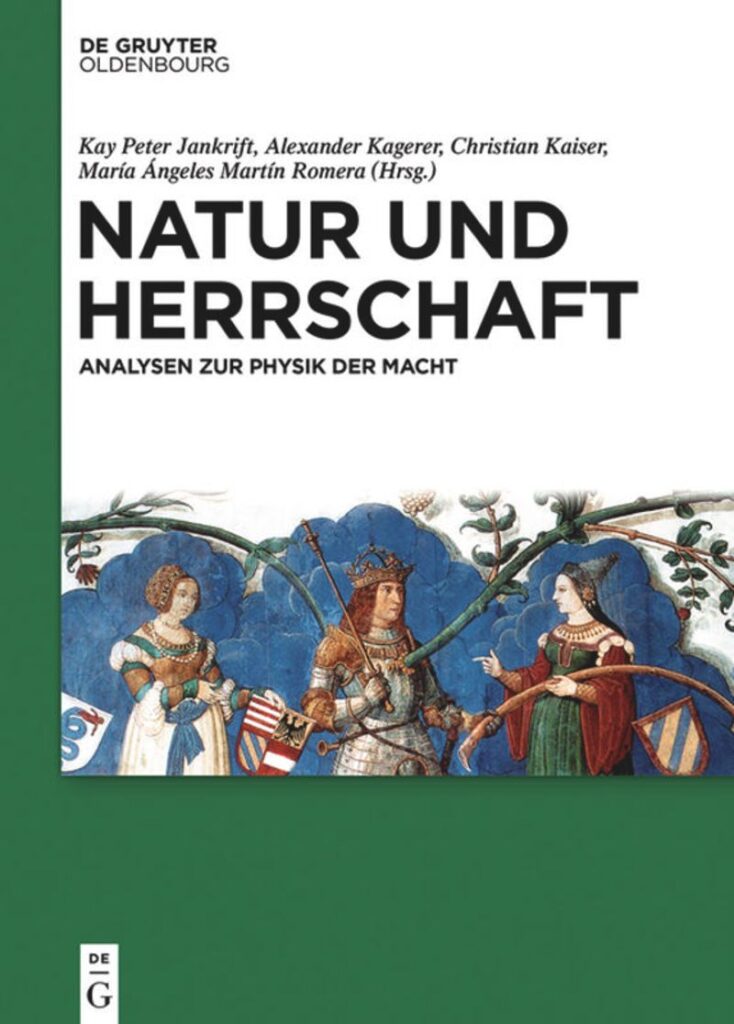
Christian Kaiser in Natur und Herrschaft: Analysen zur Physik der Macht
Leuenberger, Martin, Art. Kingship of God (OT), in: Das Wissenschaftliche Bibellexikon im Internet (www.wibilex.de), 2012
The earthly kingship in Israel and Judah as well as the kingship of Yhwh form a section of ancient oriental concepts of rule and can only be understood historically or in terms of the history of religion and theology against this background or within these concepts. […]
King Hammurabi thus sees himself as “the shepherd appointed by Enlil” in parallel with the appointment of the god Marduk to an “eternal kingship (šarrūtum darītum)” (Hammurabi Stele 1:21) by Anu and Enlil (1:1ff) […]
In the wake of the global political rise of the Persian king Cyrus, Deutero-Isaiah visionarily proclaims the imminent, definitive, “eschatological” fulfillment of salvation for Israel in the near future. The (original) book gradient leads to Isa 52,7-10*, where the phrase “your [sc. Zion’s] God has become king and reigns” (מָלַךְאֱלֹהָיִךי mālakh ‘älohājikh; qatal-x) emphasizes the dawning of the kingship of Yhwh (at least in the divine world), which will now inevitably lead earthly events to their goal. In the process, Yhwh’s “Messiah” Cyrus (Isa 45:1) inherits the worldly kingship of the Davidids, which is thus boldly globalized in the course of Deutero-Isaiah’s confrontation with the Babylonian dominant culture – in correspondence with the worldwide kingship of Yhwh over all “gods” (whose divinity is famously disputed) and all peoples. […]
[Deutero-Isaiahs] integration into the book of Isaiah results in a new dynamic: the exilic problematization is caught up in literary terms by the sequence of the present kingship of Yhwh (Isa 6) and the eschatological (new) dawn (Isa 40-52*). The same applies to the earthly level, when the royal texts Isa 7; Isa 9; (Isa 11), historicized in the course of the book to the Davidides, are continued through Isa 45 with the Messiah Cyrus. […]
[In the apocalyptic literature] the theme is never explicitly at the center, but Yhwh is not infrequently dubbed king and the (secular) enforcement of his kingship is consistently maintained against secular resistance of very different kinds – ultimately for the sake of God’s divinity (see in detail Camponovo, 1984, 230ff; Lindemann, 1986, 196ff; Collins, 1987, 88ff). […]
[In book of Daniel] God allows his “everlasting kingship (מַלְכוּת עלַם malkhût ‘ālam)” (Dan 3:33) to be realized in the succession of time by changing (world) rulers (see especially Kratz, 1991, 148ff; Seow, 2004). Only in the following (Hebrew) book redactions do eschatological-apocalyptic upheavals take place, which bring the earthly and divine kingship into an intensifying opposition (see Dan 2:44; Dan 7:14.18; Dan 10-12). […]
Finally, the Psalter, which was successively formed in the post-exilic period, is conceptually characterized by the kingship of Yhwh in its younger two theocratic books IV-V as well as in the present final composition (see Leuenberger, 2004, 392f [lit.]; Janowski, 2010, 301ff). Various conceptions can be distinguished, which locate Jhwh’s kingship in the course of the book in cosmic (natural order), large-scale political (world of nations / legal order), priestly (cultic legal order) and finally everyday (elementary salvation and provision in Ps 101-150) areas of experience; the spatial and temporal universality of Jhwh’s kingship is also spelled out in detail. The theological climax and final accent of the Psalter is then reached in the artfully constructed hymn Ps 145:
V. 1 I will exalt you, my God and King, / and praise your name forever and ever. (…) V.13 Your “kingdom” is a “kingdom” for all time, / and your reign lasts from generation to generation.
Ps 145
A historical analysis of the Yhwh-related מלך * mlk statements (king) in their literary (near) contexts brings to light a quite extensive field of words and concepts of “kingship of Yhwh”: on the one hand, there are more or less close parallel terms to מלך * mlk “to be / become king” or מֶלֶךְ mælækh “king” or the abstracts for “kingship” such as משׁל mšl “to rule”, שׁפט špṭ “to judge / rule”, Aramaic שׁלט šlṭ “to rule” or מוֹשׁל môšel “ruler”, מָשִׁיחַ māšîaḥ “anointed one” (Messiah), שֹׁפֵט šofeṭ “judge”, רֹעֵה ro’eh “shepherd”, רֹאשׁ ro’š “head”, נָגִיד nāgîd “prince” resp. מֶמְשָׁלָה mæmšālāh and Aramaic מָשִׁיחַ šālṭān “rule” etc. On the other hand, there are also numerous royal or imperious attributes (such as גֵּאוּת ge’ût “majesty”, הוֹד hôd “majesty”, הָדָר hādār “splendor”, עֹז ‘oz “power”, אַדִּיר ‘addîr “mighty” [s. especially the superiority over the chaos waters] etc.), functions (e.g. ישׁב jšb “to throne / dwell”, עלה ‘lh “to ascend / be exalted”) and conceptual elements (e.g. כִּסֵּא kisse’ “throne”, סוֹד sôd “throne council” [council of the gods], אַרְמוֹן ‘armôn “palace”, הֵיכָל hêkāl “temple / palace” and more) should be included: They all characterize Yhwh – admittedly in different forms and accentuations – as king. […]
3) brk ∙ jhw[h …] (4) brk ∙ bgj[m … j]mlk … (6) brk ‘dn[j] jh … (3) Blessed is / be Jhw[h …,] (4) Blessed is / be he among the nations who reigns / will reign as king. … (6) Blessed is / be the Lord; jh[…]”
Inscription from En Gedi
The Lord Yhwh is thus blessed (lines 3/6), whom the central statement (line 4) describes in a nationwide perspective (cf. ‘šr “Assur” line 1)[…]
The following should be mentioned: mlkj(h)w “(my) king is Jh(wh)” or jhwmlk “Jh(wh) is king” (cf. parallel formations such as mlkj’l “king is God” or ‘dnmlk “the Lord is king”). In addition, there are semantically related ruler names of the type “name of God + ruler terminus”, i.e. above all jh(w) “Yhwh”, ‘l “God” or ‘dn “Lord” with rwm “to rise / to be exalted”, qwm “to rise / to be high” or ‛lj / ‛lh “to ascend / to be high”, whereby the order of the two elements can change.
Hermisson, Hans-Jürgen, Art. Deutero-Isaiah, in: Das Wissenschaftliche Bibellexikon im Internet (www.wibilex.de), 2017
One of the elements of the promise of help is the mention of the redemption of Israel. The term comes from family law and refers to the redemption of clan members from debt slavery (redeemer / ransom); in DtIsa it is used exclusively as a predicate of Yahweh: Yahweh is Israel’s “redeemer”, now therefore from the Babylonian exile. However, the idea is significantly modified: Israel’s “ransom” does not, after all, mean that Yahweh pays a ransom to the previous overlord Babylon. Isa 43:3 comes closest to the conventional idea: Yahweh pays “Egypt, Cush and Sheba” as a ransom for Israel, but not to the previous owner, but to the future owner, to Cyrus, the conqueror of Babylon. It is different in Isa 44:22, where the word of Israel’s “redemption” follows the statement of the redemption of its sin and guilt: Admittedly, “redeem” there also means specifically to free from Babylonian captivity, but this is a consequence of Israel’s guilt towards its God. The payment of a ransom to Cyrus or Babylon is disputed by later authors (Isa 45:13bβ; Isa 52:3), but that is not DtIsa’ problem: it is concerned with the analogy of the familial relationship and the resulting duty to liberate: Yahweh has declared such a relationship to his people with the word of redemption. […]
Here we must speak of the earthly agents of Yahweh with DtIsa. There is Cyrus, addressed in two oracles of calling: In Isa 45:1-7 he is to conquer Babylon as Yahweh’s “anointed one”, in Isa 42:5-8* he is to release the captives. This is the earthly-concrete form of the divine victory over Babylon and the repatriation of the “spoils” after the final part of the prologue: Cyrus is commissioned and authorized by Yahweh to do so. […]
The great “imperative poem” in Isa 51,9-10.17-23; Isa 52,1-2, which is linked to the text of the jubilantly welcomed entry of Yahweh into his city in Isa 52,7-10 and the concluding call to the exiles in Isa 52,11f. The plaintive call to Yahweh’s arm to wake up and prove his power in Israel’s favor, as he once did at the Exodus, at the Red Sea (Isa 51:9f.), is answered with the counter-call to the woman Jerusalem / Zion to rise in her turn (Isa 51:17), to rise from the dust, put on her festive garments and sit on the throne (Isa 52:1-2). Zion is drawn here in contrast to the woman Babylon, who loses her throne (Isa 47), but unlike Babylon, she is not Yahweh’s rival: she receives her royal role as the wife of King Yahweh, who now moves into Jerusalem and begins his world reign there: “Yahweh has bared his holy arm in the sight of all nations, and all the ends of the earth see the salvation of our God” (Isa 52:10).[…]
DtIsa’s message is presented in a wealth of vivid images that cannot all be set off against each other, but which in essence amount to the same thing. They can be summarized in a few sentences. The prophet proclaims the liberation of Yahweh’s people from exile and their return through the desert to the land of promise as a Yahweh miracle, in which Yahweh proves his saving creative power as the only God before all peoples. He needs three earthly agents for this: the chosen, created in the womb and called prophet. The chosen prophetic servant of God, created and called in the womb, who brings the despondent and unbelieving Israel to faith and on the way, as his “active witness”, the chosen servant of God Jacob / Israel, created and called in the womb, who then sets off and allows the miracles to happen to him, as the (initially) “passive witness”, and Cyrus, called and created by Yahweh, as his “shepherd” and “anointed one”, whom he “raised up” for the warlike conquest of the world empire of Babylon and thus for the liberation of the exiled people of Yahweh. All three are portrayed as royal figures with similar predicates. The triumph of Cyrus also serves as an example in which Yahweh proves his uniqueness as God, because he brings it about through his word of creation, which he had previously given to the world through his prophetic servant. In the end, Yahweh will reign from Jerusalem as King of Israel and King of the world, and all nations will confess him as the only God who saves: Thus, in the sum of his message, the prophet proclaims an eschatological event.
The fourth servant song after the death of the prophet goes beyond this by seeing the whole event as initiated by the suffering and death of the prophetic servant and by the miracle of Yahweh in his deceased servant (servant of God).
The 39 books written in Hebrew or Aramaic according to today’s count are divided into three large groups in the arrangement of the Hebrew Bible: Torah (“Instructions”; Pentateuch), Neviim (“Prophets”) and Ketuvim (“Writings”). This is why in Judaism the Bible, which we Christians call the “Old Testament”, is referred to as “TaNaK” (pronounced: TaNaCh), an artificial word made up of the first letters of the three groups. […]
Overall, however, the TaNaK was probably completed and generally accepted around 100 AD. From this late date, the text-forming work is finished.[…]
It was based on four different sources: J = Yahwist around 950 BC; E = Elohist around 800 BC; D = (Pre-)Deuteronomi-um in the 7th century BC and P = Priestly Writer around 550 BC.
[“Münster Pentateuch model”]: A central change compared to the older theory formation is that the first written traditions are dated approx. 100 to 200 years later (instead of the 10th century to the 8th/7th century BC). After the first larger, written narrative contexts in the 7th century, the Münster Pentateuch model sees the decisive formation phase for the Pentateuch in the exile-post-exile and Persian period (6th-4th century).[…]
Only at first glance does it appear that the biblical tradition intends to narrate a course of history; if one takes a closer look, it becomes clear that the biblical tradition is a theological space of teaching and reflection that chooses narrative as a mode as well as lived life and experienced history as a place for orienting theological reflection.[…]
The supreme priest is the king. Staff are employed at the places of worship and the royal court (priests, prophets, etc.), who are paid for their services. They assist the king as advisors in theological and political matters, e.g. in (warlike) decision-making situations (cf. 1 Kings 22; 2 Kings 3).
Like the Codex Hammurapi, the Deuteronomic Law is divided into a prologue (Deut 5-11), a body of laws (Deut 12-26) and an epilogue with blessings and curses (Deut 28).[…]
In addition, the character of the law was changed insofar as the law is in the form of an Assyrian vassal treaty. It can be shown that the core of the blessing and cursing chapter in Deut 28:20-44 has been literarily adopted from the oaths of succession to the throne of Azarhaddon (VTE § 56; 38A-42; 63-65).[…]
The Assyrian treaties were not simply imitated, but were theologically reinterpreted in their own context: Unlike in the Assyrian vassal treaties, it is now not the Assyrian king or Assyrian deities who are the contract givers, but YHWH is the lawgiver and concludes a mutual contract (“covenant”) with the people of Israel.
Judah in the 10th century BC
The kingdom of Judah must be understood as a remote mountainous region in the hinterland, where a small-scale, agrarian society of farmers and small livestock breeders lived in subsistence farming organized in villages and clans. There is no material evidence from Judah from either the 10th or 9th century BC that would suggest a centrally governed, territorially organized state. Archaeological research in recent years has led to a new assessment that revises the biblical image of a centrally governed territorial state under David and Solomon in the 11th/10th century BC. How large the territory of Judah actually was is disputed. At this time, Jerusalem was a small village without monumental architecture or written records. Excavations show that after a gap in settlement, early Iron Age Jerusalem was probably only a modest village settlement of 1 ha and around 200 inhabitants.[…]
This makes Jerusalem in the 10th century BC a typical Judean mountain village – not significantly larger or smaller than others. This village certainly did not have the dominant position of a capital and a central administrative center. The continuation of the dynasty with Rehoboam as narrated in the books of Kings can hardly be proven historically. It could be that Rehoboam was also a figure who, from a later Judean perspective, served to narratively construct continuities. The campaign of the Egyptian pharaoh Shoshenq I (945-924 BC; biblical name: Shishak) in Palestine, which is traditionally dated to around 926 BC, tells of the plundering of the temple and the palace (cf. 1 Kings 14:25-26). Egyptian sources about this campaign, however, omit Judah and Jerusalem. The findings indicate that Judah and the region as a whole were under Egyptian domination.
There is a gap of 350 years between the first non-biblical mention of “Israel” on the Merenptah stele (1209 BC) and the next, in which “Ahab of Israel” is mentioned on an inscription by the Assyrian king Salmanassar (853) and a little later “Jehu, the son of Omri” on the stele of the Moabite king Mesha (around 840). However, on the inscription from Tel Dan, found in 1993 and written in Aramaic around 835, there is a note that King Hazael (ca. 843-803) killed the king of Israel and a king from the “House of David”. This is the only non-biblical source that – over 100 years after David – proves the existence of a “House of David”. Since ruling houses are named after the founder of dynasties, the position that David is a historical person seems plausible in view of this finding, even if there is no further extra-biblical evidence for this. […]
In view of the archaeological findings, it can be assumed that there was no developed territorial state with a central administration under David. “If kingship as an organized state does not emerge until the 9th century BC and there was neither a united kingdom nor a division of the empire, Israel is the name of the state in the 9th century BC and has no connection to the local ruler David, whenever (10th or 9th century BC) he is to be placed.” […]
An important argument in the discussion about the figure of Solomon’s reign are the building measures in Jerusalem, Megiddo, Gezer and Hazor, which are attributed to Solomon in 1 Kings 5:6, 27-32; 9:15-19. […] However, archaeological excavations in Megiddo and other cities have now made it clear that the facilities found, such as warehouses, stables and gates, do not date to the time of Solomon, as had long been assumed, but to a much later date and therefore cannot be linked to the construction measures (allegedly) initiated by Solomon. […]
In the narratives, Jerusalem is a not unimportant city with an ambitious kingship, palace complexes, central administration and international contacts. However, Jerusalem only achieved this status in the 7th century BC. In the world of the text, however, it already appears to readers as such under David and Solomon.
The narratives tell of the three or four generations of the family of Abraham and Sarah (Gen 12:1-23:20), Isaac and Rebekah (Gen 24:1-28:9), Jacob with Leah and Rachel and his twelve sons (Gen 28:10-35:20). The family originally came from Ur in Chaldea in Babylonia and emigrated to Haran in Syria under their father Terah (Gen 11:31). From there, Abraham and Sarah moved to Canaan at God’s command (Gen 12:1-3). From now on, the wanderings of Abraham and Sarah’s family in the Syro-Palestinian region are recounted. […] It is only in the Books of Kings that we find dates that allow us to reconstruct the times within the text (!). According to this, Abraham and Sarah must have lived around 2300 to 2200 BC. [N]o realistic route can be recognized in the narrated wanderings of the patriarchs. Sometimes thousands of kilometers are covered for no apparent reason (cf. Gen 12:9-10; 13,1.17; 18,1; 20,1; 22,19). This does not indicate any real migration of peoples, nor can it be derived from a (semi-)nomadic existence. […] In the narratives, places are mentioned whose settlement history has been archaeologically researched, such as “Ur in Chaldea”. In Ur, an ancient place in southern Mesopotamia, Aramaic-speaking Chaldeans had only been living since the 8th century BC. If the reference to Terah and his clan coming from “Ur of Chaldea” and moving away from there (Gen 11:31) were a “historical” note, Terah and Abraham could have left Ur of Chaldea in the 8th century BC at the earliest. According to the biblical narrative, Abraham and Sarah would not have arrived in Israel until the middle royal period, especially since, according to Gen 11:31, they had previously lived in Haran for a longer period of time. Another example is the place “Gerar in the land of the Philistines” (Gen 20:1, 2; 21:32; 26:1, 6, 17, 20, 26), which plays an important role in the Abraham narratives. Excavations have shown that Gerar was an important place – but only in the first half of the 2nd millennium and then in the late 8th and 7th centuries B.C. The (Indo-European) Philistines, however, reached the Canaanite coast around 1200 B.C. (Gen 10:14; 21:32 etc.), at a time when Gerar had no settlement. […]
Camels are frequently mentioned in the stories about Abraham (Gen 12:16) and especially in the stories about Rebekah and Isaac. The one-humped camel or dromedary as a domesticated beast of burden and hunting animal only became known in Palestine after 1000 BC via the Midianites (= Ishmaelites) (Jdg 8:24-26). In the narratives, the camel is a status symbol to illustrate the wealth of Jacob (cf. Gen 30:43; 32:8.16) and Pharaoh (Gen 12:16). However, it is unlikely that the pharaoh owned camels, as camels are not found in Egyptian texts or images; moreover, there is no Egyptian character for “camel”. Even if the camel was already known around 1000, it was not used intensively as a means of transportation suitable for the desert until the 8th to 7th century BC in the Assyrian Empire. This is because the camel is the only animal that can endure long stretches of desert without needing water or food. The camel was therefore the prerequisite for the global trade in luxury goods (e.g. rare spices, precious stones or resins/incense) from southern Arabia. However, this trade is already mentioned in the narratives of the first parents, for example in Gen 37:25. However, the economically lucrative caravan trade cannot have developed in the “time of Abraham”, but only in the Assyrian Empire, because the camel had not yet been domesticated. The camels and camel caravans in the narratives of the first parents must therefore date from much later times. […]
These examples show that the archetypal narratives cannot be set in the 3rd or 2nd millennium BC but are narratives that have grown over many centuries and fulfill different purposes and functions. […] For example, we are told that Abraham erected altars in Bethel and Shechem (Gen 12:7-8), but also in Hebron (Gen 13:18). In this way, important cult centers of the northern kingdom and the old center of the south are linked together and a bridge is built between north and south. In this way, the individual, originally localized legends become a common story and the patriarchs, as a family, become the common ancestors of the entire people. In the Priestly Document written in the exilic-post-exilic period (2nd half of the 6th century BC.) and in the Great Post-Exilic History (Genesis 1:1-2 Kings 25*), the arch-parents – and Abraham in particular – have an important function: The overarching narrative arc, which extends from the beginnings of creation to the downfall of kingship (Gen 2:4-2 Kings 25*), begins – not coincidentally – with the stories of Abraham and Sarah and the great migration that leads the patriarchs, at God’s command, from Ur in Chaldea to Haran in northern Mesopotamia (Gen 11:27-32) and then from there to a land unknown to them but promised by God. This migratory movement describes the path to which the exiles were called in the 6th century BC: the path from Babylonia (= Ur in Chaldea) to the land unknown to them, which they, living in the second or third generation in Babylon or Persia, do not know or which has become foreign to them. Thus, the textual world of the arch-parent narratives (Gen 12) reflects the Babylonian or Persian world empire: Abraham’s origins lie in Ur, in Babylonia! […] The fact that Abraham and Sarah, despite all the adverse and improbable circumstances, still had a son, the bearer of the promise (!), was a message of hope in the presence of exile. The arch-parents are not about an “once-upon-a-time” world, but about the political, theological and personal questions that deeply preoccupied people. With the narratives of the parents, stories have been placed at the beginning that seem to tell “how it was”, but which actually want to tell how things could go on.
The book of Exodus recounts the exodus from Egypt and the journey through the desert to Sinai, while the book of Numbers recounts the journey from Sinai through the desert to Moab and the border of the Promised Land. At the center of the Torah is the Book of Leviticus, which takes place at Sinai and in which instructions are given that are to be constitutive for Israel’s life in the land. In other words: The stay at Sinai with the making of the covenant and the giving of the Torah (Ex 19:1-Num 10:10) is framed by the descriptions of the wandering in the desert (Ex 15:22-18:27 and Num 10:11-20:29) and concluded by the sojourn in the East Bank (Num 21-36) and the account of the day of Moses’ death (Deut). […]
The Exodus – as the Bible describes it – is not historical. The most important reasons for this clear statement from a historical perspective are: (a) The biblical chronology, which dates the Exodus 480 years before the building of the Temple and thus around 1440 BCE under Pharaoh Thutmose III (1479-1425 BCE), is contrived and at the same time contradicts the participation of the Israelites in the building of the city of Ramses under Ramses II (1279-1213 BCE). (b) The routes of the Exodus reported in the Exodus narrative contradict each other. (c) In Ex 12:37; Num 11:21 the Bible assumes 600,000 people, in Num 1:46; 2:32 even 603,550 able-bodied adult men. It is impossible for such a group to survive in the desert, as there is not enough water in the natural springs. Apart from this, there are no archaeological traces of a 40-year mass movement in the LBA period [= Late Bronze Age, B.S.] on the Sinai Peninsula. (d) The oasis of Kadesh (‘ğn el-Quudğrat), where Israel is said to have stayed several times and for long periods (Num 13:26; 20:1; Deut 1:46, etc.), is not known to have been inhabited in the LBA until the Iron IIB period in the 8th century BC. The same applies to Arad (Num 21:1), the East Jordanian city of Heshbon (Num 21:25f.) or the port city of Ezion-Geber (Num 33:35f.). (e) There is no evidence of a mass exodus or mass expulsion of Semites in Egypt during the 19th-21st dynasties. Egyptian sources are completely silent about the Exodus. Since none of the biblical evidence is contemporary and its source value remains limited, the historical proof of an exodus is hopeless.
Christian Frevel, Geschiche Israels (History of Israel)
[…]In addition, there is no evidence in Egyptian and other sources that “Israel” stayed in Egypt. […] So the question is: who told of an “exodus”, when, for what reason and for what purpose? Interestingly, the probably oldest literary evidence is not found in the Book of Exodus, but in the Book of the Twelve Prophets and also in Israel (Hos 8:11-13; 9:3-4; 11:1-6; 12:8-14 cf. Am 2:10; 3:1, 9:7). It is assumed that the listeners and readers can contemplate something under the cipher “Egypt”. At the same time, it is noticeable that in these texts “Egypt” is often used in parallel with “Assyria”. This leads to the conclusion that it was not experiences from Egypt, but those from the time of Hosea with the Assyrians and the imperial policies of Sargon II (722-705), Sennacherib (705-681) and Asarhaddon (681-669) that were the impetus and driving force. […] The narrative about the childhood of Moses takes up an old literary model that was revived in the 7th century BC: King Sargon I of Akkad (around 2340-2284 BC, in Akkadian: šarru-k̅ en = “the king is legitimate”) was of unknown, non-dynastic origin, which was legitimized by a legend. This legend tells that he was abandoned in a basket of rushes as an infant. Many centuries later, this legend was taken up by Sargon II (722-705) for his own legitimization and seems to have been adopted from there in the childhood story of Moses. […] The concept of the covenant, which is found in the context of the Exodus traditions, is decisively influenced by Assyrian vassal treaties (= “covenant”), with which the Assyrians defined the relationship to their vassals. This “covenant” is a contract in which the Assyrians define the tasks, duties and obligations and demand the obedience of their subjects through an oath of allegiance. These treaties were received in the biblical texts with the opposite sign, especially in the Deuteronomistic literature, in that the early versions of the Book of Deuteronomy draft a counter-treaty to its Assyrian models. In Deuteronomistic literature, the Assyrian oath of loyalty is of course not to the Assyrian king, but to YHWH (cf. Deut. 13*; 28*) – Israel is loyal to him alone! The fact that this subversive counter-reading is set in the context of the Exodus tradition, the narrative of liberation from bondage and enslavement, speaks for itself.
During the Babylonian exile and in Persian times, the Exodus narratives are retold. The Exodus narratives now serve to call on people to leave their lives in the Babylonian and Persian empires and move out in order to live in their own country. The fact that the location of this narrative is not Egypt in the 13th century BC, but rather the situation of exile, can be seen in Deutero-Isaiah (Isaiah II). Here, the possibility of returning from exile to the promised land is described as an exodus (Isa 48:20-21; 52:11; 55:12). […] The Exodus traditions are thus narrative condensations of historical experiences – not necessarily of a historically fixable enslavement in Egypt, but of “Egypt”, i.e. of experiences of foreign rule, exploitation and lack of freedom, for example by the Assyrians, the Babylonians, etc.
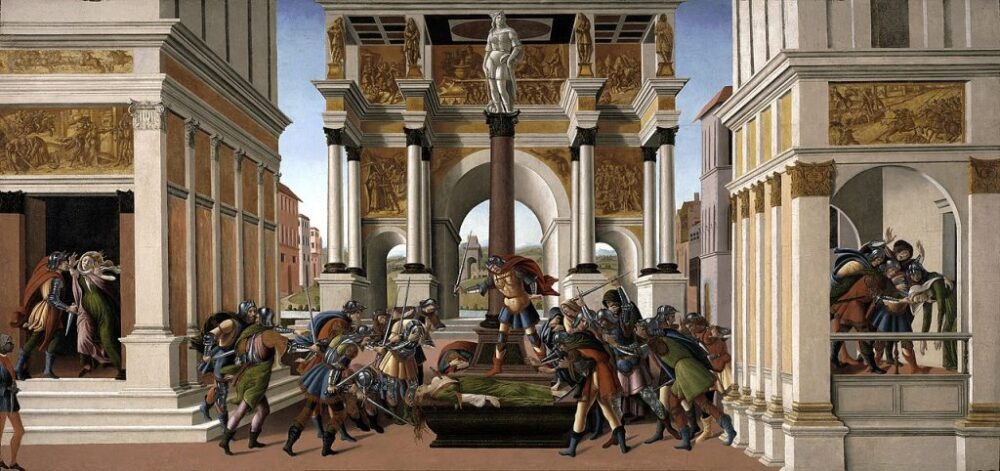
Our image of ‘kingship’ in Rome is shaped by a more or less uniform version of the beginnings of the city and the history of the res publica, which can be found in Cicero, Livy, Tacitus and Florus: After its foundation by Romulus and the reign of a total of six ‘good’ kings, the monarchy turned into a tyranny under Tarquinius Superbus. The tragedy surrounding Lucretia, who was ravished by the king’s son Sextus Tarquinius, was the trigger for the oppressed Romans to defend themselves against escalating violence and arbitrary rule and, under Brutusʼ leadership, expelled all members of the gens Tarquinia from the city. Afterwards, the citizens of the now free polity, traumatized by the previous despotism, swore an oath never to tolerate a king in their city again. This odium regni, sworn for all eternity, was to prove to be a constitutive characteristic of the newly founded res publica, whose internal and external policies were determined by the Romans’ collective hostility to everything associated with kingship and royal rule: “[T]he last Tarquin had given the name of king an evil ring to Roman ears for all time; rex and regnum were opprobrious terms”. This collective national Roman trauma triggered by Tarquinius Superbus was fueled in the 3rd and 2nd centuries BC by military conflicts with hostile kings of the East (Philip V, Antiochus III, Perseus), came to a head from the Gracchi onwards through the polemical use of the term ‘rex’ as a political invective in domestic power struggles and led to the assassination of C. Julius Caesar on March 15, 44 BC, who allegedly wanted to become king of Rome after his victory over Pompey. Octavian, who also emerged from the turmoil of a civil war as sole ruler a few years later, learned from the fate of his adoptive father and attempted to conceal the monarchical character of his reign by referring to himself not as rex but as princeps in consideration of the odium regni. However, this common image of the Romans’ hatred of kings contrasts with numerous positive uses of the terms ‘rex’ and ‘regnum’ in Roman literature as well as references to kings and kingship in political culture. This ambivalence, which had already been pointed out by Republican authors of the 1st century BC, has been demonstrated in research on individual phenomena: for example, attention has been drawn to the fact that the six ancient Roman kings before Tarquinius Superbus were always honored for their services to the genesis of Rome. The literature painted an extremely positive picture of foreign rulers (such as Cyrus or Hieron II) and even bitter enemies (for example Pyrrhus) and held them up as exemplary models. The terms ‘rex’ and ‘regnum’ were not only used to refer to the person(s) sitting in front of the drinking party, but a patron was also reverentially addressed as ‘king’ by his clients – like the parasite’s brother in ancient Latin comedies – without this form of address being offensive. The traditional divine apparatus of the Romans, headed by rex Iuppiter, also seems to contradict the theory of the odium regni, but like the positively connoted reminiscences of kingship in the sacred sphere (rex nemorensis, rex sacrorum, regia), it should be excluded insofar as old concepts (here: from the royal era) often persist unchanged in cult traditions despite changed circumstances (here: in Republican Rome). Furthermore, the Romans cooperated with reges socii and often (again) appointed ‘vassal kings’ to represent the interests of the Roman people in conquered territories. What is particularly remarkable, however, is that Roman senators were very close to Hellenic kings in many respects. Even Caesar’s assassination in 44 BC, the highest expression and culmination of the Romans’ rejection of the ‘monarchy’ form of government, did not detract from the many positive ways in which it was used. For example, the ‘Augustan’ poets only used terms from the word family ‘reg-‘ in a pejorative sense in the rarest of cases, and the attitude of the Romans towards the subject of ‘kingship’ was evidently far more differentiated than the image of blanket hatred of kingship would suggest.
From Königtum’ in der politischen Kultur des spätrepublikanischen Rom Christian Sigmund, De Gruyter 2014
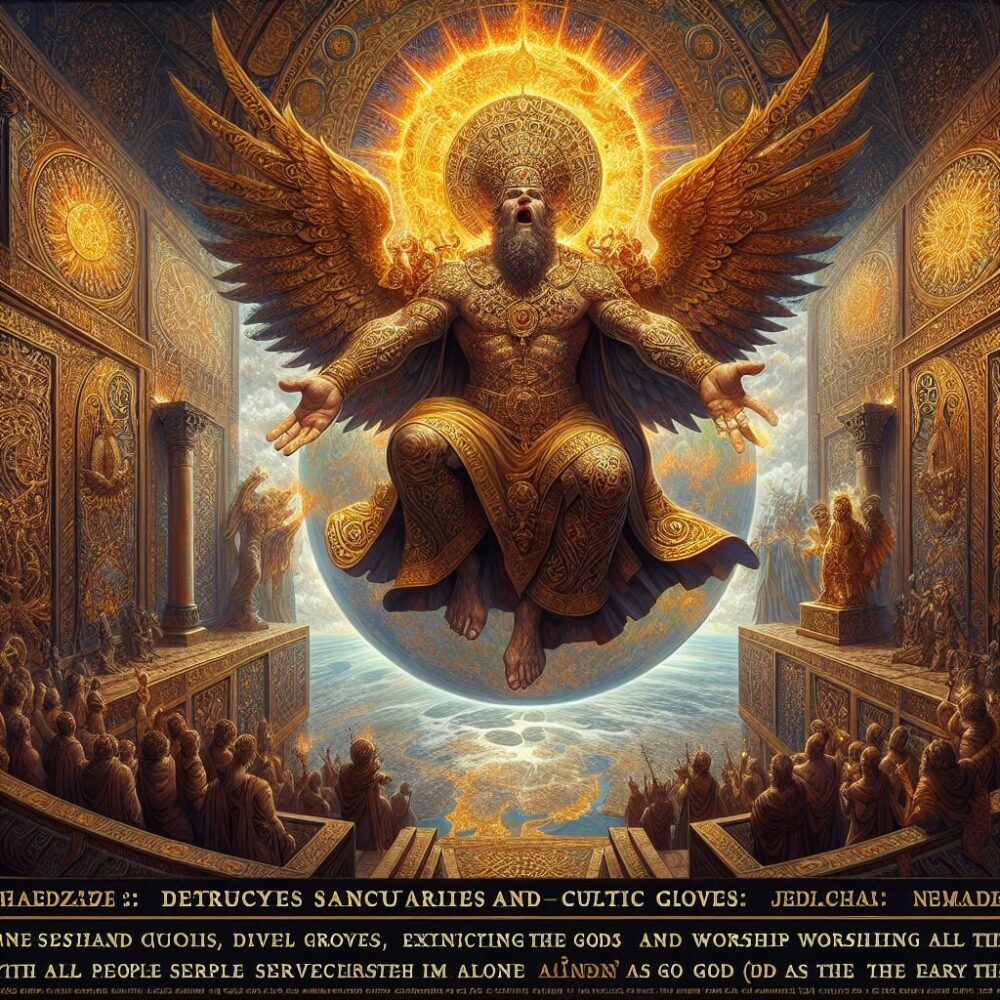
In the ancient world, political power tends, to occupy the realm of its control with iconic and symbolic representations. This may have applied also to the period of monarchy in ancient Israel, from the times of Saul, David, and Solomon down to the fall of Jerusalem, a fact that may be gathered from the numerous prophetic invectives against idolatry. We must not confuse the Mosaic Law as it is codified in the second through the fifth books of Moses, which for us has become the core of biblical monotheism, with what prevailed as mainstream religion in Israel during the kingdom. The iconoclastic and monolatrous movement of the Torah was a matter of opposition born by the prophetic tradition from Amos and Hosea down to Jeremiah and Ezekiel and by a literate elite that finally asserted itself under king Josiah and gave rise to the first iconoclastic cleansing of official religion and the redaction of canonical scripture centered around Deuteronomy, containing a quite revolutionary conception of state and religion. This innovation on the political-theological plane did not lead to an iconic turn but to its contrary, a ban on images. The prohibition of images occurs at the most prominent place within the Bible: as the first or second commandment of the Decalogue, together with a commentary that refers unequivocally to the political sphere:
You shall not make for yourself a carved image, or any likeness of anything that is in heaven above, or that is in the earth beneath, or that is in the water under the earth. You shall not bow down to them or serve them, for I the LORD your God am a jealous God, visiting the iniquity of the fathers on the children to the third and the fourth generation of those who hate me, but showing steadfast love to thousands of those who love me and keep my commandments.
2 Moses
God resents the making of images as an act of defection and apostasy. The distinction between friend and foe, those who love and those who hate God and His Law, has a predominantly political meaning. Carl Schmitt even saw in this distinction the hallmark of the political in general. This may be going too far, but nobody will deny that the principle of association and dissociation has a fundamentally political significance. If God makes the question of images a criterion of friend or foe, belonging or exclusion, he gives it a political meaning. Whoever wants to belong to the community of God’s friends must abstain from any image making and image worshipping. This story is not only about the foundation of a new form of religion but also of a new form of polity built on a treaty or covenant between God and the children of Israel. This is made clear by the whole body of legislation that follows the Decalogue as well as by the story of Exodus that forms its frame. It is highly significant that this concept of divine leadership precludes the making of images. The idea of the covenant implies a conception of direct theocracy. In the same way as the idea of direct democracy, the idea of direct theocracy precludes any mediating institutions of representation. The will of God chooses Moses as interpreter, and Moses will be followed in this function by a line of prophets down to the times of Artaxerxes, but he bans from his covenant all representations because he wants to reign directly and not by representation. The political sense of the prohibition of images is made clear at the very beginning, during the reception of the covenant at Mount Sinai, by the scene of the golden calf, which functions as a kind of primal scene of idolatry. Moses climbed on top of Mount Sinai and stayed there for 40 days.
When the people saw that Moses delayed to come down from the mountain, the people gathered themselves together to Aaron and said to him, “Up, make us gods who shall go before us. As for this Moses, the man who brought us up out of the land of Egypt, we do not know what has become of him.” So Aaron said to them, “Take off the rings of gold that are in the ears of your wives, your sons, and your daughters, and bring them to me.” So all the people took off the rings of gold that were in their ears and brought them to Aaron. And he received the gold from their hand and fashioned it with a graving tool and made a golden calf. And they said, “These are your gods, O Israel, who brought you up out of the land of Egypt!”
2 Moses
The people did not want to defect to other gods but to replace the vanished Moses, whom they believed dead, with a representation, an image. They wanted the calf for a leader to take over what Moses had done for them, to go ahead, represent God, and intimidate any possible enemies. Moses acted for them as a representative of God; now they needed another form of mediation and fell back on Egyptian idolatry. Representation and mediation were the principal functions of the king in the ancient world. Covenantal law aimed at destroying any forms of mediation, to radically eclipse the figure of sacred kingship, and to establish an immediate link between God and the people. Instead of images, the king is instructed to make a copy of the text of the Torah and to learn it by heart so that his royal activities become nothing but a fulfilment of scripture. This is the exact counterimage of the usual dynamics of political and iconic display of power. Where the power is handed over to an invisible God, the images must disappear and give way to scripture. We may call this a scriptural and aniconic turn and may recognize in it the same interrelatedness of politics and image making as in Egypt, only in an inverse key. The ban on images amounts to an eclipse of the king as a representative of God and a mediator between God and humankind. The Deuteronomistic concept of the covenant or treaty—berît in Hebrew— that JHWH established between himself and the children of Israel has a primarily political meaning. The term berît occurs, however, already a century earlier with the prophet Hosea, but couched in bridal and filial metaphors and without any political connotations. Hosea is the first one to conceive of monotheism as a matter of fidelity, truthfulness, or loyalty. Like Amos, Hosea reproaches Israel for its sins, but in his eyes, these sins do not consist primarily in injustice and oppression but in “whoredom” with alien gods. I collate here several of Hosea’s most striking invectives against Israel’s infidelity:
They sacrifice upon the tops of the mountains, and burn incense upon the hills, under oaks and poplars and elms, because the shadow thereof is good: therefore your daughters shall commit whoredom, and your spouses shall commit adultery. I will not punish your daughters when they commit whoredom, nor your spouses when they commit adultery: for [the men] themselves consort with whores, and they sacrifice with harlots: therefore the people that doth not un-derstand shall come to ruin. I found Israel like grapes in the wilderness; I saw your fathers as the firstripe in the fig tree at her first time: but they went to ba’al pe’ôr, and separated themselves unto that shame; and their abominations were according as they loved.
Hoseas
A different image used by Hosea for the special bond between YHWH and his people is that of a father-son relationship: “When Israel was a child, then I loved him, and called my son out of Egypt. But the more they were called, the more they went away from me: they sacrificed unto Baalim, and burned incense to graven images.” About a century after Hosea, the original version of Deuteronomy was presented in Jerusalem as an accidental finding during restoration work in the temple and identified as a book dating from the time of Moses. This legend has a kernel of truth because it refers to the truly “Mosaic” spirit in which it is written. Deuteronomy codifies the covenant in the form of a formal treaty of alliance, thereby giving it the status of an institution recognized under international law. The covenant is now no longer metaphorical but the real thing. The authors of Deuteronomy borrowed the model of a political contract from Assyria. The loyalty oath that in 672 bce King Essarhaddon had his subjects and vassals swear to his designated successor, Ashurbanipal, makes its influence felt right down to the wording of the biblical text. One of those vassals must have been King Manasseh of Judah, so it may be assumed that a copy of the succession treaty and oath was stored in the royal archive in Jerusalem. When applying this Assyrian template to the covenant between YHWH and the people, the biblical authors adopted and adapted it in two ways. First, God does not make this treaty with the king, in his capacity as the people’s representative before the gods, but directly with the people themselves; second, the loyalty clauses are not between the people and the king, in his capacity as the gods’ representative before the people, but between the people and God. In a startling innovation, the king’s position as representative and intermediary is thus bypassed. Through the “transference” of the king-god relationship and the king-people relationship to the relationship between God and his people, Assyrian state ideology is converted into Israelite covenant theology. The fact that God makes his covenant with the people as a whole rather than through the intercession of royalty, priesthood, or some other representative authority becomes the basis for a new; specific; emphatic; and, to some extent, “democratic” conception of the people. The people—not Moses, not the seventy elders, not Aaron, not the Levites—assume the role of a sovereign partner in the covenant. This direct access to God is what lends the biblical concept its democratic force. In Egypt, the Pharaoh was regarded as the son of the supreme deity and given the title, son of Ra. The Jerusalem monarchy also adopted the model of the king’s divine sonship from Egypt. “Thou art my son; this day have I begotten thee,” God tells the king in Psalms 2:7. God chooses the king to be his son, a transformation that takes place the instant he is crowned. In Psalm 89:27, God pledges: “I will make him my firstborn, higher than the kings of the earth.” The image of Israel’s divine sonship is firmly anchored in the Exodus myth. Unlike the bridal metaphor, which, with the prophets Hosea, Jeremiah, and Ezekiel, always has tragic connotations and looks backward to the adulterous violation of the covenant, the image of sonship in Exodus has positive connotations and looks forward to Israel’s election and the fulfillment of God’s promises: “Thus saith YHWH, Israel is my son, even my firstborn. And I say unto thee: let my son go, that he may serve me. And if thou refuse to let him go, behold, I will slay thy son, even thy firstborn.” Rather than looking back in anger at the broken covenant, the image of sonship here looks forward in hope to the liberation of Israel, soon to be exacted by the death of the Egyptian fi rstborn, and to the covenant, which will make the children of Israel God’s chosen people and hence his adopted son. Whereas the sonship is transferred from the king to the people, the function of legislator is transferred from the king to God. On the famous Louvre-stela of Hammurabi, we see the king presenting his law code in a gesture of recitation to Shamash, the sun god and god of justice. According to the biblical concept, Moses receives the law from God. Bereft of his prerogatives of sonship and legislation, there is nothing peculiar left to the king. This is what Deuteronomy has to say concerning the role of the king:
If, having reached the country given by Yahweh your God and having taken possession of it and, while living there, you think, “I should like to appoint a king to rule me”—like all the surrounding nations, the king whom you appoint to rule you must be chosen by Yahweh your God; the appointment of a king must be made from your own brothers; on no account must you appoint as king some foreigner who is not a brother of yours. He must not, however, acquire more and more horses, or send the people back to Egypt with a view to increasing his cavalry, since Yahweh has told you, “You must never go back that way again.” Nor must he keep on acquiring more and more wives, for that could lead his heart astray. Nor must he acquire vast quantities of silver and gold. Once seated on his royal throne, and for his own use, he must write a copy of this Law on a scroll, at the dictation of the levitical priests. It must never leave him, and he must read it every day of his life and learn to fear Yahweh his God by keeping all the words of this Law and observing these rules, so that he will not think himself superior to his brothers, and not deviate from these commandments either to right or to left. So doing, long will he occupy his throne, he and his sons, in Israel.
Dtn 17
This is no longer the idea of kingship as represented in a paradigmatic way by King David. The king is no longer chosen by God, who says to him “Thou art my Son; this day have I begotten thee,” or with regard to him—“I will be his father and he will be my son” and “Also I will make him my firstborn, higher than the kings of the earth.” Instead, the king is appointed by the people if they like and is seen as a danger rather than a blessing that must be restricted in his display of power as much as possible. The original idea of kingship is deferred into the future and turned into as a figure of messianic expectation. The new religion as worked out by the exilic prophets and the deported literary elite emerged in a situation of total loss: of kingship, state, temple, and territory and enabled Judaea to do without external stabilizers. Law, statehood, temple, and priesthood were created at Mount Sinai, in the desert, and in a radically extraterritorial situation. This new concept of religion no longer depends on state, kingship, and territory; it can be realized wherever Jews live and follow the law of the covenant. In this differentiation and emancipation of religion from state and territory lies the secret of the survival of Judaism and Jewry as the only nation of antiquity over two millennia of diaspora and persecution, whereas ancient Egypt and all other states and cultures of antiquity succumbed to the assault of Christianity and Islam.